Art Contest
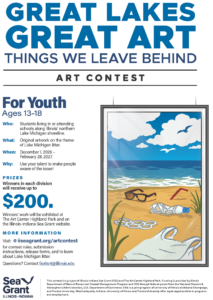
Click on the image for a full-size printable poster.
Ages 13-18
Illinois-Indiana Sea Grant and its partners are hosting a new art contest—Great Lakes Great Art. The 2027 contest is for students ages 13–18 living in or attending schools in communities along Illinois’ northern Lake Michigan shoreline—from Evanston to Winthrop Harbor. This year’s theme is Things We Leave Behind.
Submission Window
December 1, 2026 — February 28, 2027
Prizes
Prizes will be awarded within two age divisions: ages 13–15 and 16–18.
Winners in each division will receive:
- 1st Place – $200 gift card and certificate
- 2nd Place – $100 gift card and certificate
- 3rd Place —$50 gift card and certificate
- Honorable mention – certificate
All winners will be part of the special art exhibits hosted by The Art Center Highland Park and the Waukegan History Museum at the Carnegie and will be featured on the Illinois-Indiana Sea Grant website. Each piece of artwork within the exhibits will include the student’s first name, last initial, grade, and school. This exhibit will also feature pieces by adult artists who have won their portion of the contest.
Theme
The 2027 theme, Things We Leave Behind, focuses on litter in Lake Michigan, also called marine debris.
Marine debris is known by many names, including litter, trash, and garbage. It is any type of human-made solid material that ends up in Lake Michigan, the other Great Lakes, or the ocean. It can get there by accident or on purpose.
Plastic is the most common type of marine debris in Lake Michigan. It can come in all shapes and sizes. Some examples are water bottles, sunglasses, balloons, straws, and food wrappers. Some plastic pieces are very small. These are called microplastics. Microplastics are smaller than five millimeters, about the size of a pea or a pencil eraser. They can come from small fibers in clothing, broken foam takeout containers, or single-use plastic items that have broken into small pieces from waves and weather. Microplastics can also be small plastic pellets used to make larger plastic items.
Scientists are still learning about how marine debris affects the plants and animals that live in Lake Michigan. They have found that microplastics can be harmful to animals that eat them by mistake. Plastic is not nutritious and can take up space in their stomachs that should be filled with real food. Plastic may also contain toxic chemicals or have toxic chemicals attached to it.
Microplastics have also been found in people. We can accidentally breathe them in or swallow them when they get into our food and drinks. Scientists are doing a lot of research to see if microplastics can cause problems for people.The best way to prevent this type of pollution is to use less plastic.
To learn more visit:
Requirements
- All art must be 2-D (e.g., photo, drawing, painting, collage); no digital art will be accepted.
- Original pieces must be 18” x 24” or smaller.
- All work submitted must be an original creation by the student; AI-generated or enhanced artwork is not allowed. All artworks will be checked for AI exclusionary criteria.
- Artwork must focus on the 2027 theme of Lake Michigan litter.
- All students must include an artist’s statement of up to 1,500 characters (about 215 words) on the theme of litter (i.e., trash, marine debris) in Lake Michigan.
- Artwork should contain no text or names.
- Artwork should be submitted as a high-resolution digital copy of the artwork via the entry form (see below). JPG or TIF formats are preferred, but high-resolution PDFs will also be accepted. Please be careful to avoid glare when scanning or photographing artwork.
- Only one entry per student, please. If a student submits more than one entry, the entry submitted closest to the deadline will be considered the student’s “official” entry.
- Students who are 18 must be enrolled in high school.Complete the online entry form and make sure to answer all questions.
Tips for Writing the Artist Statement
- The artist’s statement is a very important piece of the entry. This description of your artwork should demonstrate that you understand the theme. It should also clearly explain what you want the viewer to understand about your artwork and how it relates to this year’s theme. You might include what you want people to notice about your artwork. For example, you could discuss your use of color, light, or artistic technique. Most importantly, include the message you’re trying to send through your art.
- Be careful not to plagiarize.
Tips for Creating the Art
- All artworks will be judged based on its quality and originality.
- Make sure your artwork reflects your understanding of the theme.
- Have your artwork show your individual style.
- Ensure that your artwork is without smudges or tears.
- Avoid depicting brand names, logos, copyrighted characters, or identifiable people.
Additional Information
- Winning artwork will be shared on the Illinois-Indiana Sea Grant and via social media, including but not limited to Facebook and Instagram. Illinois-Indiana Sea Grant and its art contest partners will have unrestricted use of all submitted artwork.
- Please note that by submitting your artwork to this contest, you are giving the contest sponsors permission to use the image for other purposes, such as on websites and in publications of the sponsoring organizations. Artists (first name, last initial, grade, and school) will be credited whenever their artwork is used, unless otherwise indicated on the entry form.
- Artists whose artwork is under consideration for a prize must send in their original physical artwork at Illinois-Indiana Sea Grant’s request.Original physical artwork may not be returned.
- Be aware of copyright rules. Copyrighted images owned by others can be used for inspiration, but should not be reproduced.
- The complete terms for participation in the contest are stated in the entry form.
For Teachers
- This Illinois-Indiana Sea Grant-sponsored contest encourages students to learn about the Great Lakes through art and to understand how they can protect water resources.
- If sending entries from an entire class, please contact fiorito4@illinois.edu.
- Links to resources
Questions?
Contact fiorito4@illinois.edu.
2027 Entry Form – Coming Soon!
Project Partners
- Art Center Highland Park
- Illinois Department of Natural Resources’ Coastal Management Program
- Waukegan History Museum at the Carnegie
 Sea Grant Illinois-Indiana