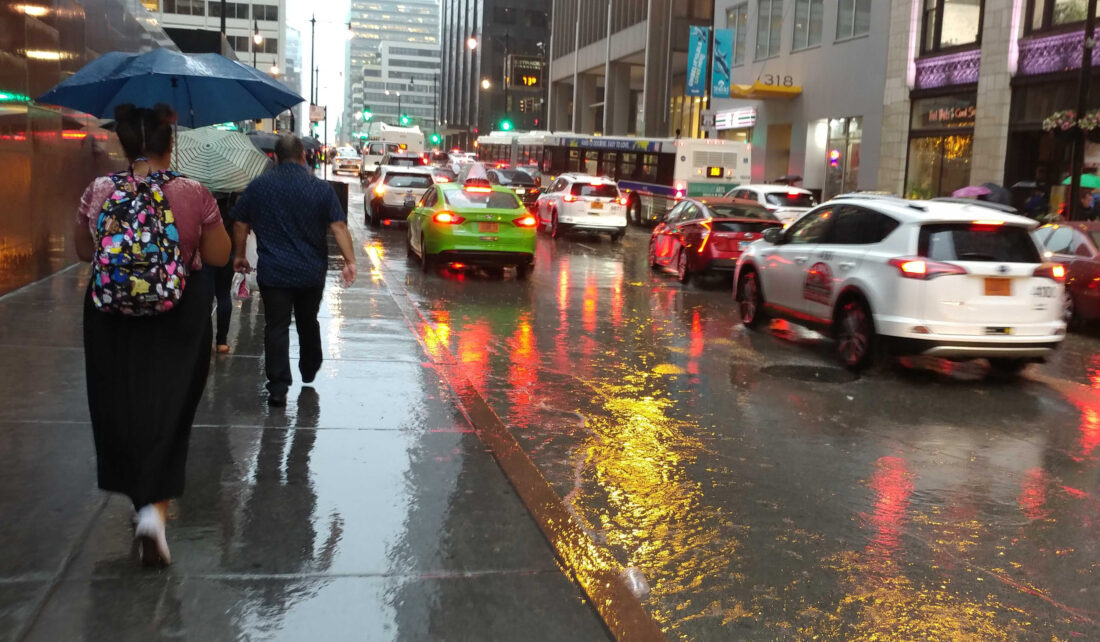
As bigger storms become more frequent, flooding is more of a concern, especially in big cities with so many hard surfaces that do not absorb rainwater. In a city like Chicago with an estimated 4,000 miles of streets, would porous asphalt, which can soak up precipitation, be a possible solution for increased flooding risks?
Ramez Hajj, a civil engineer at the University of Illinois Urbana-Champaign, studied this question as part of his funding through the Illinois-Indiana Sea Grant Faculty Scholars Program.
Porous asphalt is developed to have more air voids to allow water to pass through, reducing flooding on roads that are otherwise watertight, and helping recharge groundwater sources. “It also offers the advantage of preventing cars from hydroplaning,” said Hajj.
This paving material is used successfully in a variety of locations, including in the state of Georgia, and it is in widespread use in the Netherlands. But porous asphalt has proven problematic in places where winters are colder, like Chicago. If water freezes in the nooks and crannies of the road, the street surface can break down when the ice thaws.
Usually, water runs right through the porous asphalt but when the air voids become clogged with debris and dust, then water can get stuck and that’s when the freeze-thaw becomes more of a problem.
“One of the biggest challenges is that you have to constantly vacuum to remove dust or debris,” said Hajj. “In cities like Chicago, this may not be practical because of all the other maintenance demands of the city’s roads.”
Add to that, the Chicago region has considerable truck traffic, which puts considerable stress on roadways.
Hajj’s team worked closely with the Chicago Department of Transportation, which shared insights into the city’s difficulties using porous asphalt successfully and provided core samples from a variety of Chicago locations for analysis.
“We had samples as old as 2008 and as recent as 2020 so we were able to see deterioration in real time,” said Hajj. “Generally, we saw a consistent trend of the porous asphalt breaking down quickly because of the heavy traffic loads on city roads.”
They also specifically studied the aging of the asphalt binder, which, unlike in conventional asphalt, was shown to happen even at the bottom of the sample due to oxygen being present throughout.
“Overall, I think the critical factor is, when you’re designing the mix, to make sure you’re choosing the right materials, those that are very resistant to water, to freeze-thaw and to aging,” said Hajj. “Then, once the road is constructed, maintenance is probably the most critical factor.”
Porous asphalt may not be ideally suited for Chicago, but Hajj did find that there might be some parts of Illinois and Indiana where it could be beneficial. Because porous asphalt has been shown to reduce traffic noise, it might be a strategy in locations where traffic intensity is lower and noise is a sensitive issue.
Going forward, Hajj and his team are interested in studying porous asphalt from a different approach—its potential impact on the environment.
“How does the quality of the water that drains through this asphalt compare with typical stormwater discharge from the road? What about air quality—what is the difference in emissions from a porous surface versus a conventional one? We want to make sure that we’re building with materials that can make things a little better,“ he said.
The Illinois-Indiana Sea Grant Faculty and Graduate Students Scholars programs help develop a community of scientists to research critical issues related to Lake Michigan and the Great Lakes region through funding and other opportunities for one year.
Illinois-Indiana Sea Grant is a partnership between NOAA, University of Illinois Extension, and Purdue University Forestry and Natural Resources, bringing science together with communities for solutions that work. Sea Grant is a network of 34 science, education and outreach programs located in every coastal and Great Lakes state, Lake Champlain, Puerto Rico and Guam.