
Illinois-Indiana Sea Grant (IISG) announces its intent to support four new two-year research projects in 2026. These projects are in addition to six one-year IISG Graduate Student Scholar grants that began earlier in 2025. Altogether, these awards add up to $853,000 of support over the next two years.
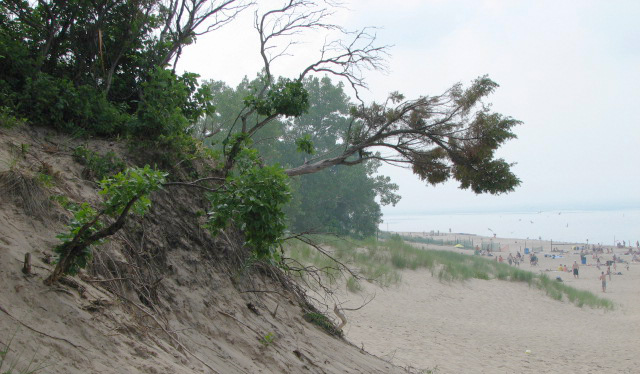
The two-year projects include a study led by a Purdue University plant ecologist Insu Jo, who will assess the presence of heavy metals from local industry in sand dunes along the Indiana shoreline and the impact of these contaminants on plant communities.
Two more pollution studies will be led by civil engineer Marcelo Garcia at the University of Illinois and Andres Prada, a Prairie Research Institute environmental engineer, each of whom will explore the effects of rubber particles from tires and other road pollutants that are picked up by stormwater runoff and then flow into aquatic systems in the southern Lake Michigan region. As car tires age, microscopic particles detach during the course of normal driving.
Finally, a study led by Carena van Riper, an Illinois social scientist, will seek to understand why anglers value certain fishing locations—this research will help inform fisheries management agencies as they work to encourage interest in fishing in urban areas.
The IISG Scholars Program is an opportunity for graduate students in the two states to apply for funding that helps extend their doctoral research and provides professional development training and resources.
“The grad student scholars program allows us to fund cutting-edge research while training the next generation of Great Lakes scientists,” said Stuart Carlton, IISG director. “This year’s projects will address key issues affecting the region, ranging from coastal resilience to land use.”
On the subject of coastal resilience, Wei Wu at Purdue will use AI to create models of southern Lake Michigan communities to assess how they respond to extreme weather events or seasonal transitions. In particular, Wu is focused on areas affected by shoreline erosion, dune morphology, stormwater runoff and vulnerable infrastructure.
Another Purdue grad student, Tianle Duan will use models and real-world road use data to develop a near-real-time system for flood inundation mapping as well as flood depth estimates in the heavily trafficked southern Lake Michigan region. This will allow for timely assessments of community transportation network disruptions during flood events.
Two Illinois grad students’ research is focused on nutrient pollution. Yuanxin Song will explore nutrient pollution dynamics across the Lake Michigan basin, identifying pollution hot spots and modeling management scenarios to reduce nutrient loads. Similarly, Qianyu Zhao will use advanced modeling technology to develop an understanding of Lake Michigan nutrients, specifically focused on timing and locations, disentangled from the impact of human actions and weather.
Finally, two atypical Sea Grant projects will take place at Purdue. Dohyung Bang will examine how short-term rental platforms, such as Airbnb or VRBO, affect housing values, rental prices and other economic factors in communities around Lake Michigan. This project will offer recommendations for balancing the economic benefits of short-term rentals with long-term housing needs as well as the social sustainability of local communities.
And, in the category of cutting-edge research, Diana Narvaez will create a prototype of a new type of lake wave energy harvester, ultimately aiming to use this technology to collect aquatic energy that can power electronics in freshwater environments.
For more information about IISG research, visit our website at iiseagrant.org/research/research-projects.