Rain gardens capture stormwater runoff

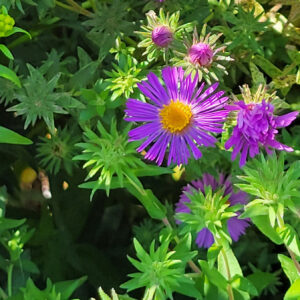
Aster from Red Oak Rain GardenIn many communities, increasing urbanization and larger storms have led to more flooding. In addition, rainwater that hits pavement and flows into drains, and then to nearby water bodies, picks up pollutants along the way. One approach to reduce flooding and protect water quality is installing green infrastructure, including rain gardens. Rainwater soaks into the garden, and pollutants are filtered by plant roots.

Illinois-Indiana Sea Grant continues to offer the Rainscaping Education Program through both Illinois Extension and Purdue University Extension. We offer workshops for Master Gardeners and other community members to learn about rain gardens and other rainscaping techniques.

In 2024, training took place in Kane County in Illinois, for 17 participants and in Indiana, for 14 participants in Marion, Noble, and Steuben counties, which included installing three demonstration rain gardens. The workshops brought together Master Gardeners, agency and organization representatives, stormwater and landscape experts, and consultants.

The new demonstration gardens are sited at an extension office, an Indianapolis school, and a library, and capture nearly 202,000 gallons of stormwater each year. Altogether, the rainscaping demonstration gardens installed since the program began capture nearly 1.4 million gallons each year, calculated using average rainfall and garden area.

IISG Instagram

This season, let’s teach eco-friendly habits while spreading cheer! NOAA’s Greener Holiday Gift Guide is full of ideas to reduce waste and protect our precious water resources. Check out the full guide at the link in bio. #teachingtuesdayNOAA Marine Debris NOAA Education
The gales of November may come early, but, as usual, the nominations for the Lakies are right on time along with our official call for nominations! Brought to you by the Teach Me About the Great Lakes podcast, The Lakies (aka "quite possibly not the least prestigious Great Lakes-focused awards ceremony there is”) are back. Our goal isn't to be the Official Arbiters of Quality, but to host a fun celebration of amazing Great Lakes-related research, outreach, and communication in the inimitable Teach Me style.Nomination categories are:-Great Lakes Science Communication of the Year-Great Lakes Outreach Program of the Year-Great Lakes News Event of the Year-Great Lakes Research Finding of the Year-Coolest Thing You Learned Listening to TMATGL in 2025-Science Podcast of the Year (Non-TMATGL edition)-Great Lakes Animal of the Year-Great Lakes Non-Animal of the Year-Great Lakes Sandwich of the Year-Great Lakes Donut of the YearThe Details: -Deadline: Nominations close on December 4th.Process: It's easy (just enter the name/title and a link).-Self-Nominations: Highly encouraged. Don't be shy.We’d love to get a broad swath of work across both the serious and less-serious categories to celebrate. Feel free to pass the link on to interested people: https://bit.ly/Lakies25
Making Sense of Social Media: Presented by Illinois-Indiana Sea Grant & Purdue Extension‌When: December 6, 2025, from 1 - 4:00 PM ESTWhere: RDM Shrimp, RDM Shrimp, 101 N 850 E, Fowler, IN 47944Registration Link in bio.‌Social media can be a great way to market your small business and products, but sometimes it might feel like you are casting a net again and again to find that your net is empty. After all, the point of using social media marketing is to connect with customers. By attending this workshop, you will:-Hear Research Findings-Participate in an Interactive Workshop Session-Learn Real World Application-Tour a Shrimp Farm-Network at the “After Hour Social”‌This program is supported by the North Central Regional Aquaculture Center and put on in partnership with the Indiana Aquaculture Association Inc, RDM Shrimp, and Ohio Sea Grant, The Ohio State University.‌For questions contact Amy Shambach by email (ashambac@purdue.edu) or phone (317-238-0511)
Skip to content