

Meet Our Grad Student Scholars is a series from Illinois-Indiana Sea Grant celebrating the students and research funded by our scholars program. To learn more about our faculty and graduate student funding opportunities, visit Fellowships & Scholarships.
Dohyung Bang is a PhD candidate in the White Lodging-J.W. Marriott, Jr. School of Hospitality and Tourism Management at Purdue University. He is studying how complex tourism systems shape societal and economic outcomes. His project, funded by IISG, examines the impact of the home-sharing economy on housing market dynamics in the Lake Michigan area.
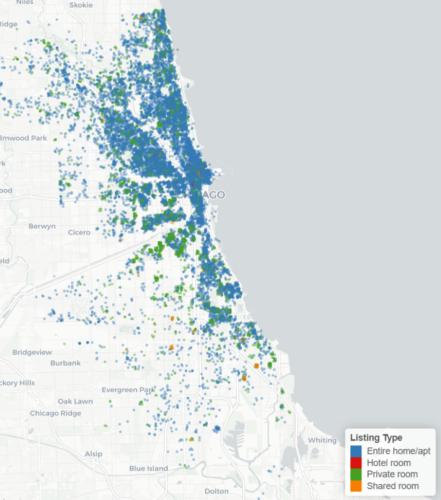
This map illustrates short-term rental distribution in the Chicago area.
Tourism is often described as a “smokeless industry” because it generates economic value without smokestacks. For regions with limited industrial bases, tourism can serve as an important engine for economic development by attracting outside spending and expanding local tax revenues. Yet tourism growth often depends on the availability of accommodations, and expanding traditional lodging supply (e.g., hotels, resorts) typically requires substantial capital investment. This challenge has made the rise of the home-sharing economy especially significant
The home-sharing economy, often referred to as the short-term rental, allows individuals to provide accommodations to other users by renting out residential properties. Over the past decade, this market has grown rapidly, driven primarily by platforms such as Airbnb. Short-term rentals (STR) are no longer limited to specialized sharing-economy platforms; traditional online travel agencies such as Expedia and Booking.com now also feature a growing number of apartments, condominiums, and single-family homes alongside conventional hotel listings.
The expansion of the home-sharing economy has created new opportunities for local economies. It has enabled destinations with limited traditional lodging infrastructure to attract visitors and has generated new income streams for property owners. At the same time, however, the rapid growth of STRs has raised important concerns about housing affordability and availability. As residential properties are increasingly converted into short-term rental units, the supply of long-term housing may decline, placing pressure on local residents and potentially weakening community well-being.
These tensions are especially relevant in communities around Lake Michigan, where the number of short-term rentals has grown substantially over the past decade. In 2024, for example, Chicago had approximately 23,000 short-term rental units, many of them concentrated along the lakeshore. Similar patterns are also emerging in smaller towns surrounding Lake Michigan. These trends suggest a possible trade-off: while short-term rentals may generate tourism-related economic benefits, they may also contribute to residential housing market instability through reduced housing supply and rising home prices.
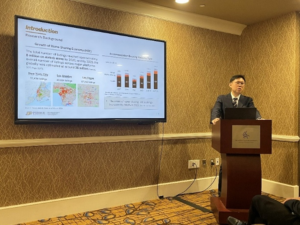
Dohyung Bang presents his research at the 31st Annual Graduate Education and Graduate Student Research Conference in Hospitality and Tourism
Through my IISG-funded project, I aim to examine how the growth of the home-sharing economy affects housing market outcomes in the Lake Michigan region. Specifically, I will investigate whether increases in STR activity are associated with changes in long-term housing supply, home values, and rental prices. Because housing prices are determined by many different factors, it is challenging to identify the causal impact of STR growth. To address this challenge, my research combines multiple datasets and applies econometric methods designed to isolate the effects of short-term rentals from other confounding influences.
More specifically, the project integrates property-level real estate data with short-term rental market data. It also considers a range of control variables, including housing characteristics, neighborhood socioeconomic conditions, and local attractiveness, such as proximity to downtown areas or the Lake Michigan shoreline. By incorporating these data sources together, I aim to identify the conditions under which the effects of the home-sharing economy on housing markets become most pronounced.
The ultimate goal of this project is to clarify the boundary conditions of the home-sharing economy’s impact on local housing markets. In doing so, I hope to generate evidence that can help local communities and policymakers better manage the trade-offs between tourism development and housing stability. Ideally, this work may contribute to policies that minimize the unintended side effects of short-term rentals while preserving their economic benefits.
Beyond this project, my broader research agenda focuses on understanding the complex dynamics of tourism systems and their societal and economic impacts from a social planning perspective. Through this work, I hope to contribute to more sustainable development and long-term economic growth.