
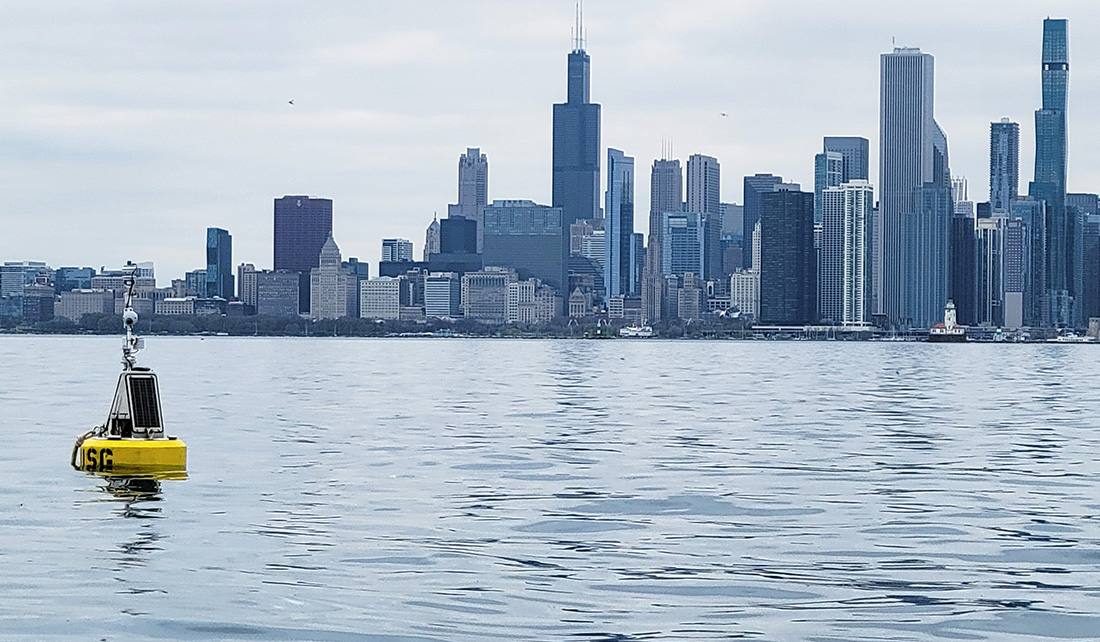
Welcome to the latest edition of Sea Grant Chats. At IISG, spring is buoy deployment season. To celebrate, Renie Miles and I sat down with Les Warren our buoy specialist who is a busy man this time of year. We discussed what makes the buoys so popular with the public and how important they’ve become to keeping the Great Lakes safe.
Renie: Les, why do we have buoys and where are they located?
Les: Illinois-Indiana Sea Grant has three nearshore buoys in Lake Michigan. They’re located off Michigan City, Indiana, and then two up in the Illinois waters near Wilmette and Chicago.
The buoy program was established first and foremost to aid public safety, with regard to beach conditions, swimming conditions, and boating safety. They really provide valuable data, including wave height and wind speed and direction that can aid in the public safety factor. But also, from a scientific standpoint, they contribute to a much larger network of buoys around the Great Lakes that’s highly utilized by the National Weather Service to do their forecasting and modeling of lake-wide conditions.
Renie: Stuart, would you like to comment on the buoys and the Sea Grant mission?
Stuart: What’s great about the buoys is they are, in many ways, the most popular thing that we do, and I think part of that is that we’re bringing data into the hands of the people who use it, right? Part of what we want to do at Sea Grant is make sure that science gets used for the people. The buoys are our most direct interface to that. We are collecting cutting-edge data and making it available for people to use in their decision-making. And I think the value in that has been reflected for many, many years through the popularity of the buoys.
We’ve done outreach around buoys through workshops, we’ve even had pancake breakfast related to the buoys, and there was a popular social media account for a while. Looking at our web stats, the buoys are, by a factor of 10, the most popular thing on our website. Not to mention we get emails when the buoys aren’t out in a timely manner. All of this shows how the buoys really are a great reflection of the Illinois-Indiana Sea Grant mission.
Renie: Speaking of that fact, that the buoy pages are by far the most popular on our website, Les, who are all these people? Who is using the buoys?
Les: The majority of our users are the general public, so like I said, anybody who is planning a trip to the beach or the lake, in general, and wants to know the current lake conditions. But they’re also highly used by recreational boaters, and local charter boat fishing captains who want to know conditions offshore. But, yeah, definitely the public and general recreationalists are our largest audience.
Renie: What about the National Weather Service? Are meteorologists part of the website hits?
Les: They’re not coming directly to our website. The data is actually transmitted directly to them. On the website, that’s the general public using those pages.
Renie: Tell me more about the information they’re getting from the buoys. What can they learn that’s important to factor into their day or their plans?
Les: The main measurements that the buoys are recording are wind speed and direction, wave height and direction, and air and surface water temperatures, which can give an idea of the swimming temperatures at the beach. Also, our buoys are equipped with a thermistor string that takes the water temperature every three feet going down. Charter captains taking their customers out on the lake use them frequently—they want to know what the temperature is at various depths to better target different fish species.
The buoys are primarily equipped to measure real-time conditions. Each buoy transmits the conditions every 10 minutes not only to our webpages, but to the National Weather Service and the National Buoy Data Center. That is the general hub where most of the different buoys around the Great Lakes are depositing their data. The data is actually publicly accessible and downloadable. For researchers, it’s a really nice place to go and get historical data sets. Our data goes back all the way to 2013, when we first started deploying the Michigan City buoy, so it’s a huge repository of historical and current data.
We also have webcams on each of the buoys that transmits 30-second videos. For folks that may not be as well attuned to what two-foot or three-foot waves look like, they’re able to look at that webcam feed and see what the conditions are like.
Many of our buoy users know that it records at the top of the hour, and it’s a pretty common thing that they try to get try to get recorded waving at the camera. Buoys can be fitted with a ton of different sensors, such as water quality or estimates of blue-green algae fluorescence. They can be customized depending on the audience and users and what kind of questions folks are trying to answer. Even though there’s this huge network of buoys, they’re not uniform by any means in terms of the data they’re collecting.
Stuart: One thing you point out, Les, is that a lot our buoy activities rely on strong partnerships, especially when it comes to deploying and maintaining the buoys. Can you talk about some of the partnerships we’ve developed over the years?
Les: We have partnerships with GLOS, which is the Great Lakes Observing System. They are a huge nonprofit that works with so many different entities that own and deploy buoys. Their goal is to bring us together and to network and work together. GLOS is a huge collaborator, not just for setting us up to work with other entities, but also helping to provide supplemental funding for upgrades and repairs at times. We also work very closely with the company Freeboard Technology, from whom we purchased the buoys. They assist us when glitches occur and make sure that the buoys keep transmitting data throughout the summer season. The National Weather Service is a strong partner. Then there’s Cary Troy in the Department of Civil Engineering here at Purdue. He helped spearhead the buoy program when we first deployed the Michigan City buoy.
And then, it takes a lot of hands to keep the buoys in the water sometimes, so David Klein is a recreationalist who helps us out. When we need an extra set of hands with deploying or retrieving buoys or doing maintenance, a lot of times he’s out there to assist. Even sometimes, the general public lends us a hand with information.
Renie: What sort of challenges has the buoy team dealt with over time?
Les: As far as I’m aware, 2013 was the first season, so we’re going into our 13th year here of having the Michigan City buoy. The Wilmette buoy was deployed in 2015, and then we added Chicago in 2021. Mostly, we’ve had to update the infrastructure. Folks have noticed that we’ve had a couple buoys break away in the last year or two. A lot of that is just aging mooring lines, and the infrastructure that keeps them anchored. That should now be all updated.
We’re also working through the long-term challenges of making sure that the program is sustainable so that it can continue forward for hopefully another 13 years.
Renie: It’s the dawn of a new buoy season. What’s new this year?
Les: Many of our users will notice new, upgraded webpages for each of our buoys this summer. The goal is to have all three pages up and running by Memorial Day weekend. These new webpages will display the data in a newly designed format that will hopefully make it easier for our users to quickly get the information they are looking for.
Further, the Michigan City buoy is getting a full retrofit upgrade. Many of our users might be familiar with the very large buoys that were out on the water previously. Michigan City was our last large buoy. It’s being retrofitted to a new, smaller hull, which will make it easier for deployment and retrieval. But it’s also getting updated wave and wind sensors, so it’s basically going to be a new buoy that’s going to be deployed off Michigan City.
Stuart: So we have a lot of small buoys now, right? The first small one, of course, was Chuoy—that’s what most people call the Chicago buoy. What are the trade-offs with the smaller ones versus the larger ones?
Les: The buoys started off at a very large size because of the amount of battery power needed. The large buoys can hold a lot of batteries and they have higher solar charging capabilities—because they’re larger, you can have more solar panels on them. As technology has improved, like with most devices, we’ve been able to shrink buoy size. The smaller ones are a manageable size—two people can actually lift one up and move it, compared to the old buoys that you needed a crane, or some kind of lifting device to get one in and out of the water.
When we’re thinking about lake conditions getting rougher sometimes during the summer, especially when bigger storms come through, these smaller buoys, because they weigh less, don’t have as much force when they get tossed around. The small buoys can kind of, more or less, float through rougher waves.
The old buoys, these heavy objects being tossed around had a little more force. When Michigan City broke free in the fall, it was an instant 12-foot wave that came through, and it probably was enough force to snap that mooring line.
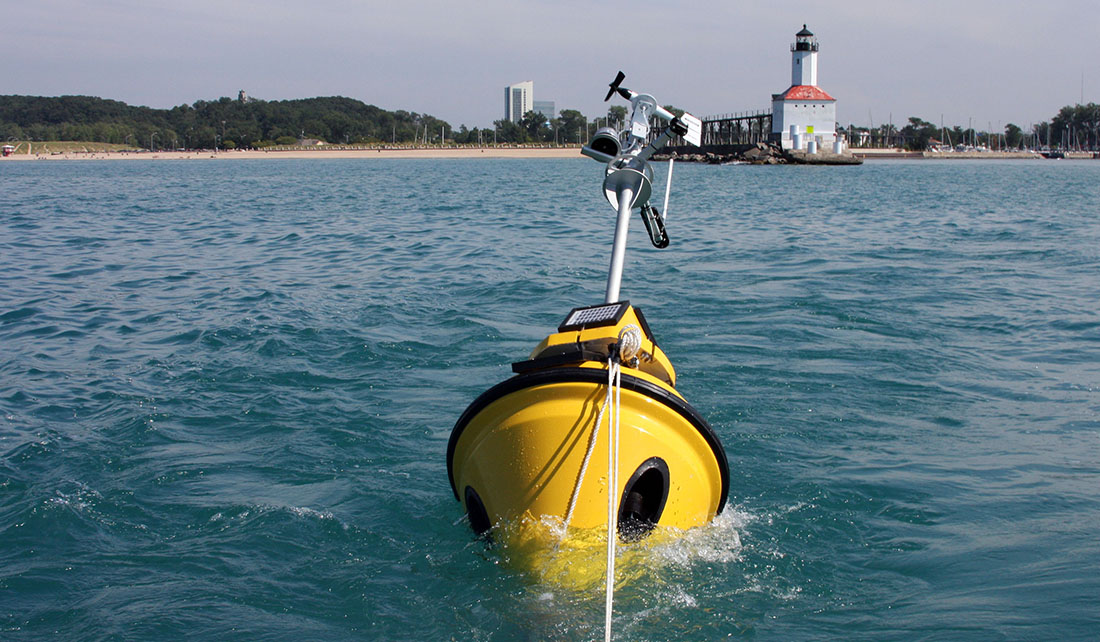
The Michigan City buoy is being reformatted into a smaller, more efficient size this year.
Renie: How many times have we had buoys on the loose?
Les: Chuoy’s only been out for four seasons, and it’s broke free for two of them so for some reason Chuoy has a track record of breaking free. But besides that, I’m only aware of Michigan City last year. I’ve been told that it’s more common than you think.
Renie: Going forward, what’s next?
Stuart: The buoys we have now are a part of IISG’s commitment to expanding our sensing in the Great Lakes and in southern Lake Michigan in particular. For example, we just put in a camera at the Dunes National Park that will soon take regular photos and video of the conditions there. We have a water quality monitoring station on Trail Creek in northwest Indiana, thanks to our partnership with the Höök Fish Ecology Lab here at Purdue. We are looking at expanding our buoy program by introducing some spotter buoys, potentially later this summer or next year. These are smaller buoys that will record key data in a way that’s a little more flexible and cost-efficient. We’re looking to expand our relationships with GLOS and other partners to continue to be leaders in data collection in southern Lake Michigan and beyond. It’s all part of our mission, which is to help bring cutting-edge science to the people. With buoy data, it’s easy: university scientists want it, agency scientists want it, boaters want it, the people want it, right? This data is clearly something that’s very important, and so we’re glad to have that as part of our portfolio.
These interviews have been edited for length and clarity.




