
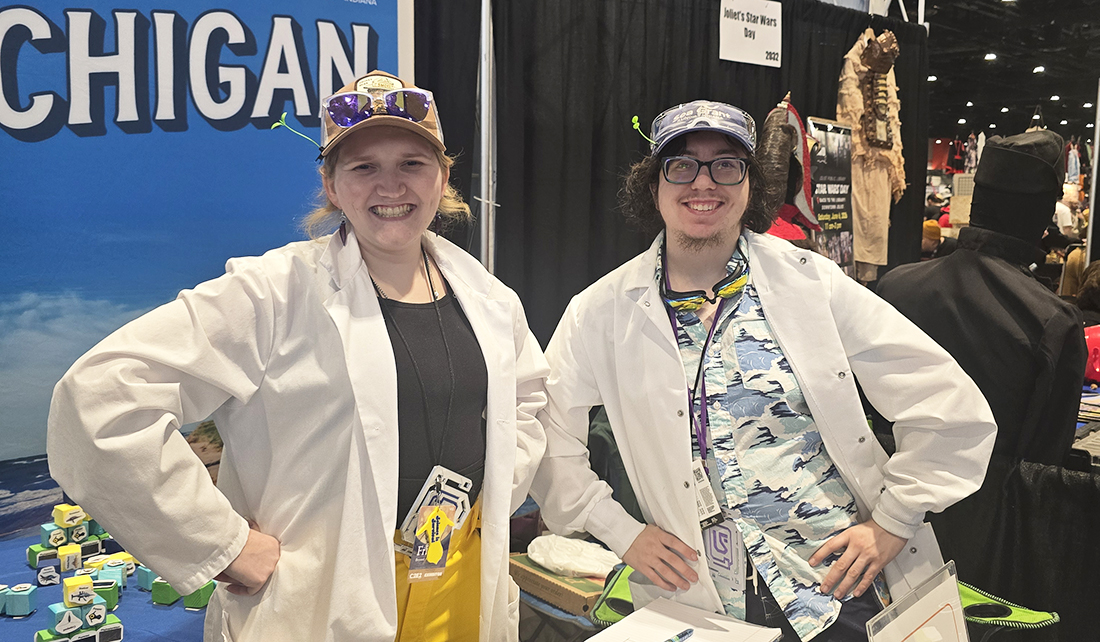
At the recent Chicago Comic & Entertainment Expo weekend event, where costumes, celebrities, and fandom ruled the day, many people were drawn to a booth with a giant postcard-like sign that said “Greetings from Lake Michigan.” There, Illinois-Indiana Sea Grant (IISG) engaged over 1,200 people of all ages with games, challenges and information about the lake and its ecology, and even aquaponics.
Using the framework of the Subnautica video game, Karter Burgdorf, aquatic invasive species (AIS) outreach associate, was the mastermind of this project, and Maggie Lawrence, aquaponics workforce development associate, his partner throughout. They were joined by University of Illinois Urbana-Champaign biologist Phil Anderson and three of his students. Anderson leads the U of I Cosplay for Science organization on campus.
Visitors had the opportunity to build a food web and learn the importance of plankton as the base of the system; to take part in decontaminating alien bacteria from toy spaceships, reflecting the importance of not transporting aquatic invasive species; and to design their own aquaponics system. (Aquaponics is a closed growing system that allows fish and plants to thrive in water that is recirculated for the benefit of both organisms.)
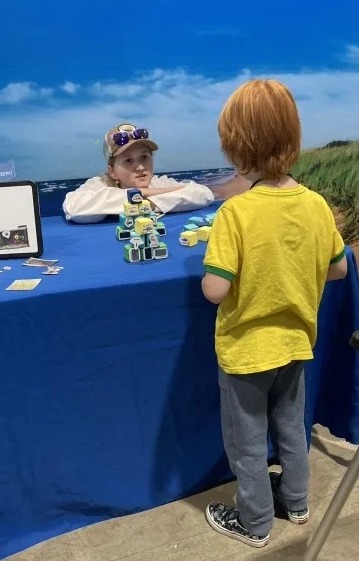
IISG’s Maggie Lawrence discusses plankton as an important part of the aquatic food web with a young visitor to C2E2.
Most of Lawrence’s interactions were with attendees who had never heard of aquaponics or aquaculture. Still, they caught on quickly. “Every aquaponic system design was different in its own unique way. Every system design could have worked—some with a little tweaking—but still they had the right idea after only a few minutes of learning,” she said.
Burgdorf was surprised and gratified by the number of children that have some knowledge about AIS and food webs in Lake Michigan, and that they made the connection with the spreading of germs. “Several children wanted to help me clean every single spaceship we had—they really seemed to enjoy having a meditative activity,” he added.
The bright, colorful nature of the booth and the activities attracted many visitors. “Once they approached us, it was very rare for someone to not want to participate or, at the very least, hear our messaging. In my opinion, this sort of work is what outreach should be—getting out there to where the people are and meeting them where they’re at,” said Burgdorf.