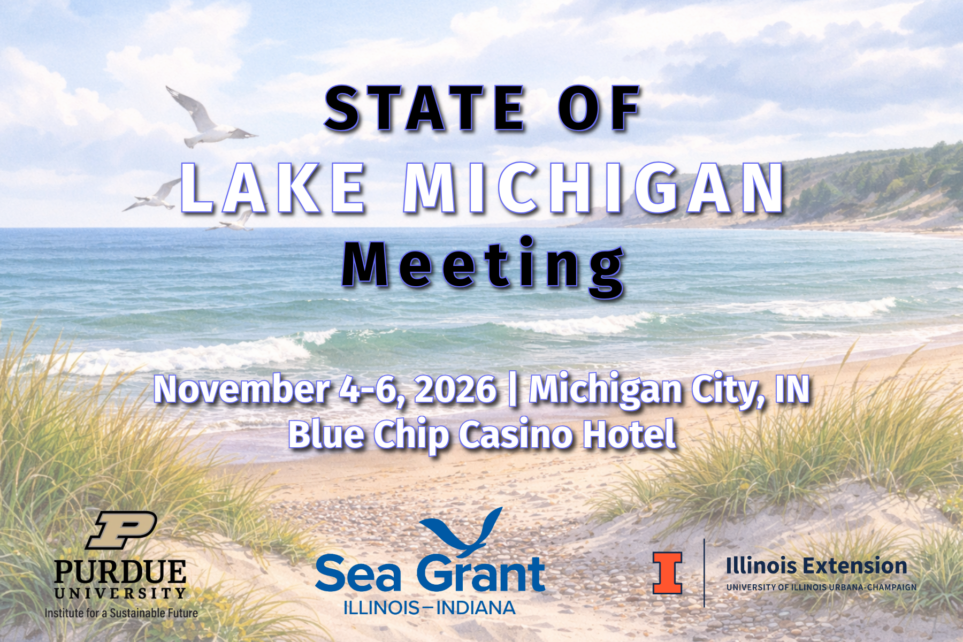
Registration is now open for the 2026 State of Lake Michigan Meeting, a forum bringing together researchers, resource managers, educators, communicators, and other professionals from across the Lake Michigan basin to share knowledge, foster collaboration, and discuss the lake’s most pressing issues.
The meeting will take place November 4–6, 2026, at the Blue Chip Casino Hotel in Michigan City, Indiana. Hosted by Illinois-Indiana Sea Grant in partnership with the Purdue Institute for a Sustainable Future, Wisconsin Sea Grant, and Michigan Sea Grant, the meeting revives a lake-specific forum that has been absent for several years.
“The State of the Lakes meetings have been dormant for several years. That’s left a real gap,” said Stuart Carlton, director of Illinois-Indiana Sea Grant. “Lake Michigan is the only one of the five Great Lakes located entirely within the U.S., and there wasn’t a dedicated place anymore for the people studying it, managing it, and communicating about it to talk to each other.”
While many conferences focus on a single topic or discipline, the State of Lake Michigan Meeting is designed to encourage collaboration across fields. Organizers hope attendees will leave with new partnerships, fresh perspectives, and a broader understanding of the challenges and opportunities facing Lake Michigan.
“Bringing people together from different aspects of Lake Michigan research, management, outreach, and education provides an opportunity to exchange knowledge and share contributions,” said Laura Esman, research and reporting coordinator for Illinois-Indiana Sea Grant. “Our hope is this leads to better communication of the science, identification of emerging issues and knowledge gaps, stronger partnerships, and new opportunities for collaboration.”
The meeting will feature symposia and presentations on topics including aquatic invasive species, contaminants of emerging concern, Lake Michigan fisheries, coastal monitoring, coastal restoration, artificial intelligence-assisted decision support for watershed management, and collaboration across research, management, and outreach.
“We’ve got symposia on aquatic invasive species, contaminants of emerging concern, Lake Michigan fisheries, coastal monitoring, coastal restoration, and more,” Carlton said. “This range, where you can go from a session on AI-assisted decision support for watershed management straight into one on collaborating across research, management, and outreach, is the key to the meeting.”
The conference is open to researchers, natural resource managers, Extension professionals, educators, students, nonprofit organizations, and others interested in the future of Lake Michigan.
Registration is now open. Click here to learn more about the meeting, view the agenda, and register.