

When I started working at the Illinois Water Resources Center in May, I had no idea what kind of summer I had signed up for. Needless to say, I hit the ground running. On my third day, we traveled to Chicago for an overnight meeting with IISG, and other state agencies. We discussed current issues, future plans, plus introduced new employees, and interns, like myself. In an unfamiliar place with new people and environmental issues new to my knowledge, I was welcomed warmly, and always encouraged to express my thoughts and opinions.
Next, a rainy Memorial Day weekend came, and with a newfound perspective of water’s role, I traveled across the state to Quincy, Illinois to visit my grandmother. Without having to do much searching, water’s effects were all around me during the trip—the green grass, beautiful flowers, wildlife, woods, and bluffs near the Illinois, and Mississippi rivers. Feeling refreshed, I started diligently planning and working on the blog for the summer. I researched, and wrote my first post on the Fox River in northern Illinois, which seemed appropriate given my recent trip to Chicago. I also went to several video shoots for various outreach projects.
I later attended the Agriculture Water Quality Partnership Forum tech-subgroup meeting in Springfield, as well as the Nutrient Management Council meeting in Champaign. The Illinois Nutrient Loss Reduction Strategy—something I studied in my agriculture classes—was put into action as the different agencies, and organizations worked together. In contrast, I then had the privilege of interviewing my dad about what conservation practices he implements on our family farm. It was amazing to not only first-hand explore these issues, but to apply, and build upon concepts I previously studied.
As someone with a strong agricultural and farm background, I realize the importance of sustaining land, wildlife, and of course, the human population. As increasingly more people move to urban environments, and are further removed from agriculture, education will only continue to be more important. I cannot wait to start my senior year at Illinois State University, apply to graduate schools, and pursue a career in natural resources as well as environmental and agriculture education. I am extremely grateful for the opportunities the Illinois Water Resources Center has given me, and even more so, the wonderful people I am fortunate to have worked with.
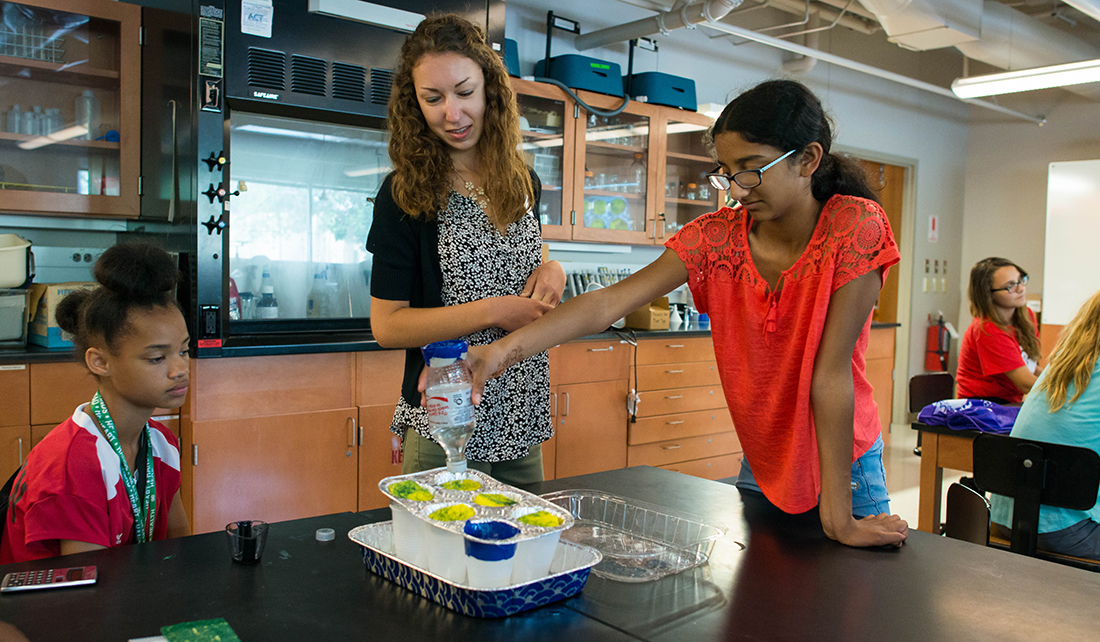
Ashley, center, helps out the campers with a stormwater workshop earlier this summer in Peoria, Illinois.
Overall, the passion my co-workers have for water related issues is truly inspiring. The wealth of knowledge, and variety of personal and educational experiences creates a very interesting dynamic. I am leaving better versed on nutrient issues, stormwater, green infrastructure, and how all agencies must collaborate to solve problems.
Through teaching an educational STEM camp, interviewing farmers, attending meetings, video shoots, and tweeting I became a better agricultural communicator. Blogging regularly also made me a stronger writer, researcher, and critical thinker. In reality, there is no cut-and-dry answer or formula to solve all environmental issues. It is something we all must work together and compromise on in order to improve, and sustain water resources, and all life that depends on it. No matter where you live, water is something not to take for granted, but to embrace. After all, we would not be here without it.