 Sea Grant Illinois-Indiana
Rain gardens capture stormwater runoff
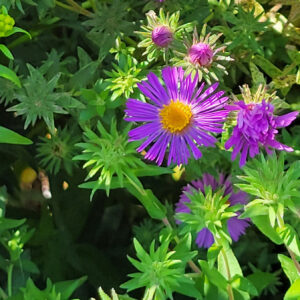 In many communities, increasing urbanization and larger storms have led to more flooding. In addition, rainwater that hits pavement and flows into drains, and then to nearby water bodies, picks up pollutants along the way. One approach to reduce flooding and protect water quality is installing green infrastructure, including rain gardens. Rainwater soaks into the garden, and pollutants are filtered by plant roots.
Illinois-Indiana Sea Grant continues to offer the Rainscaping Education Program through both Illinois Extension and Purdue University Extension. We offer workshops for Master Gardeners and other community members to learn about rain gardens and other rainscaping techniques.
In 2024, training took place in Kane County in Illinois, for 17 participants and in Indiana, for 14 participants in Marion, Noble, and Steuben counties, which included installing three demonstration rain gardens. The workshops brought together Master Gardeners, agency and organization representatives, stormwater and landscape experts, and consultants.
The new demonstration gardens are sited at an extension office, an Indianapolis school, and a library, and capture nearly 202,000 gallons of stormwater each year. Altogether, the rainscaping demonstration gardens installed since the program began capture nearly 1.4 million gallons each year, calculated using average rainfall and garden area.
Recent News
- Sea Grant Chats: Looking back on our AIS legacy as we move forward
- National Sea Grant welcomes 2026 Knauss Marine Policy Fellowship finalists
- IISG’s new year starts with a new research and reporting coordinator
- Ripple Effects curriculum engages students on the spread of aquatic invasive species
- Coastal communities can tap into IISG resources as they manage beach sand and structures
IISG Instagram
Join us for a hands-on @projectwet Make-and-Take Workshop in Chicago!
📅 When: March 12, 2026 from 9:00 AM – 3:30 PM CT
📍 Where: 200 S Wacker Dr., Chicago, IL
💲 Cost: $25 (includes classroom-ready activity kits, lunch & refreshments)
🗓️ Registration closes February 26.
✅ Open to 3rd–8th grade formal & informal educators
✅ Earn 6 PD hours
✅ Leave with ready-to-use water education kits aligned to Common Core & NGSS
👉 Don’t miss out—space is limited!
Learn more and register at the link in bio.


Explore the history, impact, and educational power of Meaningful Watershed Educational Experiences (MWEEs).
eeLEARN: MWEE 101 is a free, self-paced online course that walks you through the MWEE framework with examples, planning tools, and downloadable resources that you can use immediately.
Start learning today at the link in bio.

Some partnerships just make sense. Happy Valentine’s Day from IISG! 💕

This February marks a major milestone: 30 years of aquatic invasive species outreach by our team! To celebrate, IISG Director, Stuart Carlton, and Strategic Communication Coordinator, Renie Miles, sat down for a Sea Grant Chat with two key figures in IISG’s AIS history: Pat Charlebois, our assistant director and program leader, who spent over two decades leading our prevention efforts, and Katie O’Reilly, who took over that role in 2022. We discussed the evolution of the invasive species issue in the Great Lakes, the shift toward understanding human behavior, and the creative strategies that make this team so effective.
Dive into the full interview at the link in bio.
