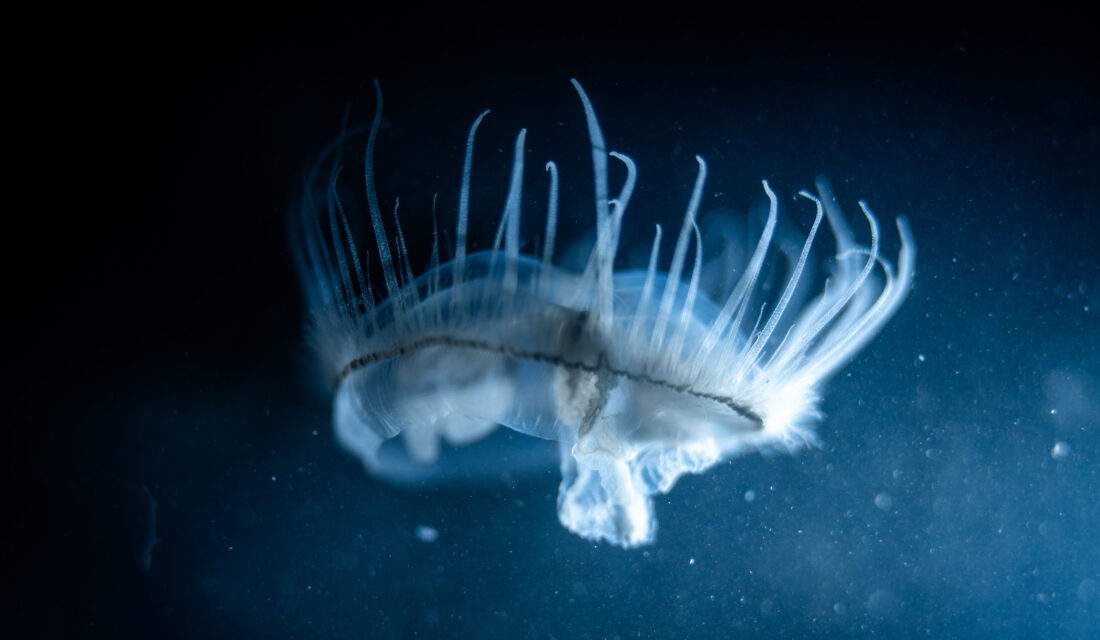
Most people think of jellyfish as only found in salty seas—perhaps some folks have stinging memories of encounters in ocean waters or have spent time observing these exotic and delicate creatures in seaside aquariums. But it turns out there are also freshwater jellyfish. They are native to China’s Yangtze River but are now found on every continent, except Antarctica.
Illinois-Indiana Sea Grant funded a research team led by biologist Nadine Folino Rorem at Wheaton College and Paulyn Carwright at the University of Kansas to study Craspedacusta sowerbii and analyze the local environmental conditions where these jellyfish are found. This species has been living in the Great Lakes region for decades, including in Illinois and Indiana waters.
“We’ve been trying to figure out the cues that control some aspects of the Craspedacusta life cycle,” said Rorem. “Our objective was to assess where jellyfish fit in food dynamics, and competition dynamics as well.”
The team also studied the jellyfish in the lab, experimenting with a range of water temperatures related to their lifecycle stages, and how they grow and transition through those stages at different temperatures.
“Since scientists are seeing increases in jellies in marine environments due to increases in water temperature, we’re thinking we’re probably going to see a similar situation with Craspedacusta,” added Rorem. The concern is that the jellyfish might become more of a threat to local aquatic food webs.
Rorem’s team found that Craspedacusta are indeed more likely to thrive in warmer waters.
Freshwater jellyfish are smaller than many ocean species—they start out microscopic in their younger polyp stage and grow to be a nickel-sized medusa or jellyfish. When a polyp transitions into a medusa, the more typical jellyfish form, it can grow to the size of a quarter. Because they are so small, these jellyfish do not have the ability to effectively sting people.
The researchers spent a good deal of time in the field, tracking down reported sightings of this organism. Rorem traveled to a lot of places, including Coal City, Illinois and Hammond, Indiana, knocking on doors to get permission to sample in backyard drainage ponds and other water bodies. The team spent some time in Wolf Lake, which straddles the Illinois and Indiana border near Lake Michigan—in both lakes, jellyfish in the polyp stage have been spotted.
According to Rorem, the reason that jellyfish in the medusa stage have not been detected in these waters is because they are not that abundant or they are not surviving, which she attributes to the possibilities of predation or other ecological factors, such as variation in water chemistry.
The team collected samples to assess the environmental conditions where the medusae are present and to bring them back to the lab for further study. Because the jellyfish polyps typically grow on surfaces, researchers also brought back pieces of wood and rocks to look for these tiny, transparent organisms.
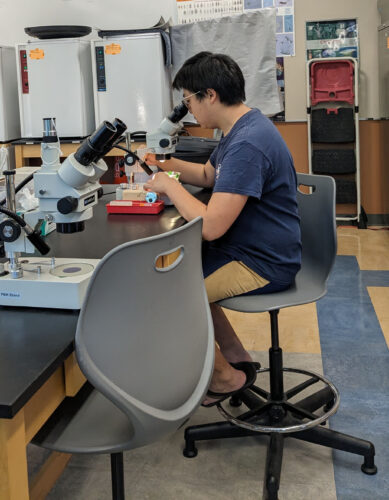
Jonathan Zhu, a student at Wheaton College, looks for freshwater jellyfish in water samples from Illinois and Indiana ponds and rivers.
This time-consuming effort led Jonathan Zhu, a Wheaton College student, to develop a much more efficient way to sample for jellyfish polyps, and other species as well. When they placed plastic and glass microscope slides in strategic locations in the water for several months, they found Craspedacusta polyps living on these surfaces.
“This new sampling method is one of the exciting things that came out of this project,” said Rorem. “Jonathan spearheaded that—he’s one of those exceptional students that I’ve really enjoyed working with since he was a freshman.”
In the lab, the research team also worked to keep Craspedacusta alive throughout its life stages. While they were challenged in achieving ideal water movement conditions and providing the right food sources, the team was able to keep the jellyfish alive in the lab for 87 days, very likely, longer than anyone before.
They also pinpointed warmer water temperatures in which Craspedacusta would likely be more successful. “We found that different populations reacted the same to temperature factors, which means if temperatures increase, you’re probably going to see a similar response in different locations in northern Illinois and Indiana, meaning increases in some of these life cycle stages,” said Rorem.