

Meet Our Grad Student Scholars is a series from Illinois-Indiana Sea Grant (IISG) celebrating the students and research funded by our scholars program. To learn more about our faculty and graduate student funding opportunities, visit Fellowships & Scholarships.
Yuanxin Song is a PhD student at the University of Illinois Urbana-Champaign, where her research focuses on nutrient loss reduction and water quality improvement. Through the Illinois-Indiana Sea Grant Scholars Program, she is developing a targeted conservation framework for the Lake Michigan watershed. Her work aims to identify nutrient pollution hotspots, diagnose the dominant factors driving nutrient loss across subwatersheds, and support more effective and spatially targeted management strategies for water quality protection.
The Great Lakes are among the most important freshwater systems in the world, supporting drinking water supply, economic activity, transportation, recreation, and ecological function across the United States and Canada. Within this broader system, the Lake Michigan watershed plays a particularly important role. It includes highly productive agricultural landscapes, rapidly growing urban areas, extensive river networks, and diverse coastal ecosystems. At the same time, this watershed faces persistent water quality challenges associated with nutrient pollution. Nitrogen and phosphorus from agricultural production and other human activities can be mobilized from the landscape, delivered to streams and rivers, and ultimately, transported to downstream waters, where they contribute to eutrophication, harmful algal growth, and long-term ecological degradation.
A central challenge in nutrient management is that nutrient loss is not distributed evenly across space, nor is it driven by the same processes everywhere. Some subwatersheds are
characterized by high nutrient inputs, whereas others are more strongly influenced by efficient land-to-water delivery or downstream transport processes. In addition, current nutrient export can reflect not only present-day inputs, but also hydrologic connectivity, legacy effects, and watershed conditions that vary across locations. As a result, effective nutrient reduction requires more than identifying where pollution is occurring. It also requires understanding why certain places function as hotspots and which mechanisms are most responsible for nutrient loss in each setting.
Yuanxin Song’s IISG research addresses this challenge by developing a HUC12-scale framework that integrates hotspot identification, watershed typology, and targeted intervention analysis across the Lake Michigan watershed. Working at the HUC12 level allows her research to capture subwatershed-scale variability that is directly relevant to conservation planning and local management. Rather than treating the watershed as a single, uniform system, this framework is designed to identify where nutrient loss risk is highest, how subwatersheds differ in their dominant controls, and where conservation actions may achieve the greatest benefit.
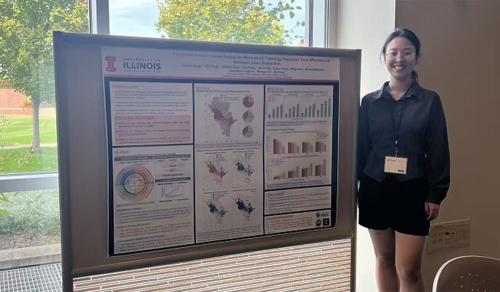
Yuanxin Song presents a poster on a conservation framework for the Upper Mississippi River Basin at a Purdue University workshop titled Nitrogen Fate Shapes Agriculture’s Sustainable Future.
The framework follows three main steps. The first step is hotspot identification. This step uses indicators that reflect nutrient loss risk to identify priority subwatersheds for management. The second step is factor diagnosis. After hotspots are identified, the framework evaluates the dominant source, delivery, and transport factors associated with nutrient loss in different locations. Source factors relate to nutrient inputs to the landscape. Delivery factors describe how readily nutrients move from land to water. Transport factors reflect the hydrologic and spatial processes that influence how nutrients move through the river network. The third step is targeted intervention. By linking these diagnosed mechanisms to conservation strategies, the framework helps identify more place-based approaches for nutrient reduction and supports improved management precision and resource allocation efficiency.
This work is intended not only to improve scientific understanding of nutrient loss, but also to strengthen the practical basis for watershed management. Conservation resources are always limited, and water quality protection depends on using those resources where they can have the greatest effect. A more spatially explicit and mechanism-informed framework can help decision-makers move beyond broad, uniform strategies toward approaches that better reflect watershed heterogeneity. In that sense, Song’s research is closely aligned with the broader goals of IISG: to connect scientific research with real-world environmental problem-solving and to support more effective stewardship of the Great Lakes.
In the long term, Song hopes this research will contribute to a stronger scientific foundation for nutrient management across the Great Lakes region. By integrating hotspot identification, watershed typology, and targeted intervention, her work seeks to advance a more precise, efficient, and decision-relevant approach to water quality protection in the Lake Michigan watershed and beyond.



