
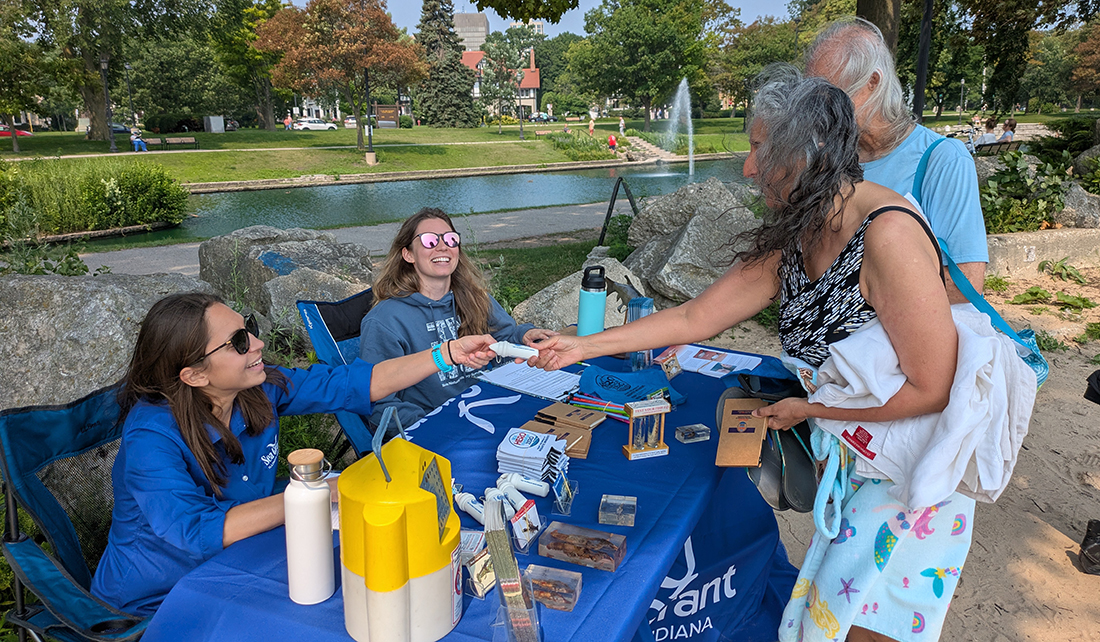
Welcome to the winter edition of Sea Grant Chats. This February marks a major milestone: 30 years of aquatic invasive species outreach by our team. To celebrate, Renie Miles and I sat down with two key figures in that history: Pat Charlebois, our assistant director and program leader, who spent over two decades leading our prevention efforts, and Katie O’Reilly, who took over that role in 2022. We discussed the evolution of the invasive species issue in the Great Lakes, the shift toward understanding human behavior, and the creative strategies that make this team so effective.
Renie: Stuart, what do you think are the strengths of the program’s AIS team and the work they do?
Stuart: I think our AIS team is extraordinarily successful for a few different reasons. The first one is that they use interdisciplinary science in a way that is particularly effective. We don’t do a lot of natural science research at Sea Grant, but we speak with natural scientists frequently to learn the latest information on AIS in terms of effects, controls, and things like that. But our AIS team also relies on social and behavioral sciences to help inform their programming.
They’re also really good at working with people who matter on this issue. You see them working with bait shops, lake management associations, resource managers. They’re finding key places and partners to really amplify their message.
We’re going at about 30 years of aquatic invasive species being a key issue in the Great Lakes. And not coincidentally, that’s about how long our AIS team has been working on it, right? We were on the ground floor doing this important work. I think people understand that we are knowledgeable, we are trustworthy, and we’re good partners.
Renie: Pat, speaking of 30 years, early on, what were some goals and challenges to do successful outreach?
Pat: Invasion biology was not a thing at that time. It was a new discipline for all intents and purposes. We didn’t have the science to know the potential impacts in the Great Lakes when these species started showing up. We had to rely on their behaviors and impacts in other types of systems to be able to forecast or guess what they would do in the Great Lakes. Sometimes we got it wrong and our trust was affected because we said, oh, we think this is going to be terrible, and then it wasn’t—like the round goby didn’t end up having the predicted impact, at least in most cases.
We have risk assessments now that give us a much better snapshot into what a new organism may or may not do. When the round goby first arrived in the Great Lakes, we were getting scientific papers translated from a colleague working in the Black Sea. We were scrambling. We had to gear up to get information out starting at ground zero every time there was a new species. And it seemed like there was a new one every week, but it was probably every year.
But then that changed when we started focusing on the pathways of introduction. We didn’t have to scramble as much because the same pathways were at work for each species. There was less need to develop outreach tools because they were basically the same steps for preventing everything.
It was also a challenge to be a female in a male world. When I started, I would go to meetings where it was 30 men and me, and I was the only female working on AIS in the Great Lakes Sea Grant Network. I was a lot younger than some of the people I was working with, and they’d been working in the profession for a while, so it was a challenge to prove myself as both a young person and a woman.
Stuart: I think the strength that it takes to fight through that—it takes a particular kind of person, and a particular strength.
Katie: That is truly a trailblazing thing that Pat did, and it set the program up to be where we’re at today.
Renie: Katie, how do you see things today? What are the team’s goals and challenges?
Katie: Today in the Great Lakes, I think there is a widespread awareness about invasive species, generally. We, as scientists and science communicators, have done a pretty good job of raising some of that awareness. I think we’ve also made strides in reducing the number of invasive species through outreach and regulations. I wouldn’t say we’ve turned off that faucet, but it’s more of a slow drip now. We’ve reduced the rate of introductions.
We still have a lot of species that are already here in the Great Lakes and are now spreading into inland water bodies or just moving around the lakes. We always have the threat of new species in trade, related to aquariums or bait shops. That’s part of the reason the AIS team has focused on communicating about pathways of introduction for invasive species—there’s always going to be some new species on the horizon.
In terms of our ultimate goal, which is reducing the introduction and spread of invasive species, we want to make sure we’re incorporating the human side of things because humans are the ones moving these guys around. So that means understanding why people do the things they do and what they value. Do they value being able to go fishing? To share traditions? Is it their livelihood?
It’s a challenge and an opportunity for us. A lot of my team, myself included, have a biology or ecology background so we work with social scientists to combine their expertise with the biological science of invasive species. Developing an understanding of human behavior and motivation helps us address specific pathways.
We’re probably never going to stop invasive species completely, but we’re trying to have people change their behavior so that they reduce the risk of it. This means that sometimes we have to think outside the box to address some new and increasing challenges.
Stuart: The AIS team at IISG and in the region—because this is an issue that we work on regionally—has been kind of relentlessly creative and experimental in what they’ve done. Everything from geofenced ads for people at a certain conference to airplane banners, and now we’ve installed boat cleaning and drying stations. Sure, we’re at a time when the questions are not getting easier, but harder, but I think we’re in a good position to be ready for that.
Renie: Let’s do a little, “how it started,” “how it’s going.” Pat, how and why did “Be A Hero” get started, and how did it roll out early on?
Pat: Because the Great Lakes was ground zero for a number of AIS, the Great Lakes Sea Grant Network was involved with the U.S. Fish and Wildlife Service to develop national messaging, which was “Stop Aquatic Hitchhikers.” After a number of years of using the campaign, we worked with a social scientist to evaluate it.
The social science research found that in Illinois, the message wasn’t resonating. The term ‘hitchhiker’ had become less relevant for younger generations. The public found the steps outlined in the campaign to be confusing, and some steps were less likely to be adopted, for example, power washing your boat. If folk weren’t going to power wash their boat, why keep telling them to? We wanted to remind them of the steps we knew they were willing to do. That, for me, had the biggest influence in wanting new messaging.
Illinois DNR (Department of Natural Resources) agreed with us and provided the funding to develop a new brand, which became Be A Hero–Transport Zero. We developed boat landing signs that were at every Chicago area boat ramp, and at every DNR-owned boat ramp, so they were fairly ubiquitous throughout the state.
We promoted Be A Hero for a few years with recreational water users, and then we wanted another brand for organisms-in-trade because we had hired Greg Hitzroth and were working on that pretty heavily. We were thinking we would create something different, but DNR steered us towards developing a parallel message with Be A Hero–Transport Zero, which became Be A Hero–Release Zero.
Renie: Katie, how would you describe Be a Hero now, in terms of success stories?
Katie: The message of Be a Hero does seem to resonate with audiences in Illinois. There was a survey done by one of our frequent collaborators, Tim Campbell of Wisconsin Sea Grant, a few years back, that looked at audience familiarity with different AIS campaigns. Be a Hero had really high brand recognition in Illinois. It showed that our efforts to bring awareness to the campaign and messaging have had some impact. Today, the way we deliver the Be A Hero messaging takes a variety of forms, whether it’s airplane banners or truck wraps, or billboards.
Pat: Building on what Katie said about the recognition of our brand, at Loyola University, Ruben Keller and Kelly Garbach did an analysis before 2020 about AIS outreach in Illinois, and our messaging was sort of the hub. I would think that fact has only gotten stronger.
Katie: Our DNR partners see the value in having an Illinois-specific campaign that is recognizable, that people know what the general gist is: to be a hero, you are going to clean your boat. If you’re being a hero from the aquarium side of things, you’re not going to release your pets into water bodies. A benefit of Be a Hero having more of an Illinois and northwest Indiana focus is that it really does make it local and relevant to users.
Stuart: We’re the glue that holds a lot of organizations together, or a lot of projects together. A good current example of that is the Invasive Crayfish Collaborative. There’s this growing problem of invasive crayfish throughout the Midwest and a real need to gather scientists, natural resource managers, people who are doing outreach, and, eventually, end users and other stakeholders.
Pat: There had been several instances of crayfish showing up in different areas in the Great Lakes, and so in 2017 we thought that through a formal collaborative, there could be more communication and a better use of resources. It made sense for IISG to do it, given my background in crayfish. So, we got a grant and then got sustained funding through GLRI (Great Lakes Restoration Initiative).
Katie: It got off to a good start. There was a crayfish community science project that got going, but like a lot of things, due to the pandemic, people got a little disconnected. When I joined IISG in 2022, we were thinking of ways to reinvigorate the ICC, seeing a lot of value in it.
We wanted to make sure we were serving the needs of our members, so we brought in a lead facilitator, Natalia Szklaruk. We did listening sessions and some strategic planning and we’ve really seen those efforts pay off. We have really good turnout at events, but the main thing I see as a success is that ICC members see enough value in it that they come to us as a potential project partner. I’ve been told anecdotally that ICC members understand that Sea Grant has the expertise to help facilitate and bring groups together. By having us on a project, they feel more confident that their results can make a difference.
Renie: Katie, what are you excited about going forward—short-term and long-term?
Katie: I think what I’m most excited about in the short term is that we have a lot of cool and innovative ideas lined up for this year to do outreach a little differently. For example, one of our staff members, Karter Burgdorf, is organizing a cosplay science event at the Chicago Comic and Entertainment Expo in late March, using a unique venue to do some science outreach to audiences that we haven’t connected with much.
We are putting together a crayfish care guide for educators. This is a cool example because Izzy Paulson and Natalia decided that, while they could create a fact sheet, they could also do something more creative, like putting together a zine. It would have information about crayfish care that will be mixed with some art activities for students.
Long term, something I’m excited about is the collaborative nature of the AIS team. We are lucky to have a decently large team, which allows us to do some cool brainstorming and collaboration. At the core, what makes me excited is that we’ve got a team that is really excited and creative and wants to keep up the legacy of the AIS program that started 30 years ago.
Stuart: Our AIS program hit a lot of things right. The work started at a time when AIS was going to become one of the key environmental issues in the Great Lakes. And it started with the right person in place on the right issue. AIS is probably our largest team, and it’s probably the team that we as a program learn the most from. We are lucky to have this team, but I wouldn’t call it luck, I would call it a confluence of a critical issue with a total dynamo who worked on that issue at just the right time.
This conversation has been edited for brevity and clarity.