Category:

Be a Hero – Transport Zero spreads to new areas

November 5th, 2014 by

In Alaska’s Kachemak Bay Research Reserve, invasive species prevention is taking on a new look. To prevent the spread of the invasive invertebrates while a local harbor undergoes renovations, officials have adopted the Be a Hero – Transport Zero logo and slightly modified the message to encourage those involved in the reconstruction to follow a few easy before moving all docks and other infrastructure.
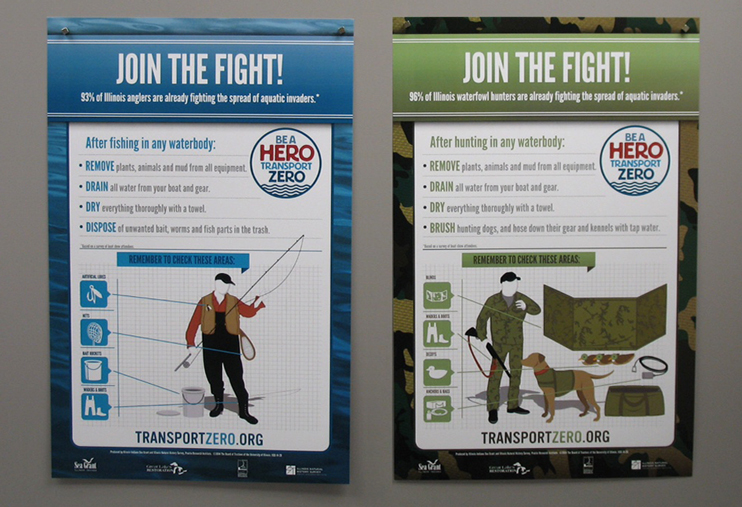
 
Closer to home, the outreach campaign developed by Illinois-Indiana Sea Grant and the Illinois Department of Natural Resources is also expanding to include hunting, hiking, and other terrestrial pathways. Posters asking customers to “join the fight” can be found in outdoor supply shops in several Illinois cities, including Springfield. The message also made an appearance at this year’s state fair in August. 
 
When it launched last year, Be a Hero – Transport Zero became the primary invasive species prevention message in Illinois. It’s simple call for boaters, anglers, and other recreational water users to “remove, drain, dry” before leaving a waterbody has been featured in magazines, broadcast on radio and television, and wrapped into outreach programs like Clean Boats Crew. 
 

To learn more about aquatic invasive species and what you can do to prevent their spread, visit our invasive species page

IISG Instagram

🌊 Save the Date! 🌊Shipboard Science Immersion 2026Join the Center for Great Lakes Literacy aboard the R/V Lake Guardian on Lake Superior, July 7–14, 2026!✅ Open to formal & nonformal educators (grades 5–12) across the Great Lakes region.📅 Applications open January 2026Learn more: https://cgll.org/signature-program/r-v-lake-guardian-shipboard-science-immersion/ or the link in bio.#TeachingTuesday
Join the Invasive Crayfish Collaborative for an exciting webinar featuring Dr. Chris Taylor from the Illinois Natural History Survey who will provide an overview of midwestern crayfish habitat requirements, feeding, reproductive biology, and life-history.Crayfishes in the Midwest occupy almost every type of aquatic and semi-aquatic habitat in the region. They function as critically important components of those ecosystems and in many cases represent a majority of invertebrate biomass. As “keystone” species, understanding their biology and roles in ecosystems is critically important. Register for the webinar at InvasiveCrayfish.org/events1 Or the link in bio.
This season, let’s teach eco-friendly habits while spreading cheer! NOAA’s Greener Holiday Gift Guide is full of ideas to reduce waste and protect our precious water resources. Check out the full guide at the link in bio. #teachingtuesdayNOAA Marine Debris NOAA Education
The gales of November may come early, but, as usual, the nominations for the Lakies are right on time along with our official call for nominations! Brought to you by the Teach Me About the Great Lakes podcast, The Lakies (aka "quite possibly not the least prestigious Great Lakes-focused awards ceremony there is”) are back. Our goal isn't to be the Official Arbiters of Quality, but to host a fun celebration of amazing Great Lakes-related research, outreach, and communication in the inimitable Teach Me style.Nomination categories are:-Great Lakes Science Communication of the Year-Great Lakes Outreach Program of the Year-Great Lakes News Event of the Year-Great Lakes Research Finding of the Year-Coolest Thing You Learned Listening to TMATGL in 2025-Science Podcast of the Year (Non-TMATGL edition)-Great Lakes Animal of the Year-Great Lakes Non-Animal of the Year-Great Lakes Sandwich of the Year-Great Lakes Donut of the YearThe Details: -Deadline: Nominations close on December 4th.Process: It's easy (just enter the name/title and a link).-Self-Nominations: Highly encouraged. Don't be shy.We’d love to get a broad swath of work across both the serious and less-serious categories to celebrate. Feel free to pass the link on to interested people: https://bit.ly/Lakies25