February 11th, 2013 by Irene Miles
Today’s blog post features a fun bit of physics from Wired.com’s science blog.
Writer Rhett Allain, professor at Southeastern Louisiana University, received an interesting question over Twitter – “What would happen if everyone on the planet jumped in the water?”
He writes:
“Let’s give a slightly refined version of the question.
‘If everyone on Earth went for a swim at the same time in Lake Michigan, how high would the water level rise?’
I have two primary assumptions to start with. First, I will assume that during this time the volume of water in Lake Michigan will be constant. So if the people make the water level rise, the water level will indeed rise instead of pushing water into the other Great Lakes. Second, I will assume that all of the humans in the lake are floating. If they aren’t ‘swimming’ or touching the bottom, then it will be easier to calculate the rise in the water level.”
Follow the link above for a fun Lake Michigan physics lesson.
February 8th, 2013 by Irene Miles
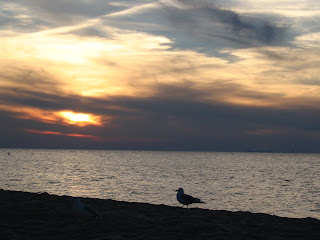
The frigid waters of Lake Michigan during a Midwestern winter may not seem very inviting to us, but some species spend a great deal of time there.
From Phys.org:
“On Nov. 2, 2010, Mueller documented 25,555 long-tailed ducks in Lake Michigan.
And on Jan. 20, 2011, 9,311 red-breasted mergansers were tallied.
 The data comes from the Lake Michigan Offshore Waterfowl and Waterbird Survey, a project initiated in 2009 by Mueller and Noel Cutright, both of the Western Great Lakes Bird and Bat Observatory in Belgium.
The work is designed to increase the understanding of key offshore Lake Michigan bird habitats, many of which have been lightly studied.”
Read more at the link above, including details about how the data they collect can help not only understand the presence and habitats of animals, but can guide safer development of energy production on the Great Lakes too.
February 5th, 2013 by Irene Miles
Illinois-Indiana Sea Grant is celebrating its 30th anniversary, and 30 years of working to protect and preserve the beauty and resources of Lake Michigan. But what is some of that work? What are some of the things that IISG does to understand, restore, and celebrate our Great Lakes resources?
We’re glad you asked. Our latest publication features 30 milestone achievements selected from the last three decades, all detailing ways that we support our mission to improve and protect the southern Lake Michigan area.
Visit the link to download your own copy of our 30 milestones, or contact us if you would like print copies to share with. And here’s to the next 30 years of keeping our Great Lakes great!
February 4th, 2013 by Irene Miles
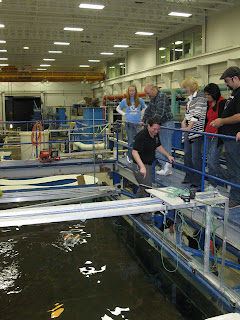 SeaPerch, a program that brings underwater robotics to classrooms and demonstrates how they can be used for educational purposes, recently held a workshop at the University of Illinois Hydrosystems Laboratory. IISG’s Robin Goettel and Terri Hallesy were among the presenters and they shared a number of educational materials that teachers could combine with their classes’ underwater robots.
Thirteen Champaign-Urbana science teachers were in attendance to learn how to incorporate SeaPerch underwater robots into their classroom curricula. Coordinators from Naval Sea Systems Command – Crane STEM led the morning session to introduce the SeaPerch program, provide helpful tips for constructing the complimentary robot kit each teacher received, and discuss relevant resources for classroom use. Additional robots commonly deployed for scientific applications were also highlighted.
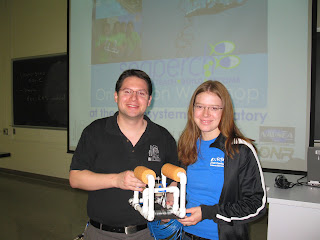 Over lunch, participants interacted with U of I graduate students in engineering to discuss research topics and applications for their in-class lessons. Robin and Terri shared educational resources including two COSEE Great Lakes curriculum collections, Greatest of the Great Lakes: A Medley of Model Lessons, and a Fresh and Salt activity, “I, Robot, Can Do That!”
During the afternoon session, a live demonstration of the SeaPerch robot was conducted and teachers had an opportunity to operate the SeaPerch robots in the large-scale laboratory facilities.
SeaPerch is a joint program of the Office of Naval Research and the AUVSI Foundation. Visit the SeaPerch homepage to learn more about bringing underwater robotics to the classroom, and for a calendar of upcoming workshops and events.
February 1st, 2013 by Irene Miles
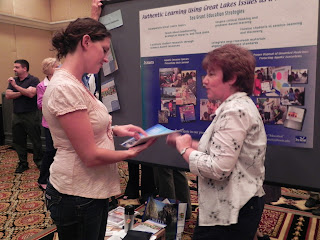 The Paul A. Funk Recognition Award provides a personal award to the winner as well as funds for their department to use in support of their work benefiting natural resources and human environmental systems.
This year, Illinois-Indiana Sea Grant’s Robin Goettel won the award for her extensive educational outreach work, including the creation of numerous curricula for science teachers and others. In particular, the Fresh and Salt curriculum, the Greatest of the Great Lakes collection of model lessons, and The Medicine Chest have helped to inform, engage, and education over 100,000 students about environmental science related to the Great Lakes.
Robin isn’t afraid to get totally immersed in her environmental education work either, as this excerpt from her nomination proves:
“No description of Robin would be complete without a mention of Zelda the zebra mussel, a ‘spokesmussel,’ as Robin describes her. Zelda is a costume that Robin is not afraid to pull out at public events. While maybe not quite ready for Disneyworld, Zelda draws a crowd. People start with a laugh, are compelled to ask questions, and end up with a better understanding of invasive species for the unconventional approach.”
Those examples don’t begin to touch on the work that Robin has engaged in throughout her many years with the program–from direct engagement with students of all grade levels, to educational displays at some of the Midwest’s biggest events, to forging partnerships with other environmental organizations to better educate, inform, and engage people in protecting and preserving natural resources.

Robin’s many years of work on environmental issues, and her dedication to fostering ever higher levels of science education for students of all ages, make her a terrific and very deserving choice for this award.
January 24th, 2013 by Irene Miles
Phragmites Australis, also know as the Common Reed, is a wetland plant that is not native to the Great Lakes. The invasive plant grows and spreads rapidly in the wetlands around the Lakes, and as a result can crowd out native plants that are beneficial to the local ecosystems.
Researchers at Michigan Tech are working on mapping the spread of the plant, though, in an effort to better understand its spread and plan for managing and reducing it.
From Upper Peninsula’s Second Wave:
“The common reed, or phragmites australis, isn’t native to the Great Lakes, but grows quickly in our climate conditions into large, tall stands that can threaten wetlands habitat.
The plant hasn’t been studied very much, or mapped, which was the goal of the Tech scientists, in cooperation with the U.S. Geological Survey, Boston College and the U.S. Fish and Wildlife Service. Together, teams first mapped the U.S. coastlines of all five Great Lakes using satellites.
Then, they did field studies along the coastlines to confirm the satellite findings, and plot the locations of large stands of the reed, in a first-of-its-kind map.”
Read more about the map at the link above and in the article at Science Daily.
December 19th, 2012 by Irene Miles
Activities associated with the purchase, sale, and use of commercially available organisms or “organisms-in-trade” can potentially result in the introduction of aquatic invasive species (AIS) to waterways such as the Great Lakes. Preventing these introductions is a much more cost-effective way to protect waterways, as opposed to the cost and effort involved in controlling or managing them once they become established.
Building on a University of Notre Dame-led project to examine the environmental risks posed by certain “organisms in trade” (OIT), Illinois-Indiana Sea Grant has been awarded grant funding through the Great Lakes Restoration Initiative (GLRI) for a project titled “GLSGN OIT Initiative – Expanding Risk Assessment Outreach.”
By creating an opportunity to remove these potentially invasive species from circulation, risk assessment is one way to prevent non-native species from becoming invasive. Risk assessment information is also important to AIS education, because studies have shown that education and outreach encourage and shape the behavioral changes necessary for preventing species introduction. For example, horticulturists decided against purchasing a given species once they learned it had the potential to become an invasive species.
This new GLRI grant provides for the creation of new risk assessment and OIT outreach tools including webinars, a training video, non-technical summaries of state laws and regulations, and publications for people involved with fish, reptile, and amphibian commerce. Development of these tools will be guided by a survey that assesses the needs and preferences of OIT user groups. The goal of all these efforts is to reduce the introduction of potentially invasive species, thereby helping to protect and preserve waterways from invasive threats.
This initiative, a collaboration among the Great Lakes Sea Grant Network, North Carolina State University (NCSU), the National Sea Grant Law Center at the University of Mississippi School of Law (NSGLC), and IISG, will also help educate and inform the public about alternatives to high-risk aquarium, water garden, bait, live food, and classroom species.
For more information, visit our webpage about aquatic invasive species.
November 30th, 2012 by Irene Miles
Communicating with people far and wide about the importance of the Great Lakes and the work that we do to ensure safe, healthy, and vibrant economies and ecosystems around Lake Michigan is one of our most important jobs. By informing and involving more people in our efforts, we can continue working to keep the Great Lakes great.
The latest addition to our effort is the Wikipedia entry for Illinois-Indiana Sea Grant. The IISG Wikipedia page is an important piece of our overall communications because it provides an encyclopedic explanation of IISG as well as references and links to additional information.
The page that you are visiting right now, our Newsroom, is another way to communicate with our audience, and to share timely information about workshops, seminars, fellowships, community projects and events, and more. And of course our Facebook page allow us to offer even more immediate interaction with individuals and organizations that care about the lakes.
Feel free to share our pages and help us spread the word about what makes Lake Michigan, and all of the Great Lakes, just so great, and how together we can keep them that way.
November 28th, 2012 by Irene Miles
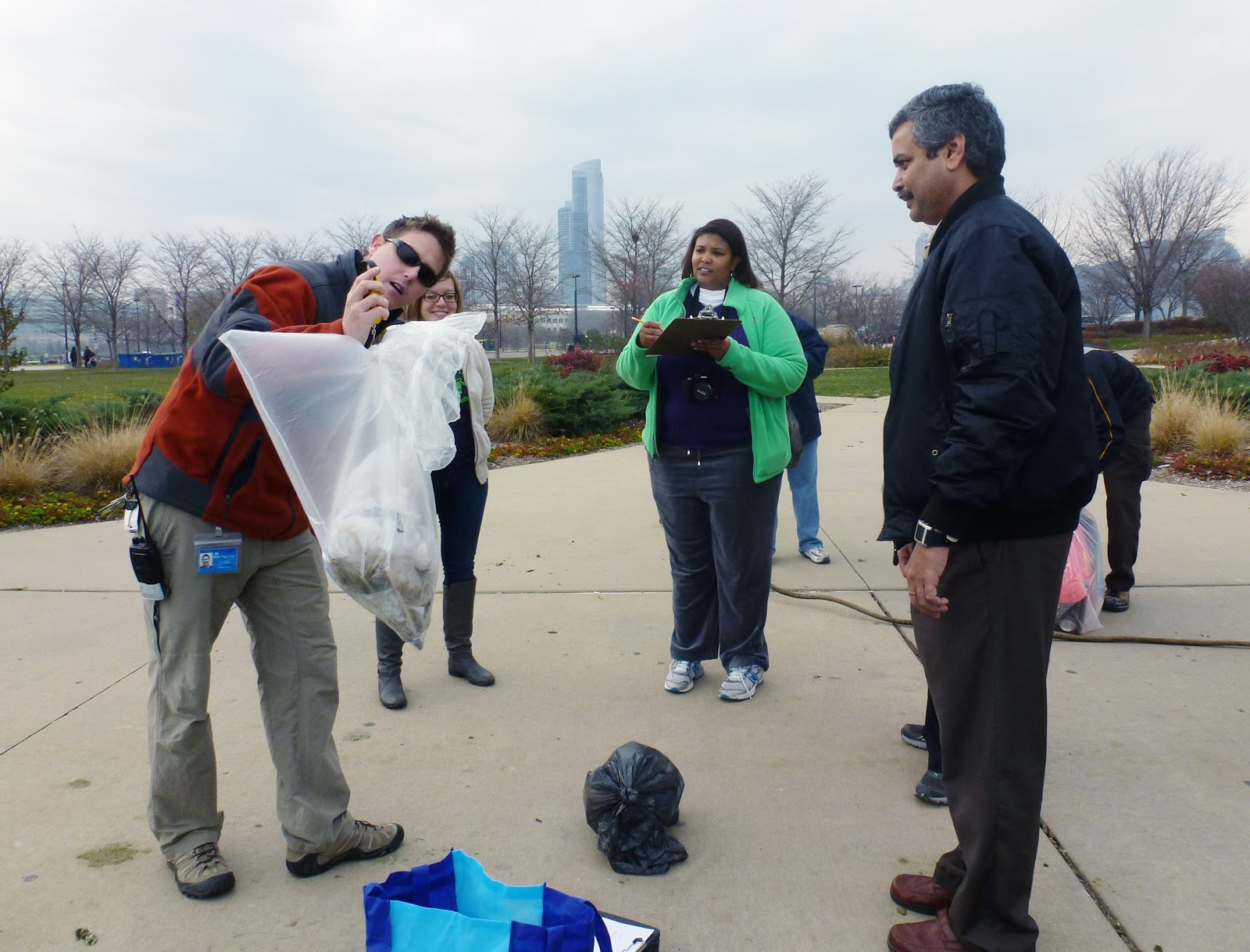
Educators from Illinois, Indiana, and Wisconsin attended IISG’s workshop Nov. 9-10 to increase the presence of Great Lakes science in their classrooms and to improve student awareness of issues related to the Lakes.
Illinois-Indiana Sea Grant partnered with Chicago’s Shedd Aquarium and the National Park Service Great Lakes Research and Education Center and the Dunes Learning Center to host the workshops, which provided opportunities for teachers to engage in science and math data collection and hands-on field work. Educators previewed Sea Grant’s Greatest of the Great Lakes and Fresh and Salt curricula to familiarize themselves with the diverse range of learning formats to enhance their science, math, and engineering units, as well as activities from Great Lakes in My World by the Alliance for the Great Lakes. Also, as part of the new Center for Great Lakes Literacy, workshop attendees learned how to help protect and restore coastal areas in the Lake Michigan watershed through a variety of teaching methods.
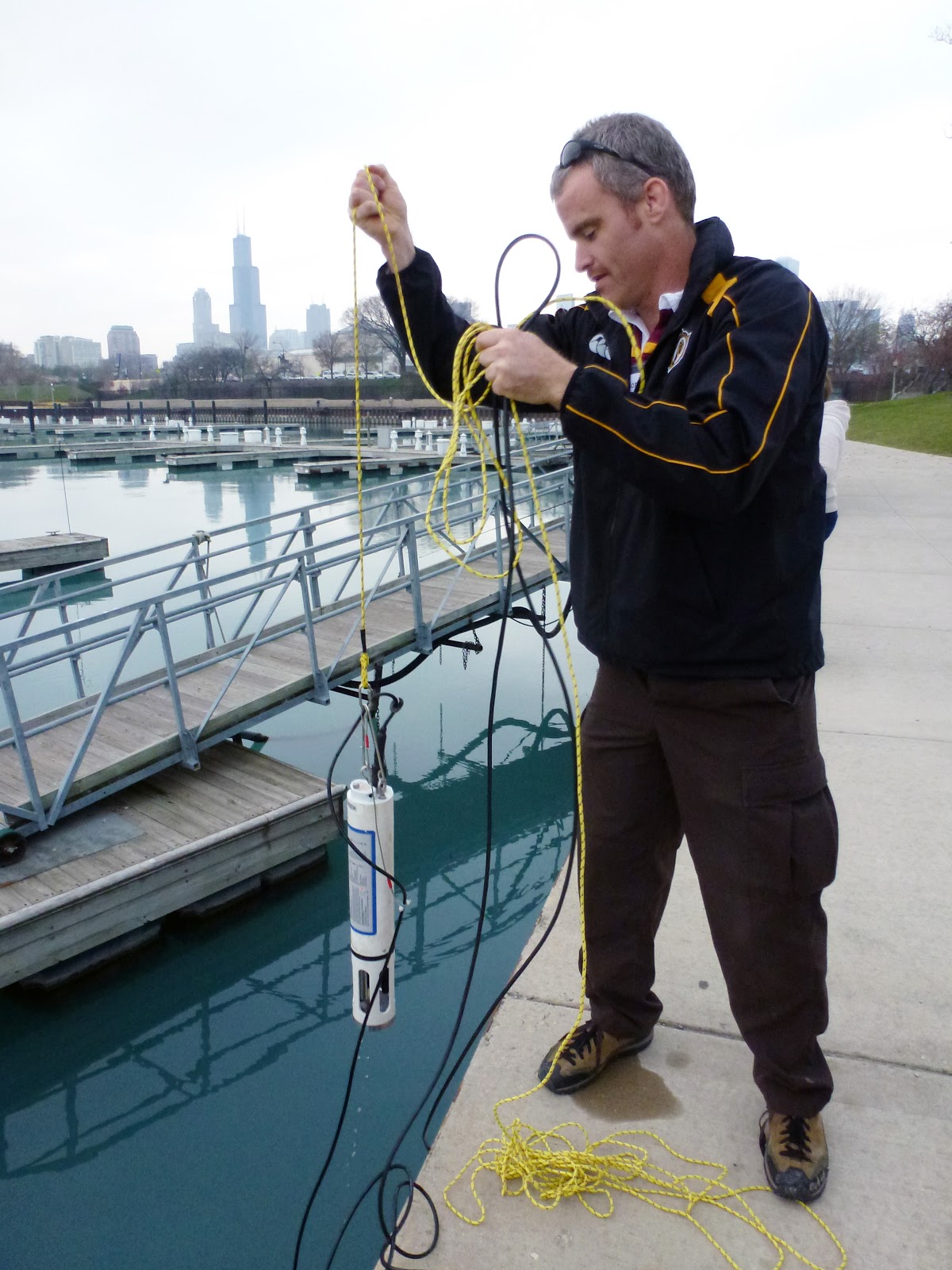
All of the teachers who attended this year’s workshop were excited to learn about programs like the Alliance for the Great Lakes’ Adopt-a-Beach, as well as the many exciting student stewardship activities offered by the Shedd Aquarium, the Dunes Learning Center, and the Indiana Dunes National Lakeshore botanists. They also enjoyed the hands-on activities, including using the Enviroscape model to learn about point source/non-point source pollution, and learning how to use GLNPO’s Hydrolab water quality monitoring instrument.
The feedback and comments from teachers was especially positive. Said one attendee, “You’ve given me great ideas about water quality, drinking water, invasive and noninvasive species, habitat restoration, and stewardship projects I can provide for my kids to become ‘Great Lakes literate.’”
To learn more about IISG’s educational programs and resources, visit our education webpage, and follow us on Facebook for more events, workshops, and information.
This Center for Great Lakes Literacy project was funded through a grant from the U.S. EPA Great Lakes National Program Office.