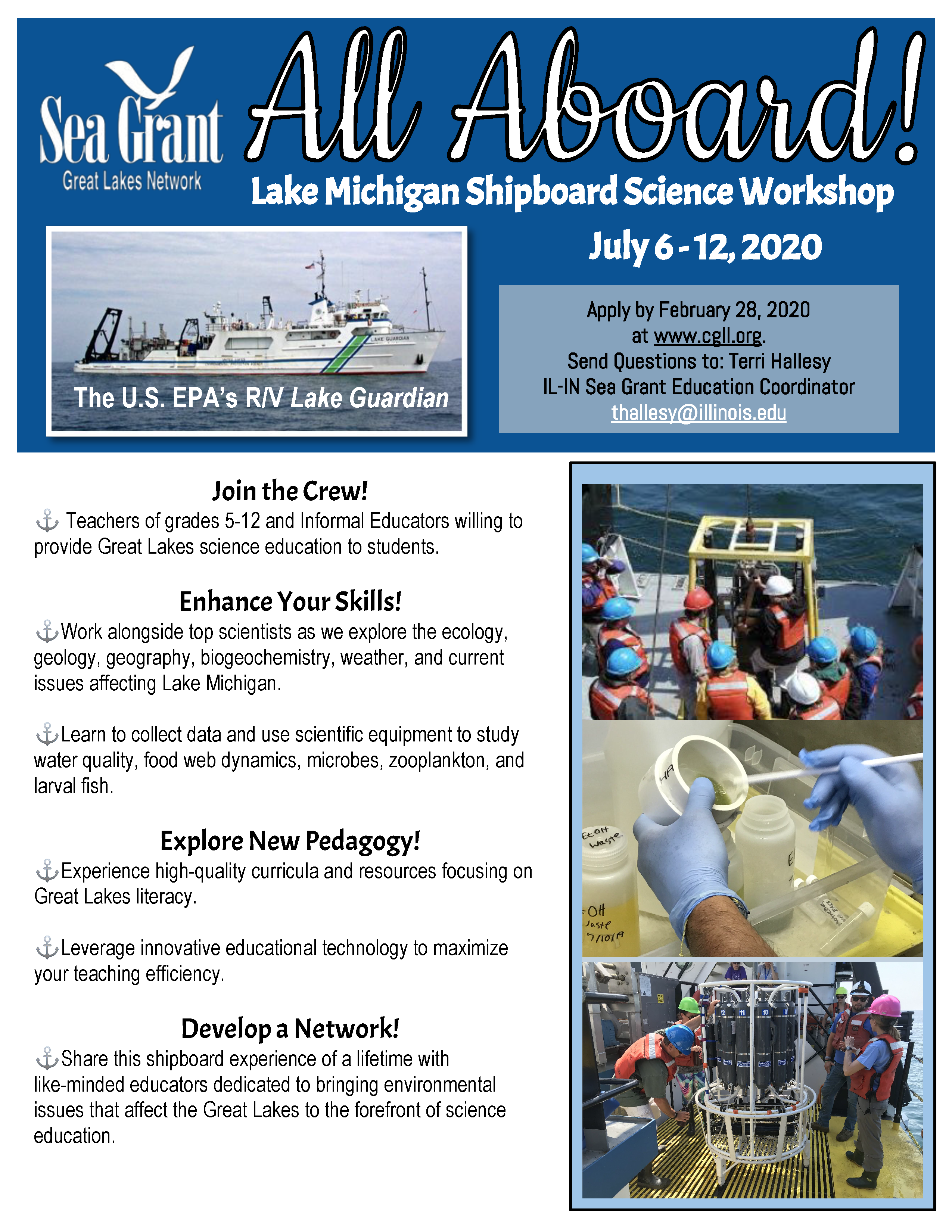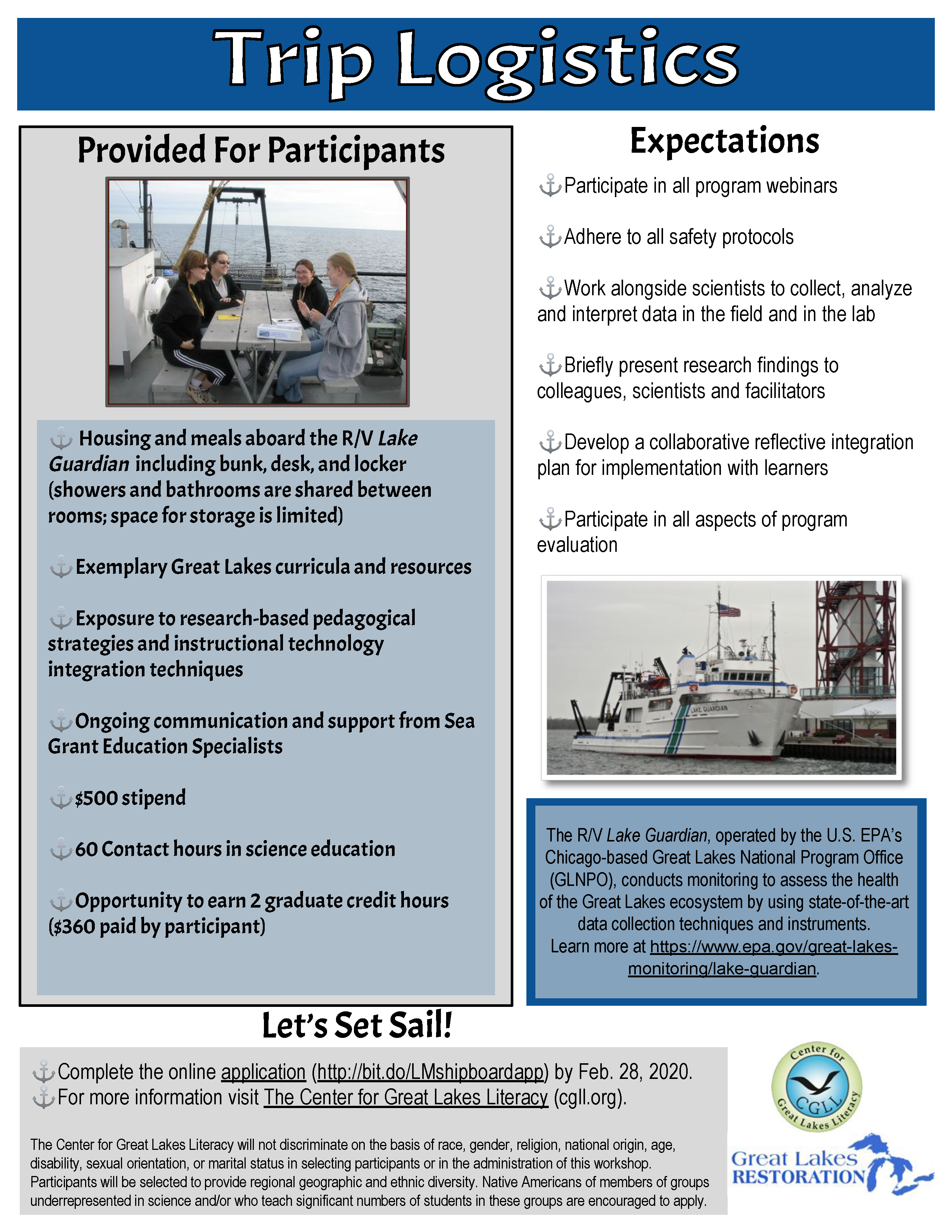
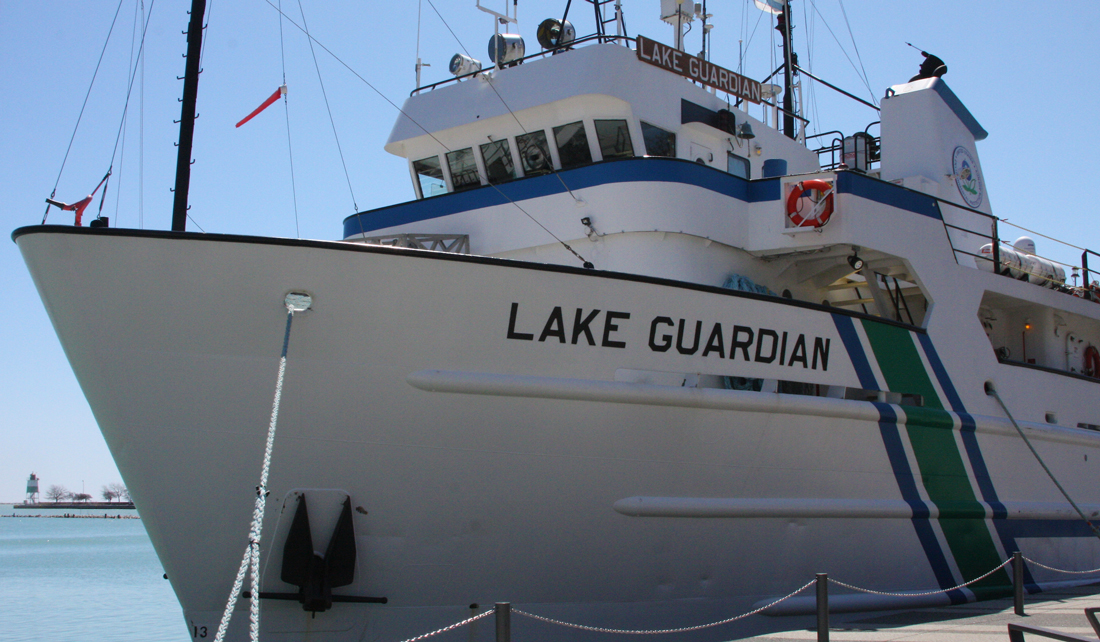
US EPA research vessel, Lake Guardian
The Center for Great Lakes Literacy and Great Lakes Sea Grant Network invite teachers (working with students in grades 5-12) and informal educators with a Great Lakes focus to apply for a spot on this unique, expenses-paid, educators’ cruise. Applicants must reside in a Great Lakes state. Applications are due February 28, 2020.
 

Join us for a week-long professional learning opportunity, working side-by-side with scientists on the 180-foot research vessel Lake Guardian. Participants board the ship on July 6, 2020 in Milwaukee, WI and return to Milwaukee on July 12, 2020.

  • Work alongside top scientists as we explore the ecology, geology, geography, biogeochemistry, weather, and current issues affecting Lake Michigan. 
  • Learn to collect data and use scientific equipment to study water quality, food web dynamics, microbes, zooplankton, and larval fish.
  • Experience high-quality curricula and resources focusing on Great Lakes literacy.
  • Share this shipboard experience of a lifetime with like-minded educators dedicated to bringing environmental issues that affect the Great Lakes to the forefront of science education.
  • Earn a stipend and 60 contact hours (if interested, two graduate semester hours from Ashland University [$360 tuition] can be purchased by the participant).

Interested? Check out the research vessel,and past blogs.

Meet two of the scientists leading the experience: Paris Collingsworth and Maureen Coleman.

Workshop Details

Registration/Application Deadline: February 28, 2020

Event Dates: July 6 – 12, 2020

Event Location: Lake Michigan (departing from and returning to Milwaukee, WI)

Applicants: Grades 5 – 12 classroom teachers and informal educators, must reside in a Great Lakes state

For More Information: Contact Terri Hallesy (thallesy@illinois.edu) or Joan Cox (jesarey@illinois.edu)

Application Materials

Personal Statement

Letter of Recommendation

Online application

flyer with more workshop info, including trip logistics. Contact Terri Hallesy at thallesy@illinois.edu for details

flyer with more workshop info, including trip logistics. Contact Terri Hallesy at thallesy@illinois.edu for details


Illinois-Indiana Sea Grant is a part of University of Illinois Extension and Purdue Extension.
IISG Instagram

Find us at Chicago Comic & Entertainment Expo, March 27–29! We’re linking Subnautica with Great Lakes science through fun, hands‑on activities about food webs, invasive species, and aquaponics.Come geek out with us! 🔗 in bio for event info
Coastal protection is not limited to concrete, rocks, and steel. Coastal protection solutions exist on a spectrum, ranging from softer “green” solutions to harder “gray” structures.Nature-based coastal solutions fall between green and gray techniques, providing multiple benefits to people and habitats.Our three-part video series, Nature-Based Coastal Solutions in the Great Lakes, is now available to watch. Learn how nature-based coastal solutions, including nature-driven and hybrid approaches, can protect shorelines while supporting ecosystems and communities.Watch the 3-part video series at the link in bio.(Photo credit: Liz Spitzer, Illinois State Geological Survey, Coastal Research Group)
Managers and researchers can be faced with a need to classify the risk of new crayfish invaders. Rapid assessment tools, such as the Science-based Tools for Assessing Invasion Risk (STAIR), can assist in this process by providing a streamlined framework for analysis and decision-making.Join us for an ICC webinar with John Bieber from Loyola University Chicago to learn how rapid assessment tools are used to classify invasive species risk and how STAIR can support invasive crayfish management.Learn more at the link in bio.