Illinois Indiana Sea Grant is pleased to announce that four middle and high school science educators—three from Illinois and one from Indiana—have been invited to join the Shipboard Science Immersion, where they’ll join the Center for Great Lakes Literacy (CGLL) team and Great Lakes scientists to work aboard an EPA research vessel July 7–13, 2025.
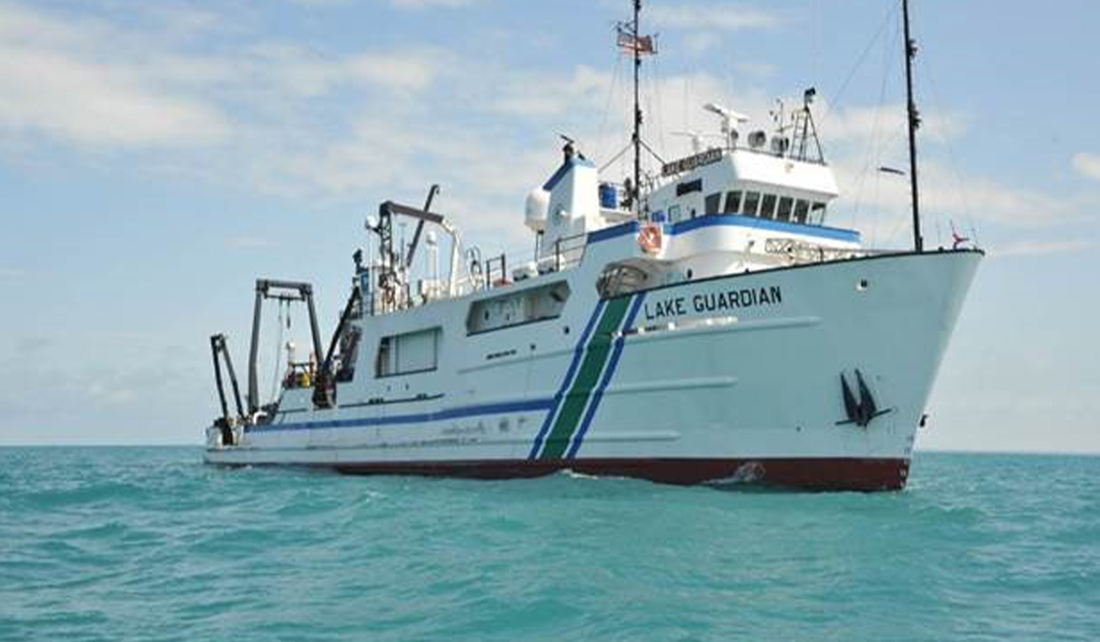
Through a partnership with the EPA Great Lakes National Program Office and NOAA, and with funding from the Great Lakes Restoration Initiative, the educators will spend a full week alongside researchers aboard the EPA R/V Lake Guardian. Afterwards, they will bring Great Lakes science back to their classrooms.
The Illinois and Indiana-based educators are:
- Gerard Kovach is a science teacher at Decatur Classical School in Chicago. Kovach, who was recently named Educator of the Year by Friends of the Chicago River, leads middle school students in ongoing ecological research tied to local waterways, including the Chicago River and Lake Michigan.
- Ryan Johnson is a 7–8 grade science teacher at Jovita Idár Elementary School in Chicago where he incorporates hydroponics, aquaponic and community-based environmental action projects into his curriculum.
- Amy Truemper is a 7–8 grade science teacher at Bednarcik Junior High School in Oswego, Illinois. Truemper leads her school’s award-winning environmental club, coordinates water quality testing along the Fox River and incorporates programs like Trout in the Classroom and Shedd Aquarium’s stewardship partnerships into her curriculum.
- Eric Parr is a 10-12 grade earth and space science teacher at Pike High School in Indianapolis, Indiana. Parr engages students in hands-on water quality testing and ecological studies at the school’s outdoor lab. He also supports astronomy instruction through the school’s planetarium and recently led a NASA-supported solar telescope project during the 2024 eclipse.
Overall, fifteen educators from across the Great Lakes were selected to work aboard the Lake Guardian. The Shipboard Science Immersion promotes Great Lakes sciences while forging lasting relationships between researchers and educators in the region. Hosts for the Lake Michigan expedition are CGLL partners Illinois-Indiana Sea Grant and Wisconsin Sea Grant.
CGLL is a collaborative effort led by Great Lakes Sea Grant program educators. CGLL fosters informed and responsible decisions that advance basin-wide stewardship by providing hands-on experiences, educational resources and networking opportunities promoting Great Lakes literacy among an engaged community of educators, scientists and youth.
For more information on the 2025 Shipboard Science Immersion visit the Center for Great Lakes Literacy website.