
Posted May 23rd, 2012 in Great Lakes Cleanup, Healthy Waters
Community members, stakeholders, and several agencies have been involved in an extensive cleanup project in Muskegon Lake for the last few years, and just this month they celebrated the project’s completion.
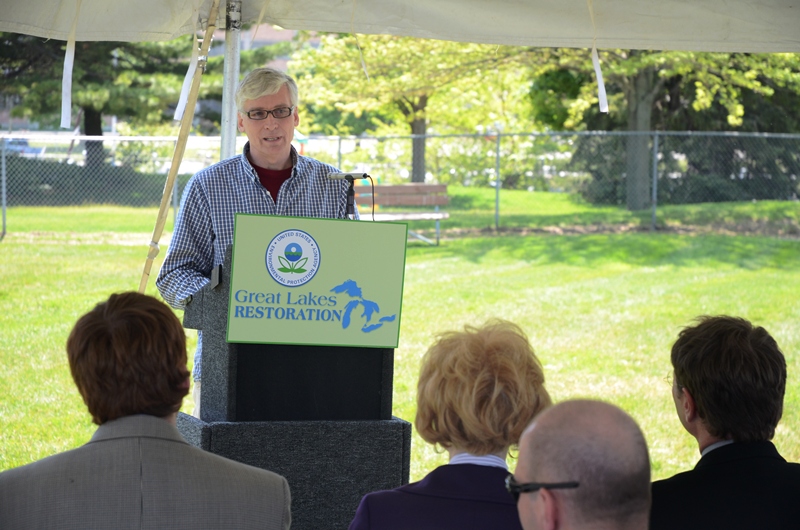 The Great Lakes Legacy Act project began with the development of a master plan and secured funding, with the goal of cleaning and restoring the lake’s natural habitats. By doing so, fish and wildlife populations can be restored, and the lake will be cleaner and safer for recreational use as well.
 Caitie McCoy, Illinois-Indiana Sea Grant’s environmental social scientist, has been heavily involved in several remediation and community outreach projects, including outreach for the EPA during the entire Muskegon Lake cleanup and restoration.
Caitie wrote to update us on the great progress that they’ve made restoring the lake. “The project removed 43,000 cubic yards of sediment contaminated with polynuclear aromatic hydrocarbons (PAHs) and mercury from Muskegon Lake, which flows into Lake Michigan. It also included habitat restoration in the area.”
Muskegon Lake is one of several designated “Areas of Concern” that the International Joint Commission identified for cleanup and restoration. Funding for the project was provided by the EPA and the Michigan Department of Environmental Quality, with efforts and support from Illinois-Indiana Sea Grant and the Muskegon Lake Watershed Partnership.
Caitie was onsite for the project completion, and worked with John Karl from Wisconsin Sea Grant to compile video footage. That footage will be part of a video being produced about Great Lakes Legacy Act cleanup projects including Muskegon Lake. Check back here to the blog later this year when we’ll have the video posted.
(Pictured above is Dennis Kirksey of Muskegon Lake Watershed Partnership, a landowner in the area who played a large role in helping the project reach completion.)