A closer look at web tools and sites that boost research and empower Great Lakes communities to secure a healthy environment and economy.
.png) Aquaculture plays an increasingly vital role in securing long-term food supplies, and the Midwest is poised to help. In fact, a rich supply of raw materials and proximity to large markets makes Illinois and Indiana prime locations for aquaculture farms and related industries.
Aquaculture plays an increasingly vital role in securing long-term food supplies, and the Midwest is poised to help. In fact, a rich supply of raw materials and proximity to large markets makes Illinois and Indiana prime locations for aquaculture farms and related industries.
To help producers cash in on these benefits, IISG, University of Illinois Extension, and Purdue Extension teamed up to create Aquaculture Economics and Marketing Resources. The site provides leading research and how-to information for developing a productive, innovative, and profitable aquaculture business.
Visitors interested in starting a new business will find resources on everything from establishing an organizational structure to creating a business plan to securing financing. New and veteran producers can also find tips for connecting with consumers and tapping into niche markets.
Aquaculture Economics and Marketing Resources is one of several tools IISG uses to help aquaculture producers define markets and create value-added opportunities for their products. Since 2005, Kwamena Quagrainie has held roughly 40 workshops with over 1,200 participants. These and other efforts in Indiana resulted in about $15 million in farm sales of aquaculture products in 2013, a nearly five-fold increase over 2005.
To learn more about how aquaculture is strengthening Indiana’s economy, read our 2013 program impacts.
 Sea Grant Illinois-Indiana
Category:
Website of the week: The ABCs of fish farming
January 21st, 2015 by iisg_superadminKnauss Fellowship takes Katherine Touzinsky around the world
January 15th, 2015 by iisg_superadminAs the 2014 Knauss season wraps up, IISG-sponsored graduate student Katherine Touzinsky wrote in to update us on her work at the U.S. Army Corps of Engineers since we last heard from her in August.
 The fellowship is now coming to a close, and the tides are changing at work. The open-ended learning ended a few months ago when I committed the majority of my time to a new and exciting project with the U.S. Army Corps of Engineers.
 Ever since the devastation of 2011, when over 14 weather and climate-related events—Hurricane Sandy being the most noteworthy—resulted in an unprecedented loss of lives and property, many federal agencies have begun their own investigation of climate change and disaster preparedness under the broad headline of “resilience.”
Website of the week: A one-stop-shop for Great Lakes educators
January 14th, 2015 by iisg_superadminA closer look at web tools and sites that boost research and empower Great Lakes communities to secure a healthy environment and economy.
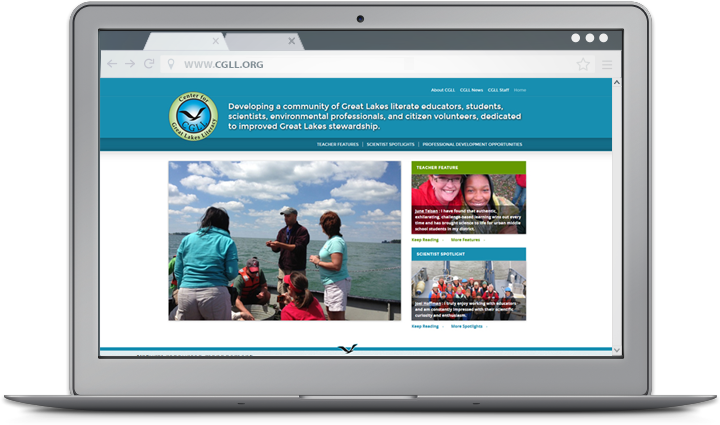.png) Educators interested in strengthening aquatic science programs and encouraging Great Lakes stewardship—look no further than the new Center for Great Lakes Literacy (CGLL) website.
Educators interested in strengthening aquatic science programs and encouraging Great Lakes stewardship—look no further than the new Center for Great Lakes Literacy (CGLL) website.
Created by Sea Grant educators throughout the region, the site is a one-stop-shop for classroom activities designed to boost Great Lakes literacy. Educators will find information on and links to teacher-tested curriculum like Fresh and Salt and Estuaries 101. And the Teacher Feature allows visitors to hear about education success stories directly from colleagues across the region.
Visitors to the site can also learn about the latest professional development opportunities available throughout the region. For example, teachers interested in the annual Shipboard Science Workshop, held this year on Lake Michigan, can find workshop information and application deadlines. Featured blogs also make it possible to read about teacher experiences at past CGLL workshops and follow along with the latest projects.
For more information on upcoming educator workshops and available curriculum, contact Terri Hallesy.
Wisconsin teachers make the most of Sea Grant aquatic education opportunities
January 13th, 2015 by iisg_superadminReal-world, hands-on activities are bringing Great Lakes science alive for a group of Wisconsin middle school students. Our friends at Wisconsin Sea Grant have the story.
.jpg)
Two Wisconsin teachers have made exceptional use of the educational resources that Sea Grant has to offer. And not just resources from Wisconsin Sea Grant—the teachers have found valuable support from the Center for Great Lakes Literacy, a collaborative effort by educators in the Great Lakes Sea Grant Network funded through the Great Lakes Restoration Initiative.
The teachers are Lynn Kurth and Cindy Byers. Kurth works as a science teacher for Prairie River Middle School in Merrill, Wis. Just a 50-minute drive away, Byers works as a science and reading teacher for Rosholt Middle School in Rosholt, Wis.
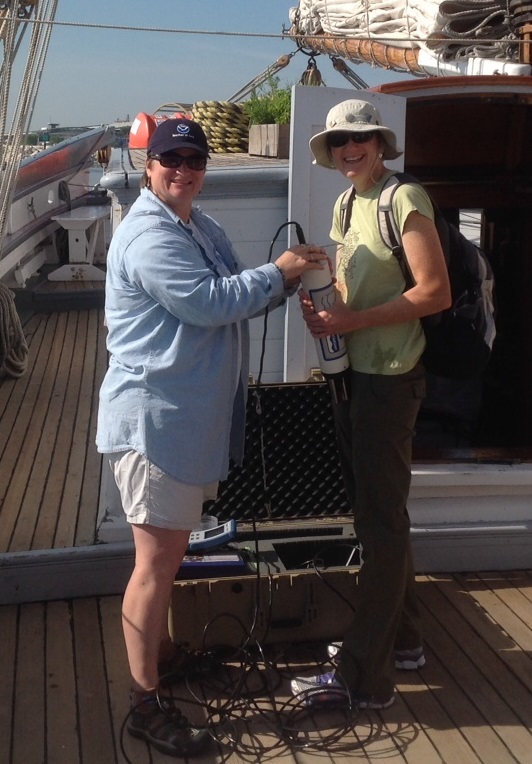
They met in 2011 during a week-long voyage on the Lake Guardian, a research vessel owned by the U.S. Environmental Protection Agency (EPA). They were participating in a Shipboard and Shoreline Science Workshop, a program conducted by the Great Lakes Sea Grant programs through the former Centers for Ocean Sciences Education Excellence (which has become the Center for Great Lakes Literacy). They were part of a team of five colleagues who worked on a research project together. Kurth and Byers bonded over a Hydrolab—a large, tubular piece of water testing equipment—and it’s led to bigger and better things for both them, their students, and other teachers across the country.
The Hydrolab takes various water quality readings. Kurth and Byers were drawn to it because both of their schools are near rivers and the EPA was providing the device on loan for use with their classrooms after the cruise. They saw the opportunity to partner in the future.
It worked. “We supported each other’s teaching and enriched each other’s classrooms by having this collaboration,” Byers said. “We had the kids Skype with each other a couple of times and present the Hydrolab data they collected. Even though our schools are not that far apart, it seemed quite exotic to the kids and they were excited to use a piece of equipment that scientists use. A lot of the reasons we’ve been able to do so much with the program is that we’ve been supporting each other all along.”nce-in-a-lifetime learning experiences for students. In fact, 26 classes across the Great Lakes region took a break from their regular activities over the last year to video chat with the scientists behind the EPA Lake Guardian‘s annual monitoring cruises. Some students even took a guided virtual tour of the boat.
And now a new group of teachers and non-formal educators have an opportunity to work with Sea Grant specialists to introduce activities like these into their aquatic sciences sections during the 2015 Shipboard Science Workshop on Lake Michigan. Applications for the 15 available spaces are due February 10.
Sara Paver looks back on her experiences as a Knauss Fellow
January 8th, 2015 by iisg_superadminThe last few months have been a whirlwind of activity. In my placement as a Knauss Fellow in the Division of Ocean Sciences at the National Science Foundation, I have continued working with the Coastal Science, Engineering, and Education for Sustainability (Coastal SEES) working group and the Biological Oceanography Program. I am currently leading the efforts of the working group to organize and plan the Coastal SEES Principal Investigators’ Meeting, which will be held January 29-30, 2015. I am looking forward to meeting the 2013 and 2014 Coastal SEES awardees and hearing about the exciting work they are doing to make progress on coastal sustainability issues.

In addition to the work I’ve been doing at NSF headquarters in Arlington, VA, I have had the opportunity to participate in valuable professional development opportunities. I presented my dissertation research at the International Society for Microbial Ecology meeting in Seoul, South Korea. I also participated in the Explorations in Data Analyses for Metagenomic Advances in Microbial Ecology Workshop at Kellogg Biological Station in Hickory Corners, MI. Ashley Shade, Tracy Teal, and Josh Herr put together an excellent week of learning modules, lectures, and guest speakers. My favorite highlight—out of many—was the question and answer session we had with Jim Tiedje.
11 ways that IISG had a note-worthy year!
December 19th, 2014 by iisg_superadmin 2014 has been an exciting year for IISG. New partnerships were forged, major projects were launched, and existing programs continued to grow. As we head towards another new year, let’s take a look back at some of the highlights of the last 12 months.
–More than $300,000 was awarded to three research projects that will improve understanding of the Lake Michigan nearshore food web, uncover connections between sediment removal projects and a community’s ability to weather environmental hazards, and identify why people adopt stormwater management practices.
–The Great Lakes Social Science Network gave researchers, natural resource managers, weather forecasters, and educators the information they need to ensure safety and planning messages meet the needs of local communities.
–Illinois Governor Pat Quinn announced a $1.1 million investment in Blue Island to expand and improve stormwater management efforts that began in partnership with IISG.
–Great Lakes Monitoring made it possible for researchers to analyze decades of high-quality monitoring data from across the region in minutes.
–Illinois EPA and the state Department of Agriculture released a plan to reduce the nutrient pollution behind the Gulf ‘Dead Zone.’
A big thanks to all of the partners and collaborates that made these and other 2014 successes possible!
Keeping drinking water safe still presents challenges
December 18th, 2014 by iisg_superadmin.jpg)
One of the largest challenges lies in the system itself. Much of our drinking water infrastructure is more than a century old and in desperate need of repair. Leaky pipes and broken water mains cost the country around 6 billion gallons of water every day—roughly 16 percent of our daily use. In the Great Lakes region alone, the annual water loss is enough to supply 1.9 million Americans with safe drinking water for a year.
Fortunately, while public water systems and communities continue to grapple with these and other challenges at a larger scale, there is a lot individuals can do day-to-day. For example, properly disposing of unwanted medicine can help keep pharmaceutical chemicals out of waterways and drinking supplies. Homeowners and gardeners can also adopt natural lawn care practices that reduce water usage and prevent landscape chemicals from washing into nearby rivers and lakes. Even simple practices like washing your car with a bucket and sponge or waiting for a full load to start the washing machine can go a long way towards conserving water.
Visit EPA’s Conserving Water site for more information and tips.
Website of the week: Plan for the future with Sustainable Communities
December 17th, 2014 by iisg_superadmin
Visitors will find information on key Purdue University Extension programs and resources to support community planning. Enhancing the Value of Public Spaces, for example, provides a framework for collecting data on community assets and using that data to preserve and improve parks, town centers, and other public spaces. The program will also help community leaders charged with managing public spaces and implementing new projects build communities that are more resilient to economic and environmental changes. The process starts with a one-day workshop that helps participants identify best practices for improving public spaces. Collaborative activities emphasize forming partnerships to achieve community sustainability goals, and follow-up working group meetings facilitated by Purdue Extension provide the resources and technical support needed to plan and implement projects tailored to individual communities. Workshops can be scheduled now. The complete curriculum will be available for download in early 2015.
This day in history: Drinking water standards go national
December 16th, 2014 by iisg_superadmin.JPG) The tides began to turn on Dec. 16, 1974 when President Gerald Ford signed the Safe Drinking Water Act (SDWA) into law. One in a string of environmental legislation, the act set the stage for the first national health-based standards for drinking water.
The tides began to turn on Dec. 16, 1974 when President Gerald Ford signed the Safe Drinking Water Act (SDWA) into law. One in a string of environmental legislation, the act set the stage for the first national health-based standards for drinking water. Recent News
- Educators become students at Great Lakes Project WET workshop
- Registration now open for the 2026 State of Lake Michigan Meeting
- Indiana science teacher chosen to join Sea Grant aboard EPA’s research vessel on Lake Superior
- Illinois educators chosen to join Sea Grant aboard EPA’s research vessel on Lake Superior
- Illinois-Indiana Sea Grant seeks proposals for Seed Grant research projects in southern Lake Michigan
IISG Instagram
What does a career in natural resources look like?
This month, a group of 4-H youth joined us at Martell Forest to find out! From tree climbing and birding to creating scent traps and dissecting owl pellets, participants spent three days exploring the many ways people work with and protect our natural resources.
Thanks to everyone who joined us! We can’t wait to see where your adventures take you next!


What does it mean to be Great Lakes literate?
It’s understanding how the Great Lakes shape your life and how your choices impact the lakes.
To be Great Lakes literate is to understand, communicate, and care for these special freshwater resources. 💙
Learn more about Great Lakes Literacy by visiting the Center for Great Lakes Literacy’s website at the link in bio.
#TeachingTuesday

Happy Juneteenth from all of us at Illinois-Indiana Sea Grant!

Got a research idea for southern Lake Michigan?
IISG’s 2026 Seed Grant Research Competition is open. Up to $150,000 total funding for pilot studies that could become your next big project.
💵 $10,000 to $50,000 per project
⏰ Applications due August 17, 2026
Two info webinars coming up: July 2 and July 21.
🔗 Full details at the link in bio.

Categories
- Aquaculture
- Aquatic Invasive Species
- Buoys
- Climate Ready Communities
- Coastal Resilience
- Director's Blog
- Education
- Featured
- Fellowships
- Fisheries
- Funded Research
- Funding
- Great Lakes Cleanup
- Great Lakes Data
- Healthy Waters
- Internships
- Jobs
- K-12 Education
- News
- Photos
- Program
- Recreation & Tourism
- Resources
- Sea Grant Scholars
- Stormwater & Green Infrastructure
- Sustainable Community Planning
- The Helm
- Uncategorized
- Video
- Water Resource Economics