June 13th, 2014 by iisg_superadmin
The Illinois Clean Marina Program celebrated its one year anniversary last month by certifying DuSable Harbor as the newest clean marina—bringing the state total to six.
The harbors earned their clean marina status by implementing a series of best management practices that make marina operations more efficient and environmentally friendly. Practices cover a range of topics—everything from marina construction to vessel maintenance to waste handling. Most are easy and affordable, such as watering plants deeply but infrequently and encouraging boaters to share excess paint instead of storing or disposing of it improperly. Others help marina personnel educate and train boaters on what they can do to protect habitats and improve water quality.
In addition to outlining best practices, the guidebook provides important information on laws and permit programs, connects readers with additional resources, and includes clean boating tip sheets that can be distributed to boaters. Illinois DNR also provides training and support as marinas work their way through the certification processes.
Illinois is one of six states in the Great Lakes region with a volunteer program that empowers boaters and marina personnel to preserve habitats and prevent pollution. The Illinois program was developed by IDNR, CPD, IISG, and representatives from the marina industry. Funding for the program and guidebook comes from a Great Lakes Restoration Initiative grant.
June 12th, 2014 by iisg_superadmin
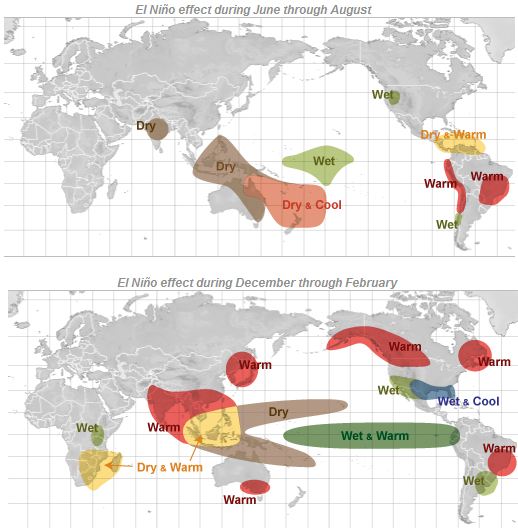
Summer and winter may look a little different this year. The National Weather Service Climate Prediction Center is reporting warmer temperatures in the Pacific Ocean along the equator, which could mean big things in the Midwest and around the world.
The global weather phenomenon is known as El Nino. It occurs every few years when a giant band of water in the tropical Pacific Ocean becomes unusually warm. This sets off a chain reaction of weather events that have historically resulted in severe droughts in portions of India, Southeast Asia, Australia, and South America. In contrast, El Nino often brings heavy rains to the West Coast.
The effects are a little milder in the Midwest, which is likely to see cooler summers and winters with less snowfall. Some parts of the region might even have better corn and soybean yields thanks to the milder temperatures.
El Nino events are difficult to predict, and there is no guarantee we will experience one this year. A recent advisory from the Climate Prediction Center, though, puts the chance of El Nino as high as 80 percent.
Keep an eye on the developing El Nino with weekly updates from the National Weather Service. And for more information on climate trends and changes in the Midwest, visit the Midwestern Regional Climate Center.
*Photo courtesy of the National Weather Service.
June 6th, 2014 by iisg_superadmin
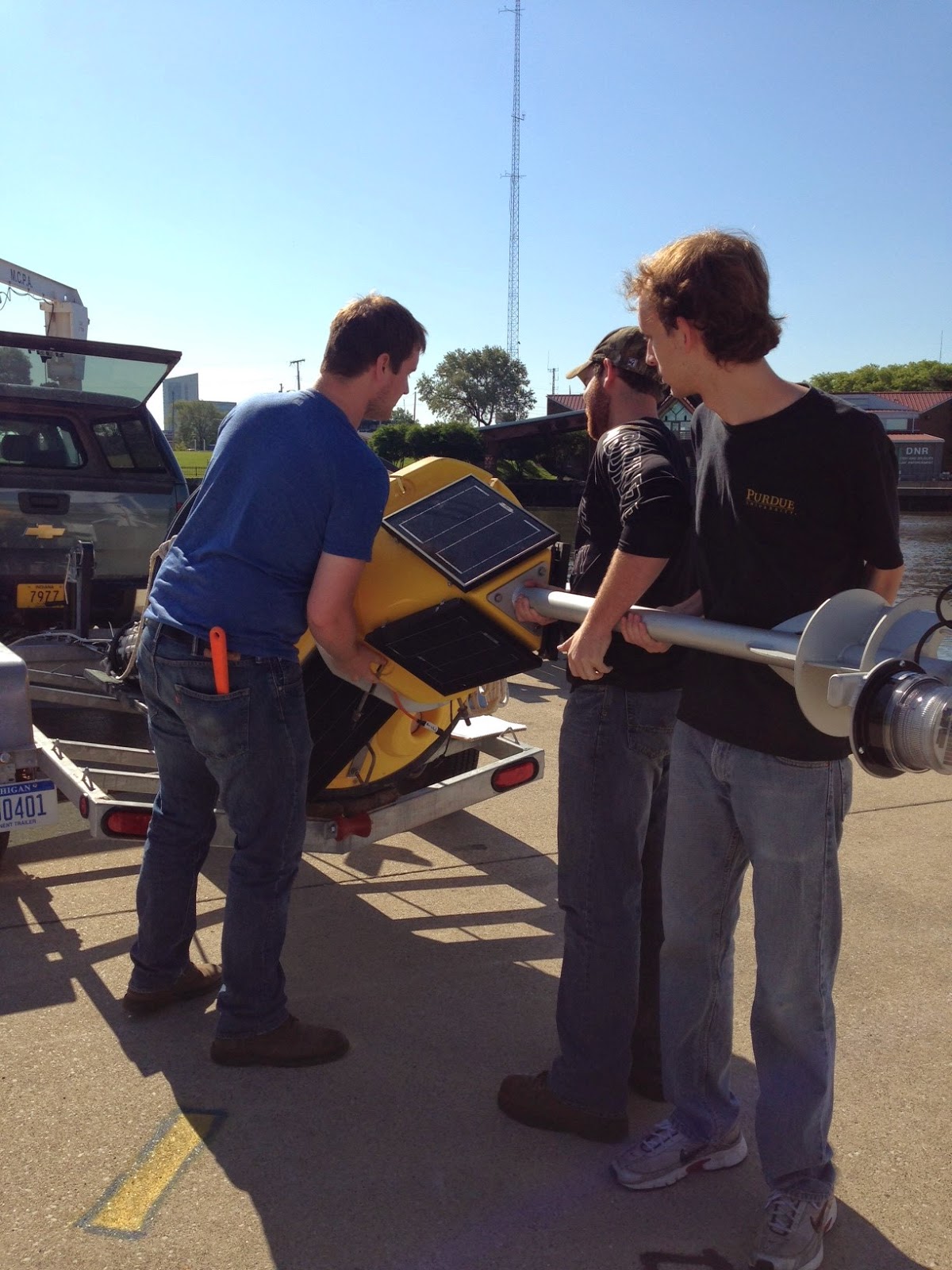
The Michigan City buoy returned to the nearshore waters of Lake Michigan on June 5—this time with an upgrade that boaters, anglers, and researchers have been eagerly awaiting. In addition to broadcasting real-time data on wave height and direction, wind speed, and air and surface water temperatures, the improved buoy now relays water temperatures at different depths.
The sensor chain, which measures water temperatures approximately every 3 ft. from the surface to the bottom of the lake, will help kayakers know when the water is warm enough to paddle out and make it easier for anglers to find and catch their favorite fish. A more comprehensive picture of nearshore water temperatures is also vital for research on fisheries and nearshore hydrodynamics.
“We’ve been getting a lot of positive feedback asking us when the buoy will be in the water again,” said Carolyn Foley, IISG assistant research coordinator. “And they’re all excited to hear that we’ve added a temperature chain to our setup. The nearest buoy with a similar chain is about 30 miles away.”
Real-time data will be available on IISG’s website until the buoy is pulled out for the winter in mid-October. The site currently shows snapshots of lake conditions—updated every 10 minutes—as well as trends over 24-hour and 5-day periods. Buoy-watchers can also download raw historical data at NOAA’s National Data Buoy Center.
Later this summer, IISG will be hosting a workshop designed to help educators develop science, math, and stewardship projects using the real-time buoy data. The workshop is scheduled for August 6 at Purdue University North Central.
June 5th, 2014 by iisg_superadmin
With the harsh winter behind us, things on the Great Lakes should be warming up for summer. But thanks in part to the harsh winter’s extensive ice cover, Lake Superior’s surface water temperature is predicted to be its lowest since 1979.
“In a follow-up to evaporation studies funded by the Great Lakes Integrated Sciences and Assessments Center, a federally funded collaboration between U-M and Michigan State University, Lenters and his colleagues developed a map-based water-temperature forecasting tool called SLATE, which stands for Seasonal Lake Temperature Energetics model.
The experimental model was used to generate the Lake Superior forecast and may later be used to create similar surface-water temperature forecasts for all five Great Lakes—possibly even evaporation forecasts. SLATE is believed to be the first map-based forecasting tool that shows anticipated variations in surface-water temperature from place to place across one of the Great Lakes.
The Lake Superior forecast is expected to be of interest to swimmers, boaters, anglers and others who will be affected by chilly water temperatures not seen since perhaps as far back as 1979.
‘If you’re planning to go swimming in Lake Superior this summer, you should probably stay close to shore,’ said Peter Blanken, a co-investigator from the University of Colorado.
The U.S. Coast Guard in Marquette has already expressed interest in using the Lake Superior forecast to help plan summer search-and-rescue operations. And a long-distance swimmer who is planning a trek from Milwaukee to Chicago in Lake Michigan this summer has also asked about water temperature forecasts.”
Read more about the temperature forecast as well as predictions about Lake Superior’s water levels at the link above.
June 4th, 2014 by iisg_superadmin
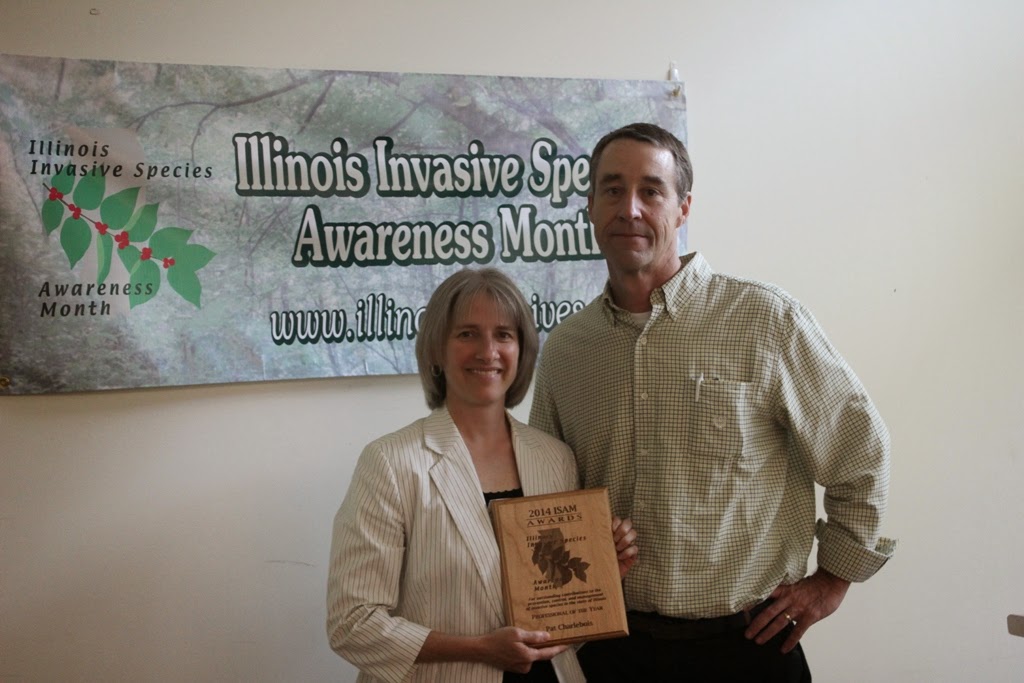
Illinois-Indiana Sea Grant’s Pat Charlebois was one of the professionals selected for this year’s ISAM awards. Recognizing outstanding invasive species work in the state of Illinois, the awards are an annual opportunity to highlight just some of the many important projects dedicated to protecting Illinois’ land and water from invasives.
“In 2011, the ISAM committee decided to initiate an awards program to formally recognize and honor outstanding contributions to the prevention, control, and management of invasive species in the state of Illinois. For 2014, The Illinois Invasive Species Awareness Month Committee would like to recognize recipients in five categories: Professional of the Year, Volunteer of the Year, Professional Organization of the Year, Business of the Year, and Educator of the Year. Recipients of the 2014 ISAM awards were officially recognized at an awards ceremony in Springfield at the Illinois Department of Natural Resources (IDNR) office. IDNR Office of Resource Conservation Director Jim Herkert was on hand to present the awards. The ceremony was part of the 2014 Illinois Invasive Species Symposium on May 29th, 2014 at the IDNR Office Building in Springfield, IL…
Pat is receiving this award for her leadership in aquatic invasive species education, outreach, messaging, and policy throughout the state. Pat’s hard work has contributed significantly to increasing the public’s awareness of aquatic invasive species. Through her efforts, the new ‘Be a Hero, Transport Zero’ campaign is being expanded towards a comprehensive campaign to address all invasive species spread throughout Illinois. In addition, Pat has been instrumental in supporting policy changes, such as the addition of 27 new aquatic plants to the Illinois Injurious Species list.”
Read about the other award recipients and their work protecting Illinois’ environment at the link above.
May 29th, 2014 by iisg_superadmin
The Illinois and Indiana Departments of Natural Resources, along with several other state, local, and federal agencies, are joining forces to coordinate a survey of Calumet Harbor and Lake Michigan waters. The efforts will help search for and combat aquatic invasive species.
“The exercise – including intensive netting and electro-fishing – will be the first of its kind utilizing provisions of the new Mutual Aid Agreement for Combating Aquatic Invasive Species, signed at the Council of Great Lakes Governors meeting on April 26 in Chicago…
Crews coordinated by the Illinois and Indiana Departments of Natural Resources are deploying boats on Chicago’s Calumet Harbor, and on adjoining waters of Lake Michigan on both sides of the Illinois-Indiana state line, for electro-fishing and netting to determine whether invasive Eurasian ruffe are present.
‘Aquatic invasive threats know no national or state boundaries. Our ability to sample fish communities, respond quickly, and effectively communicate on efforts could be critical in the future to respond to a threat within the Great Lakes basin,’ said Indiana DNR Aquatic Invasive Species Coordinator Eric Fischer.
Eurasian ruffe, an eastern European species of fish, have been found in Lake Superior since the mid-1980s, have a similar diet and feeding habits of native fish, and could present problems for the food web in Lake Michigan. Researchers detected environmental DNA of Eurasian ruffe in Calumet Harbor last year.”
Read the complete article at the link above.
May 21st, 2014 by iisg_superadmin
It has been nearly one year since IISG set sail on Lake Michigan to sample for plastic pollution. Since then, Sam Mason, a chemist from State University of New York Fredonia, and her research team have been hard at work analyzing those water samples. The initial results are revealed in the latest edition of IISG’s interview series UpClose.
In this issue, Mason talks about her ongoing work to quantify plastic pollution in the Great Lakes for the first time. In addition to the Lake Michigan results, Mason discusses plastic levels in the other four lakes, explains how plastics could impact aquatic wildlife, and suggests additional research needed to understand this emerging contaminant.
This is the sixth edition of UpClose, which takes readers behind the scenes of the latest research on pharmaceuticals and personal care products. Each interview targets a different component of PPCP research—everything from what happens to pharmaceuticals when water is treated to what bacterial resistance could mean for other aquatic wildlife living in urban rivers. Readers also get an insider’s view of the complex, and sometimes tricky, process of conducting field studies, and the potential implications of research on industries and regulations.
Read previous issues of UpClose at unwantedmeds.org. For print copies, contact Pollution Prevention Program Specialist Laura Kammin.
May 16th, 2014 by iisg_superadmin
 “IISG has been instrumental in providing financial assistance for take-back programs in Indiana,” said Scott Morgan, IHHWTF president. “Without this support, some of the programs may not have been established.”
The $1,000 gift will go to purchasing secure collection boxes for communities interested in creating permanent prescription disposal drop-off locations. These types of easy disposal locations help to prevent unused medicine from contaminating aquatic environments, protect children and pets from accidental poisonings, and reduce prescription or over-the-counter drug abuse.
IHHWTF has provided financial support to programs working to reduce household waste for several years. The task force works with private and public groups across Indiana to educate the public on the proper handling and disposal of a range of environmentally-harmful chemicals—from medicines to batteries to motor oil.
Communities interested in starting their own medicine take-back program can contact Laura Kammin with questions and for additional support.
May 14th, 2014 by iisg_superadmin
The National Weather Service’s Weather-Ready Nation initiative was begun to help communities throughout the country better prepare for and respond to severe weather events. Much of that preparedness has to do with increasing the speed, accuracy, and effectiveness of weather monitoring and warning mechanisms on the local level. And finding the strongest ways to communicate weather messages to residents is key.
That is why, as part of the Weather-Ready Nation project, the Great Lakes Social Science Network conducted extensive research into the most effective impact-based warnings. Their report, “Evaluation of the National Weather Service Impact-based Warning Tool,” utilized interviews, focus groups, and surveys to determine the most and least effective ways for broadcast meteorologists and emergency managers to communicate these warnings to the public.
National Weather Service piloted an impact-based warning system in 2012 in five select offices, and expanded it to the central region’s 38 offices in 2013. The report offers a sort of mid-term evaluation of the system’s effectiveness and stakeholders’ perceptions of it, while also providing recommendations for further training and implementation improvements.
This research was a team effort between representatives from five Great Lakes Sea Grant programs. Caitie McCoy and Leslie Dorworth from Illinois-Indiana Sea Grant were involved, as well as Dr. Jane Harrison (Wisconsin Sea Grant), Dr. Kathy Bunting-Howarth (New York Sea Grant), Hilarie Sorensen (Minnesota Sea Grant), Katie Williams (University of Wisconsin-Milwaukee), and Dr. Chris Ellis (NOAA Coastal Services Center). The report was presented earlier this year to the Social Coast Forum in Charleston, SC, sparking a number of other groups and agencies to inquire about the report and possible opportunities to expand on it with further research.
For further information about the Great Lakes Social Science Network, as well as training and future research projects, visit the link above.