February 25th, 2014 by iisg_superadmin
Much like a gardener hopes that their scattered seeds will eventually bloom into a lush garden, Illinois-Indiana Sea Grant awards seed grants to projects that address some of the biggest concerns in the Great Lakes in the hopes that the initiatives will grow into something larger. These Discovery Grant projects—totaling over 40 since 2009—cover a broad range of topics, and their results help natural resource managers and policy makers preserve Lake Michigan and strengthen nearby communities.
So, what are these projects exactly? We’re glad you asked. Discovery Grant Projects II shines a light on unexpected and emerging contaminants in stream water. Other featured projects examine the market for domestic seafood and give Hoosiers real-time access to fish consumption advisories. And another still paints a clearer picture of how Asian carp are changing the food web in the Illinois River.
Download the first edition, Discovery Grant Projects, to learn about past research on water quality, aquaculture, biodiversity, and more. And visit our Research page to read more about past projects and get a peek at ongoing research.
February 12th, 2014 by iisg_superadmin
Go To 2040—northeastern Illinois’ compressive development plan—received a 2013 National Award for Smart Growth Achievement earlier this month for its innovative approach to conserving natural resources, protecting public health, and strengthening local economies. Developed by the Chicago Metropolitan Agency for Planning (CMAP), the plan addresses transportation needs, energy efficiency, and other long-term concerns for the ever-growing metropolitan area.
Illinois-Indiana Sea Grant’s Margaret Schneeman and Martin Jaffe worked closely with CMAP to develop the water supply planning recommendations included in the regional plan. IISG has also taken the lead in implementing key recommendations such as full-cost water pricing and outdoor water conservation. And Molly Woloszyn, IISG’s extension climatologist, assisted in the development of climate adaptation recommendations for municipalities.
February 11th, 2014 by iisg_superadmin
Illinois river otters are just one of the susceptible organisms in the local environment, and a recent study is showing that they are indicating some very high levels of dangerous toxins (including a banned insecticide).
“‘Thus otters serve as biomonitors – organisms that contain information on the quantitative and qualitative aspects of the environment – of wildlife exposure,’ according to a new study. They also serve as biomonitors for human health because the same toxic chemicals found in otters have also been found in people who eat contaminated fish.
The study published in the journal ‘Ecotoxicology and Environmental Safety’ found high concentrations of chemical compounds in the livers of 23 otters in central Illinois.
Especially troubling were the highest concentrations of dieldrin ever reported in otters anywhere in the United States, said lead author Samantha Carpenter, a wildlife technical assistant at the University of Illinois, Urbana-Champaign.
Dieldrin is one of the organochlorine insecticides banned in 1978. More than three decades later, high levels of the chemicals remain in river sediments and accumulate in the fish that otters and people may eat.
The compound has been linked to neurological, behavioral and immune-suppression problems in wildlife. Scientific studies disagree on adverse human effects, but some studies have linked dieldrin to asthma, Parkinson’s disease, Alzheimer’s disease and breast cancer, Carpenter said.”
Read the complete article at the link above.
February 7th, 2014 by iisg_superadmin
From UnwantedMeds.org
Last week’s trip to Indianapolis for the annual Indiana Veterinary Medical Association conference was not a typical event for IISG. The three-day conference gave Laura Kammin a unique opportunity to talk with students before they begin their careers as veterinarians or veterinary technicians about the importance of properly disposing of unwanted medication.
“It’s becoming a rarity for me to chat with a veterinarian who doesn’t know about the environmental impacts of improper medicine disposal,” said Laura. “The next step for IISG is to make sure that students are aware of the need for proper storage and disposal.”
Many of the students were unfamiliar with the topic or the disposal options available in their communities. Laura introduced them to simple steps for managing pharmaceuticals in clinics and talked about how they can help spread the word about proper disposal to their future clients.
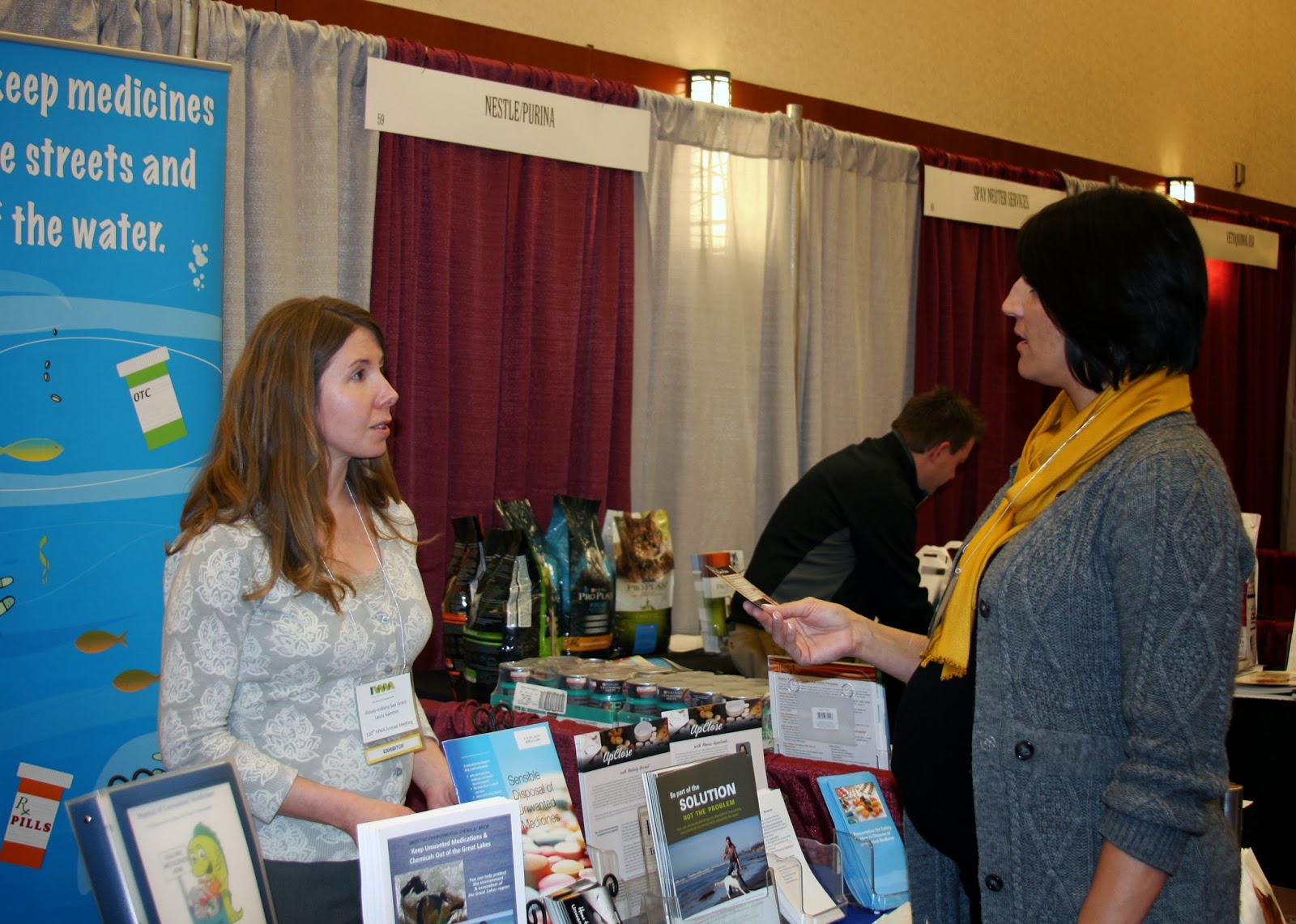 The event is one of several Laura has attended in the last few years to share resources and speak directly with veterinarians about pharmaceutical stewardship. It is all part of a partnership between IISG and the American Veterinary Medical Association (AVMA). Since they joined forces in 2011, IISG and AVMA have developed brochures, public service announcements, and other materials for veterinaries to share with their clients.
Many of these materials have been tailored to small animal veterinarians—those who work with dogs, cats, and other household pets. Now, though, IISG and AVMA are turning their sights towards livestock and the vets who care for them. Antibiotics and other pharmaceuticals used to treat livestock have been found in waterways across the country. In fact, animal agriculture is often the primary contributor of pharmaceutical pollution in rural areas, and some of these chemicals have been linked to impaired development and reproduction in aquatic wildlife.
The transition to livestock pharmaceuticals took a big step forward during the conference thanks to an opportune meeting with Dan Walsh, a distance learning instructor at the Purdue College of Veterinary Medicine. Laura and Dan traded resources that will help both programs strengthen their efforts to educate future vets and vet techs about the importance of proper medicine storage, use, and disposal.
February 6th, 2014 by iisg_superadmin
Jordan Lake in North Carolina suffers from a condition similar to Lake Erie – algal blooms that threaten wildlife and water quality. Due to nutrient runoff, the blooms continue to grow and pose a significant problem for the community that relies on it for water.
While the EPA rules regarding processes and procedures to reduce runoff and mitigate the problem await implementation, there is a proposal for a potentially less expensive and more immediate way to reduce the algal blooms in the lake.
“The N.C. General Assembly authorized a $1.44 million plan to put 36 floating water circulators into the lake. It’s a hefty price tag, but is actually one of the drivers for the experiment. If it works, the savings could be huge as costs for implementing the EPA rules are estimated at $1 to $2 billion.
Representatives from Medora Corporation, the company that will supply the mixers, say that the mixing process may confuse the algae, making them think they’re at different depths in the water. It could make them more vulnerable to viruses. The reps also say the mixers will work, claiming a 90 to 95 percent success rate in other lakes.”
Read more about the proposal at the link above.
February 5th, 2014 by iisg_superadmin
This winter weather hasn’t exactly been friendly to people, but it has definitely been helping out the Great Lakes (and possibly wildlife in and around the Lakes too).
“Nearly 60% of the lakes are now under a cover of ice, according to the Great Lakes Environmental Research Laboratory in Ann Arbor, Mich.
The ice cover could help lake levels this summer, but that is far from certain. And biologists are keeping a close eye on northern Lake Superior in the hope that an ice bridge will link Ontario to Isle Royale.
The island is the home to a struggling gray wolf population in desperate need of new genetic stock — and more wolves.
One possible effect of so much ice this winter is that come summer the ‘lake effect’ in cities such as Milwaukee, Chicago and Duluth, Minn., could be even cooler.
The ice cover this winter is a stark contrast to last winter, when the five lakes had only 38% cover, according to the research laboratory, which tracks ice conditions on the lakes. The long-term average of the lakes is about 50%, according to George Leshkevich, a scientist with the laboratory, which is part of the National Oceanic and Atmospheric Administration.”
Read the complete article at the link above.
February 4th, 2014 by iisg_superadmin
Following the U.S. Army Corps of Engineers’ report on Asian carp entering the Great Lakes (and methods to prevent them), there have been some articles looking more closely at the methods.
From Quest:
“Because of this, engineers have been encouraged to develop just about any solution to keep carp at bay — or out of one.
One such solution was the electric barrier in the Chicago Sanitary and Ship Canal, which was meant to keep Asian carp from swimming through the CAWS and into Lake Michigan. Of the identified 18 points of entry into the Great Lakes, the Army Corps believes the CAWS point is the most critical.
The barrier consists of three electrodes arranged in a line. These electrodes power a barrier much like an electric fence for dogs. Fish swimming into it receive an electric shock sufficient enough to stun them and keep them out — in theory. According to a report issued by the Army Corps in December, 2013, the barrier is effective against adult carp, but smaller fish of two to four inches long were able to find a loophole…
…It’s a big risk to take when plans require billions in funding. Still, an appropriate plan may pay off in the long term. Recent studies suggest that controlling the spread of invasive species already present in the Great Lakes can cost up to $800 million annually.”
Read more about the options at the link above, including a large graphic that helps visualize some of the suggested methods for controlling or preventing Asian carp from reaching the Great Lakes.