June 1st, 2009 by Irene Miles
Planning with POWER’s latest publication—Smart Growth and Protection of Natural Resources in Indiana—responds to a problem persistent in urban and residential development in Indiana as well as other states.
“Local land use planning in the past has not incorporated natural resources,” said POWER project leader Robert McCormick. “Typically, housing is scattered in a sprawled fashion without regard to environmental impacts. As a result, we have seriously degraded our water and other natural resources.”
The goal of smart growth—an idea promoted by the U.S. EPA Smart Growth Network (SGN) in 1996—is to protect communities’ natural resources and improve the quality of life in neighborhoods through mixed-use development, transportation accessibility, and protection of open spaces.
With help from Planning with POWER, smart growth development is already underway in Porter County and is under consideration in a handful of other Indiana counties. POWER’s new publication provides details on smart growth development in Indiana and outlines methods for implementation, including SGN’s “Ten Principles of Smart Growth.”
Planning with Power—a statewide educational program that links land use planning with watershed planning at the local level—is coordinated by Illinois-Indiana Sea Grant and Purdue University Extension. The project is designed to empower communities to prevent and solve natural resource problems resulting from changing land use in growing watersheds and to empower local officials to incorporate watershed protection measures into comprehensive land use plans.
For more information or to download the publication, visit Planning with Power or contact Robert McCormick at 765-494-3627.
May 27th, 2009 by Irene Miles
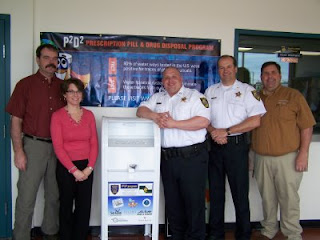
On May 1, 2009, LaSalle County joined the Illinois Prescription Pill and Drug Disposal Program (P2D2) Network. IISG helped sponsor this collection box for unwanted medicines in Ottawa, Illinois. Pictured from left to right: Bob Shull, Ottawa public works director; Jennifer Sines, clinical pharmacist, Illinois Valley Community Hospital; Captain Brent Roalson, Ottawa Police Dept.; and Bob Rick, Ottawa Public Works Director.
May 22nd, 2009 by Irene Miles
From Science Daily:
Eating fish – long considered ‘brain food’ – may really be good for the old grey matter, as is a healthy dose of sunshine, new research suggests.University of Manchester scientists in collaboration with colleagues from other European centres have shown that higher levels of vitamin D – primarily synthesised in the skin following sun exposure but also found in certain foods such as oily fish – are associated with improved cognitive function in middle-aged and older men. Read more.
May 18th, 2009 by Irene Miles
Now that spring is finally here, many of us are thinking about gardening. Is this the year you put in a water garden? Or do you already have a water garden, and plan to add new plants? Well, before you head out to the garden center, you should know that water gardening is one way that invasive aquatic plants can spread into new waterways. When introduced into local waters, these plants can displace native ones, which are sources of food and shelter for native wildlife. Because they grow so prolifically, invasive plants can also clog drainage pipes, impede navigation, and make fishing difficult.
Does this make water gardening a bad idea? Not at all. It means you should be careful to choose plants that are native or non-invasive. It also means you should be careful how you get rid of plants you no longer want or need. For instance, do not release them into natural waterways.
IISG has a 4-page brochure, Invasive Aquatic Plants: What every Plant Enthusiast needs to Know, that provides tips on how best to situate your water garden and how to choose plants carefully. You might want to take the “Most Wanted List,” included in the brochure, with you to the garden center. These are the baddest of the bad invasive plants.
April 27th, 2009 by Irene Miles
From the Milwaukee Journal Sentinel:
Lake Michigan is on the rebound after flirting with near-record low water levels in 2008.
In January 2008 the water was so low that the human polar bears taking their annual New Year’s Day plunge off the Door Peninsula had to navigate around yellow police tape so they didn’t slash their feet on an offshore shipwreck.
Sixteen months and two cold and wet winters later, the lake has added more than 2 feet of water, and it continues to rise almost daily. Read more.
April 21st, 2009 by Irene Miles
From the Sangamon County Department of Public Health:
On Saturday, April 25, residents are encouraged to rid themselves of any unwanted or expired medications at the Illinois State Fairgrounds, Lot 21 entering Gate 11, from 8:00 a.m. to 1:00 p.m. This initiative is sponsored by the Illinois EPA, Sangamon County Department of Public Health, C.W.L.P., Illinois-Indiana Sea Grant, Illinois Lake Management Association, Sangamon County Sheriff’s Department and Springfield Metro Sanitary District. Residents can properly dispose of the following items: over the counter medications, medicated aerosol products, medicated shampoos, soaps, creams, and pressurized inhalers. No controlled substances will be accepted. If you have questions about whether or not your medication is considered a controlled substance, contact your pharmacist.
Residents are asked not to flush their pharmaceuticals and personal care products (PPCPs). The PPCPs can enter the water supply via sinks, toilets, or trash disposals. Most people dispose of human and pet medication either by flushing them down the toilet or throwing them in the trash. These methods create the potential for harmful chemicals to end up in our rivers and streams. An excess of PPCP in the water can harm local aquatic ecosystem. The effects of the pharmaceuticals can be observed in certain aquatic life, such as feminization and altered neurological behavior in fish. Medications that are flushed down the toilet can build up in the water system and alter the environment. Even medications that are thrown in the trash can spend years degrading into the soil and making their ways into the water supply. In addition to the effect on the water, chemicals from medicinal waste can end up in fertilizers used for agricultural land.
Pharmaceutical-related chemicals have been found in trace amounts in samples of finished drinking water. Waste water treatment and drinking water treatment plants do not have the technology to remove 100 percent of the drugs. With increasing amounts of PPCPs entering rivers and streams that provide the source of much of our water supply, and with increases in the use of medications by the aging baby boomer generation, it is important to take steps to reduce their impact on water resources.
Several environmental groups in Illinois have teamed together with the Illinois Environmental Protection Agency to create drug disposal sites within the state. These sites were created in order to provide an environmentally safe method of disposing of old, expired, and unwanted medications.
“Sangamon County was on the forefront with including acceptance of unwanted and expired medications within our Household Hazardous Waste collections two years ago,” said Angela Harris, Recycling Coordinator with the Sangamon County Department of Public Health. “We believe it is important to educate residents on how to properly dispose of their medications. Illinois EPA notified us that due to the State’s budget, we were not selected for HHW collection this year. Therefore, we are focusing solely on collecting unwanted and expired medications.” This event is a prelude to establishing permanent drop-off location programs.
April 20th, 2009 by Irene Miles
From the Environmental Almanac:
Today’s Environmental Almanac comes to you courtesy of students from Zanne Newman’s class at Stratton Elementary School in Champaign. This Spring, some of Newman’s fourth graders have been working with University of Illinois students enrolled in a service learning program called Community Stewardship through Environmental Education, which is offered cooperatively by Illinois-Indiana Sea Grant Program, the UI Department of Natural Resources and Environmental Sciences, and the Center for Teaching Excellence. Read more.
In addition to song lyrics written by the Stratton students, this blog post includes a video of Franklin School eighth graders performing their play about the problem of invasive aquatic species.
April 2nd, 2009 by Irene Miles
Shelley Cabrera is a recent graduate from the University of Chicago with a B.S. in environmental science. She is now an O.R.I.S.E. (Oak Ridge Institute for Science and Education) intern working in conjunction with the U.S. EPA Great Lakes National Program Office and IISG. Here is her post:
As an intern I have the opportunity to learn about effective product stewardship and a wide range of environmental issues. In turn I am able to pass this knowledge on to others, and provide them with tools and resources needed to make a difference in their communities and their own lives. More specifically, in the realm of product stewardship, we are concentrating our efforts on the proper disposal of pharmaceutical and electronic waste. Just last week I was able to speak with a representative of the Great Lakes and St. Lawrence Cities Initiative who intends to relay, to participating mayors and local officials, information on how to implement ongoing PPCP (pharmaceutical and personal care product) collection programs in their cities. Knowing that cities throughout the Great Lakes basin and the rest of the country want to take charge of the situation is reassuring; unfortunately others are not as fortunate.
Recently, an AP article highlighted the Iska Vagu stream in Patancheru, India that is so polluted with pharmaceuticals that “enough of a single, powerful antibiotic was being spewed into one stream each day to treat every person in a city of 90,000.” Some of the possible consequences of these unregulated releases include cell growth failure, harm to reproductive systems, and the promotion of antibiotic-resistant bacteria. As if the degradation is not enough, the Iska Vagu stream acts as the only water source to many of the villages downstream. The villagers and manufacturing facilities upstream that are releasing these high concentration residues know that the river is highly contaminated, yet not much has been done either due to apathy or inability. This story is a sad reminder of the consequences a lack of product stewardship can have on the environment and communities. I am pleased to be a part of the effort to make sure that an incident like this one does not happen in the Great Lakes.
In line with protecting our environment, IISG’s Disposal of Unwanted Medicines: A Resource for Your Community toolkit has been sent to locations throughout the U.S,, even to Canada and New Zealand! Whether it is helping an individual, group or local government set up their own collection event, increasing awareness among the general public through education and outreach is imperative to changing the way we think about our everyday actions. In fact, I was able to pass on educational materials to a Montessori grade school teacher (who happens to be my aunt), after she mentioned that she would be starting an ecology course soon.
As to electronics recycling and disposal, we have been working with U.S. EPA and Ohio Sea Grant to redesign ecyclingtools.com to more effectively provide businesses with the information and tools needed to refurbish and/or recycle their old computer equipment. Among the many sites providing information on electronics disposal, we noticed that there was a lack of recycling information provided to businesses. Our hope is that this user-friendly site will act as a one-stop shop for businesses to find out about energy star ratings for new equipment, recyclers in the area, regulations for their state, etc. In my opinion, before the redesign the site was too much like the report it grew from. Now, almost everything is displayed when you first enter the site in a format that is not overwhelming for the user, and clickable maps will make finding regulations and recyclers for a state a bit easier. The best part is that this is just one more step toward keeping hazardous chemicals from entering the environment and contaminating our water supplies.
In addition to working on proper waste disposal, I have also been fortunate enough to work on production of a type E botulism manual for the Great Lakes states. Our goal is to have a document that local and state governments and the public can refer to for information on symptoms to look for, avian carcass disposal, cooking temperatures for fish and birds, as well as any federal and state advice that may exist. Before starting work on this manual, I had no idea that there were even various types of botulism or the conditions required to activate the toxin. The only thing I knew was that improperly canned fruits and vegetables could contain botulism, but I never thought that it was naturally occurring in the Great Lakes. With each new assignment I feel that I am probably learning even more than I realize, and these tasks are just a few of many that, as an intern, one is able to accomplish working with Illinois-Indiana Sea Grant and U.S. EPA.
March 18th, 2009 by Irene Miles
COSEE Great Lakes recently completed another successful online workshop—“Great Lakes Alive!”—in which scientists and educators were brought together to exchange information about the biological aspects of the Great Lakes.
The workshop—held in February—is the third in a series of workshops started in 2006. Among its components are streaming video presentations from university scientists and educational resources pertaining to the topics discussed.
“These workshops are a great opportunity for educators to converse with scientists, collect exemplary teaching resources, share varied experiences, and expand their understanding and knowledge of Great Lakes science,” said IISG education specialist Terri Hallesy.
Over 155 people participated in this year’s workshop and 26 received graduate credit for their participation.
“The lessons have been extremely popular with students and teachers,” said participant Wendy Lutzke, who used resources from the workshop in her own classroom. “I highly recommend the ESCAPE lessons.”
“It is amazing how many people were able to benefit from this online workshop,” said participant Corista Nichols.