
Illinois-Indiana Sea Grant (IISG) has not one, but two coastal resilience specialists who are providing support for communities along the southern Lake Michigan shore. These specialists came to Sea Grant from different disciplines and bring skill sets that complement each other.
Sarah Peterson is the program’s coastal engineering and community resilience specialist and as her title implies, she brings her engineering background to focus on coastal changes along the shore due to natural and human forces. She will also work directly with communities, sharing coastal process information and providing technical guidance on beach management solutions that can lessen the impact of changes over time.
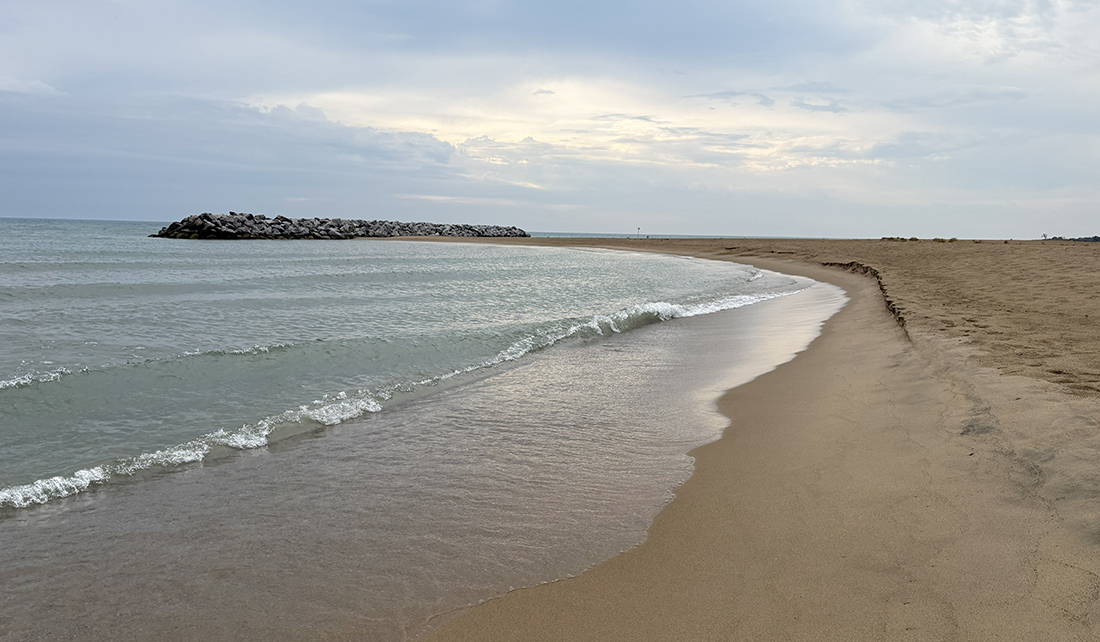
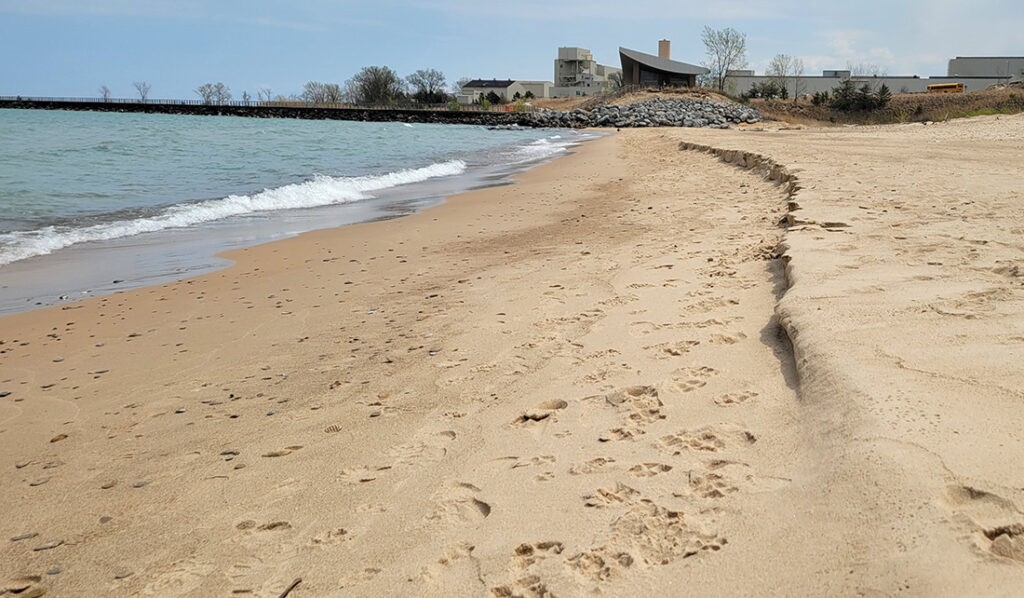
She sees the implementation of shoreline structures as having dramatically altered the flow of currents and sand along the shoreline. “They can create a situation where sand accumulates updrift of a structure, leaving some downdrift areas sediment-deprived,” said Peterson.
The structures, which pose challenges for communities or even landowners with regards to sand management, can be of varying sizes—from massive harbors and piers to those that are suitable for maintaining sand on individual properties.
Peterson noted that significant water level fluctuations in Lake Michigan are a concern for communities as well, referencing the six feet of water level rise between 2013 and 2020. “It’s been challenging for existing infrastructure to withstand those dramatic changes as well as for communities to build new infrastructure that is resilient under both highs and lows.”
She added that high water levels can also exacerbate the problem of storm surges that can lead to more flooding, putting more infrastructure, homes, and people at risk.
Hillary Glandon is an aquatic ecologist and is focused on habitat fragmentation as a key issue in southern Lake Michigan waters.
“We used to have much more contiguous habitat that was better connected to our rivers and the nearshore wetland system—this was very critical for almost every species, which at some life stage uses the more protected, sheltered environment,” she explained. “Now, access to rivers and wetlands is limited due to development on land, but also marinas and other hardened structures along the shore. The bottom line is that there’s a lot of habitat loss.”
As IISG’s coastal ecosystem and community resilience specialist, Glandon brings her rich research history as a marine biologist to studying how geological processes influence the ecology of the lake’s nearshore waters. She is involved in several research projects to quantify aquatic life, including one funded by IISG before Glandon joined the program.
Despite the fact that Peterson is located in Indiana and Glandon in Illinois, they are not dividing their coastal resilience work geographically, but rather are leaning into their strengths.
“Hillary will have more direct interaction with research—she’s already doing a lot of great work up in Illinois Beach State Park.” said Peterson. “My role will be more focused on connecting with people on the ground at a community level. Together, we’ll be pulling relevant information and communicating it to the relevant audiences in the region.”
Peterson has been interviewing representatives from coastal communities, government agencies, and local groups to understand their needs and perspectives and how IISG can be a better resource when it comes to coastal resilience. The specialists are also connecting with other scientists.
They are compiling resources and have begun to develop new ones, including a video series that illustrates natural coastal processes and how structures along the shore can change these processes. Peterson and Glandon are also hoping to bring some newer approaches to communities looking for solutions.
“I think it’s fairly well understood that we need to stop hardening our shorelines,” said Glandon. “It’s not very useful for people to only hear that because they don’t know what else they should do. We’re trying to leverage research in a way that can provide actions for these communities.”
One approach is to implement nature-based solutions, which enhance, integrate, or mimic natural features for coastal protection and habitat restoration. To help introduce this idea, the specialists are developing an educational video that will explain the scope of nature-based solutions in Lake Michigan.
“For example, along the Illinois shore at Fort Sheridan, submerged structures have been installed. These rock piles mimic natural rocky reefs and act as a natural habitat for aquatic species, but also dampen some of the incoming wave energy,” said Peterson. “Also, the structures are below the water’s surface, so they don’t take away from the scenic views of these sites.”
One of Glandon’s research projects is to assess the effectiveness of the Fort Sheridan structures and the impact on species diversity and abundance. She will also be part of a study to evaluate the effects of 27 new breakwaters at Illinois Beach State Park.
“Because these breakwaters are parallel to the shore, which allows for sand transport, and the project includes beach nourishment and habitat enhancement features, it can be considered a nature-based solution,” she said.
In terms of other new opportunities, IISG is working with the Webcam Coastal Observation System and the Great Lakes Observing System to install cameras on at least one beach in the region that will monitor coastal processes and changes and may be useful as a resource for community groups, researchers, and outreach specialists.



