
Meet Our Grad Student Scholars is a series from Illinois-Indiana Sea Grant (IISG) celebrating the students and research funded by our scholars program. To learn more about our faculty and graduate student funding opportunities, visit Fellowships & Scholarships.
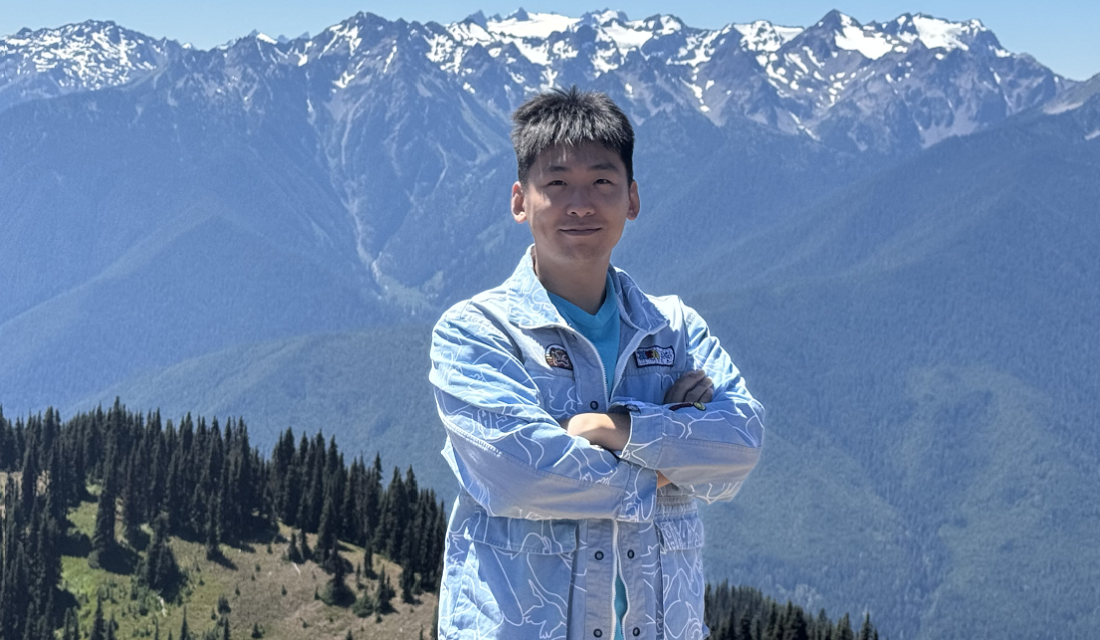
Qianyu Zhao is a PhD student at the University of Illinois Urbana-Champaign, focusing on understanding and reducing nutrient loss pollution. His research combines diverse datasets, watershed modeling, and machine learning to trace the movement of nitrogen and phosphorus at the regional scale. Through IISG, he is working to identify the sources and pathways of nutrient loading and translate that science into actionable guidance for policymakers and land managers protecting water quality across the region.
The Great Lakes system holds about 90% of the freshwater in the United States and approximately 20% of the world’s freshwater supply. Forty million residents of the U.S. and Canada depend on this system for clean drinking water. Lake Michigan alone stretches 307 miles long and touches four states. Its beaches draw millions of visitors every summer. Its waters support commercial fishing, shipping, recreation, and the daily lives of communities all along its shores. It is one of the most precious bodies of water on Earth. And for the past century and a half, human development has been putting it under pressure.
The story of nutrient pollution in the Great Lakes is inseparable from the story of how the region was settled and developed. Over the past two centuries, western settlement and the Industrial Revolution have dramatically changed the water quality of the Great Lakes. New economic activities and cultural centers emerged, while the lakes hosted new species and were polluted by industry, agriculture, and cities. As forests were cleared and farmland expanded across the Midwest, the land’s capacity to retain nutrients began to erode. Rain that once soaked slowly through prairie root systems now rushed across bare fields, carrying fertilizers and manure directly into streams and tributaries.
The first step in Qianyu Zhao’s research has not been to build a model or run a simulation. It has been to look backward. Before anything else, he has studied the historical record: decades of water quality monitoring data collected at river gauges, tributaries, and lake inlets across the Lake Michigan watershed. He has examined how human activities in the region have changed over time, how small farms have become industrial operations, and how drainage infrastructure has expanded to move water off fields and into streams more efficiently. He is tracing how nutrient loadings in the water have responded to each of those shifts.
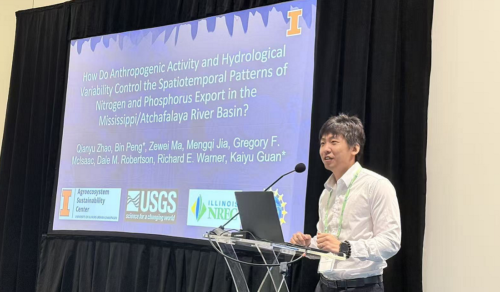
Qianyu Zhao presents research on the Mississippi-Atchafalaya River Basin at the Society of Freshwater Science Annual Meeting in 2025.
This historical foundation is not just background reading. It is the backbone of everything that follows. Understanding where nutrients have come from and how the relationship between human activities and water quality has evolved over time enables Zhao to build models grounded in reality rather than assumptions. It is also what makes his research relevant to policy: the history of the Great Lakes makes clear that technical fixes alone are not enough.
Armed with that historical understanding, Zhao is developing a comprehensive model that tracks the full journey of nutrients from their sources to the lake. The model covers three interconnected stages. First, nutrient inputs—how much nitrogen and phosphorus are being applied to the land. Second, transport—how those nutrients move across the landscape, into drainage ditches, down tributaries, and ultimately into Lake Michigan. Third, in-stream processes—what happens to nitrogen and phosphorus once they enter the waterbody, including the biological and chemical reactions that transform them, allow them to fuel algal growth, or cause them to settle into sediments and be re-released later.
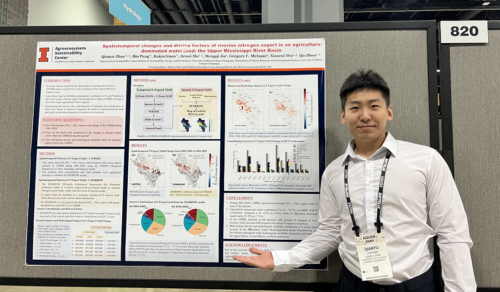
To help guide targeted nutrient loss reduction strategies, Zhao illustrates nitrogen change and anthropogenic and hydrological effects.
To capture this complexity, Qianyu integrates diverse data types and advanced modeling tools. Satellite remote sensing data provides information on land use, vegetation, and soil conditions across the watershed. Statistical watershed models structure how nutrients move through the system. Machine learning algorithms help identify patterns in large, complex datasets that traditional methods might miss. And field water quality measurements grounded the entire framework in observed reality.
The goal of all this work is not a paper. It is cleaner water. Once the model is built and validated, Zhao’s findings will be translated into practical guidance for the people who actually make decisions about Tland and water: policymakers, conservation agencies, farmers, and local governments, who try to figure out where to invest limited resources for maximum impact. It took more than a century of pollution for the Great Lakes to reach their lowest point. Bringing them back is a multigenerational project. Zhao sees his work as one piece of that effort, not a solution on its own, but a scientific foundation that enables better solutions.