
Category:

IISG and Brady STEM Academy learn from each other

May 2nd, 2017 by

St. Elmo Brady STEM Academy welcomed two IISG specialists to their roster of teachers recently.

Climate Specialist Molly Woloszyn and Education Coordinator Terri Hallesy carried on in the spirit of the academy by sharing their expertise with underrepresented fourth- and fifth-grade students in the Champaign, Illinois area.

The program was developed in 2013 by Ricky Greer, a K-12 education specialist, and Dr. Jerrod A. Henderson, a University of Illinois lecturer in Chemical and Biomolecular Engineering (CHBE). Its name, St. Elmo Brady, honors the first African-American student to earn a PhD in chemistry in the United States in 1916. Although the program is housed in CHBE, it’s meant to introduce students to a range of STEM disciplines.

Woloszyn and the students toured the weather station with Jim Angel, the Illinois state climatologist. She also did an activity that demonstrated air pressure – the collapsing can. She then taught them how to make a rain gauge from a 2-liter bottle that they could take home.

“I had a really great time doing this event,” Woloszyn said. “It was really fun to interact with the students and see them be so interested in making the rain gauge.”

Hallesy spent her time with the students talking about the role aquatic invasive species play in altering the Great Lakes basin ecosystem. She used fun games like “Stop Asian Carp in their Tracks” and “Nab the Aquatic Invader,” to explain how students by making simple changes, like properly disposing of a pet fish, can do their part in helping  to prevent the spread of AIS.

“I see them as agents for change in their community. The kids were so interested in learning about what they could do to help,” Hallesy said. “They loved it!”

Program director Joe Gamez has seen the positive impact the program has had on the students.

“Without this exposure, minorities and girls think, ‘Oh, this this is not for me. This is for other people. Other people do that kind of stuff,’” Gamez said.

“But when they get exposure to it, it changes the way they look at things. The exposure the children get to these STEM topics from people who are so knowledgeable and passionate has really made a difference.”
Website of the week: Bringing science to life has never been so easy

January 28th, 2015 by

A closer look at web tools and sites that boost research and empower Great Lakes communities to secure a healthy environment and economy. 

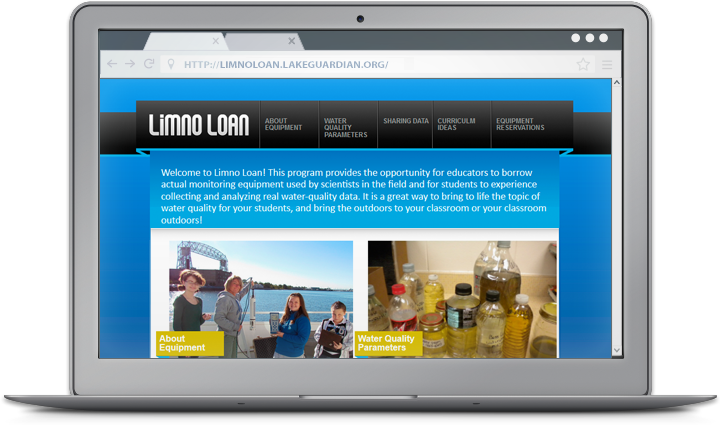
For over two years, the Limno Loan program has been shaking up science class across the Great Lakes region. Coordinated by IISG and the U.S. EPA Great Lakes National Program Office, the program gives students an opportunity to collect water quality data from local waterways with the same kind of monitoring sensors used by scientist aboard the R/V Lake Guardian. 

And now, teachers can take their Hydrolab projects one step further with help from IISG’s new Limno Loan site. In addition to information about the equipment and the parameters it measures, the site provides lessons and activities to help teachers K-12 better integrate the Hydrolab into their aquatic science sections. 


The activities, most of which were created by educators who used the equipment in their own classrooms, focus on demonstrating the connections between water quality, aquatic food webs, and human activities. Sample water quality data sheets are also available. 
The website also provides a unique opportunity for classes to share their data and compare it to information collected by fellow students across the region. 

New activities will be added as they are developed, so be sure to check back later. You can also read more
 about how the Limno Loan program has helped improve student understanding of Great Lakes sciences in our Winter 2012 Helm

IISG Instagram

Do you work or live along the Great Lakes coasts? Watch our newly released video series collection, containing several short videos that overview the range of coastal protection options in the Great Lakes, including:- Natural processes in the Great Lakes- Hard coastal protection structures and how they interact with/alter natural processes- Nature-based coastal solutions in the Great Lakes, ranging from green to gray approachesFind our two new video series at the link in bio.
Located in Washington, D.C., the Sea Grant Knauss Fellowship provides a unique educational and professional experience to graduate students who have an interest in ocean, coastal and Great Lakes resources, and in the national policy decisions affecting those resources. This is a one-year fellowship open to any student, regardless of citizenship, who is enrolled toward a degree in a graduate or professional program on the day of the deadline.Students enrolled at an Illinois or Indiana university or college should submit their applications through Illinois-Indiana Sea Grant by emailing Angela Archer at amcbride@purdue.edu. Students in surrounding states without a Sea Grant program should contact the National Sea Grant College Program at oar.sg.fellows@noaa.gov for a referral. Application deadline: June 3, 2026.To learn more about the fellowship, visit the link in bio.
Science is Survival at C2E2 2026! Catch us at the Chicago Comic & Entertainment Expo (March 27–29) as we explore the underwater world of Subnautica through the lens of Great Lakes science.Stop by our booth to discover how Great Lakes food webs, invasive species, and aquaponics stack up against your favorite survival game!Learn more about the event at the link in bio.