Community members, stakeholders, and several agencies have been involved in an extensive cleanup project in Muskegon Lake for the last few years, and just this month they celebrated the project’s completion.
The Great Lakes Legacy Act project began with the development of a master plan and secured funding, with the goal of cleaning and restoring the lake’s natural habitats. By doing so, fish and wildlife populations can be restored, and the lake will be cleaner and safer for recreational use as well.
Caitie McCoy, Illinois-Indiana Sea Grant’s environmental social scientist, has been heavily involved in several remediation and community outreach projects, including outreach for the EPA during the entire Muskegon Lake cleanup and restoratio
n.
Caitie wrote to update us on the great progress that they’ve made restoring the lake. “The project
removed 43,000 cubic yards of sediment contaminated with polynuclear aromatic hydrocarbons (PAHs) and mercury from Muskegon Lake, which flows into Lake Michigan. It also included habitat restoration in the area.”
Caitie was onsite for the project completion, and worked with John Karl from Wisconsin Sea Grant to compile video footage. That footage will be part of a video being produced about Great Lakes Legacy Act cleanup projects including Muskegon Lake. Check back here to the blog later this year when we’ll have the video posted.
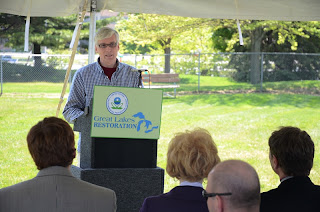
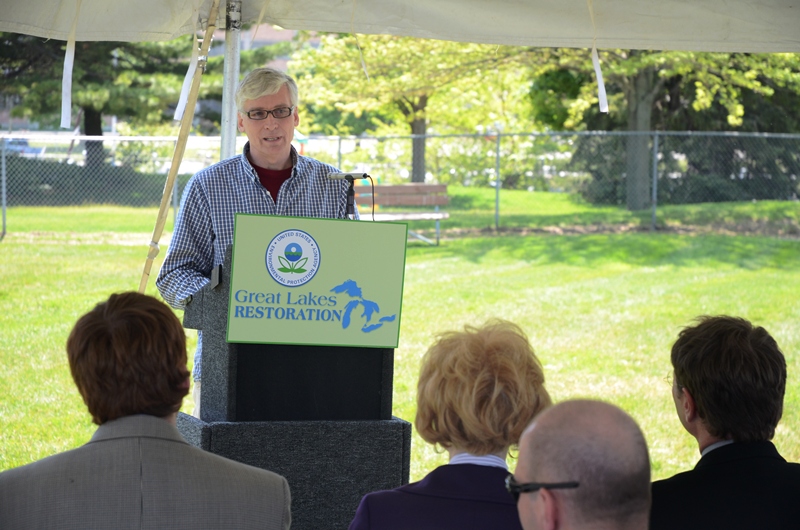
(Pictured above is Dennis Kirksey of Muskegon Lake Watershed Partnership, a landowner in the area who played a large role in helping the project reach completion.)
A proposed water trail along Lake Michigan’s shoreline would improve access to 450 miles of the lakeshore, making it easier for recreationists to enjoy the water.
“The trail will eventually run from the Wisconsin-Illinois border north to the tip of the Door County Peninsula and south along the Green Bay shoreline to the city of Green Bay.
The Lake Michigan Water Trail was selected as one of the top 100 state projects as part of President Barack Obama’s America’s Great Outdoors program that encourages increasing outdoor recreation opportunities close to home.”
The project involves several agencies and could provide expanded opportunities for businesses near the lakeshore.
A data collection project is currently underway that would help communities prepare for and prevent flooding in the Great Lakes basin. There are also six technical workshops for coastal management and associated professionals to be held next month at several locations around the Great Lakes.
“Federal officials are studying how to help Great Lakes communities better prepare for hazardous floods.
‘It will be the most comprehensive study ever conducted of shoreline flooding,’ said Ken Hinterlong, a senior engineer with the Federal Emergency Management Agency. So far, only ‘…the first phase of the project is done, which is a basin-wide data collection for Lake Michigan and Lake St. Clair.’”
Visit the link above for the full article including a link to the full workshop schedule.
The term “food web” is used to describe the intricate relationships between the many different plants, animals, and organisms that can exist in small or large areas. Understanding food webs in specific environmental locations, such as in one or more of the Great Lakes, can help researchers and communities better respond to changes in those delicate systems. Invasive species are just one example of a potential influence that can drastically alter a food web and have substantial impacts on native environments.
On April 3 and 4, 2012, Illinois-Indiana Sea Grant (IISG) and GLRRIN Lake Michigan
partners from Wisconsin Sea Grant(WISG), Michigan Sea Grant, the NOAA Great Lakes Environmental Research Laboratory, the US EPA Great Lakes National Program Office, and the USGS Great Lakes Science Center hosted a research meeting in Ann Arbor, MI. Approximately 60 researchers from federal, state, university, tribal, and non-profit organizations gathered to discuss their current understanding of food webs in Lake Michigan. Food web structure and function can be affected by many variables, including changes in water temperature, water quality, and/or habitat loss. Recent aquatic invaders, including zebra and quagga mussels, have drastically altered the Lake Michigan ecosystem, leaving researchers with new questions about what variables most affect commercial and recreational fishing, bird populations, non-toxic algal blooms, and overall quality of life for humans and animals.
GLRRIN Lake Michigan hosted a similar meeting in 2008, which helped launch the 2010 Lake Michigan Intensive Monitoring Field Year. Findings presented during the 2012 meeting highlight the inherent variability of Lake Michigan, especially in areas that are less than 20 m deep. Researchers also stressed the need to further understand how the lowest levels of the food chain, such as microbes and nutrient cycling, operate. Understanding these basic levels will help create better tools for decision makers like fishery managers or watershed planning committees. A full report on the meeting presentations and discussions will be made available through the GLRRIN Lake Michigan and IISG websites.
Communication is a crucial part of any project, and especially one as significant as cleaning up an ecosystem that has been deemed an Area of Concern. One of those AOCs is the Sheboygan River, and Illinois-Indiana Sea Grant Environmental Social Scientist Caitie McCoy has been very involved in the remediation project, working with and reaching out to the communities that live near and rely on the river in a variety of ways.
To better understand community views and concerns about the river and the river cleanups going on this summer, several interviews were conducted with local stakeholders. The findings and resulting recommendations are presented in a qualitative study put together by Caitie and Ada Morgan, entitled “A Scoping Exercise to Understand Community Perceptions of Contaminated Sediment Remediation in the Sheboygan River Area of Concern.” You can download and read the entire study here.

 The Great Lakes Legacy Act project began with the development of a master plan and secured funding, with the goal of cleaning and restoring the lake’s natural habitats. By doing so, fish and wildlife populations can be restored, and the lake will be cleaner and safer for recreational use as well.