
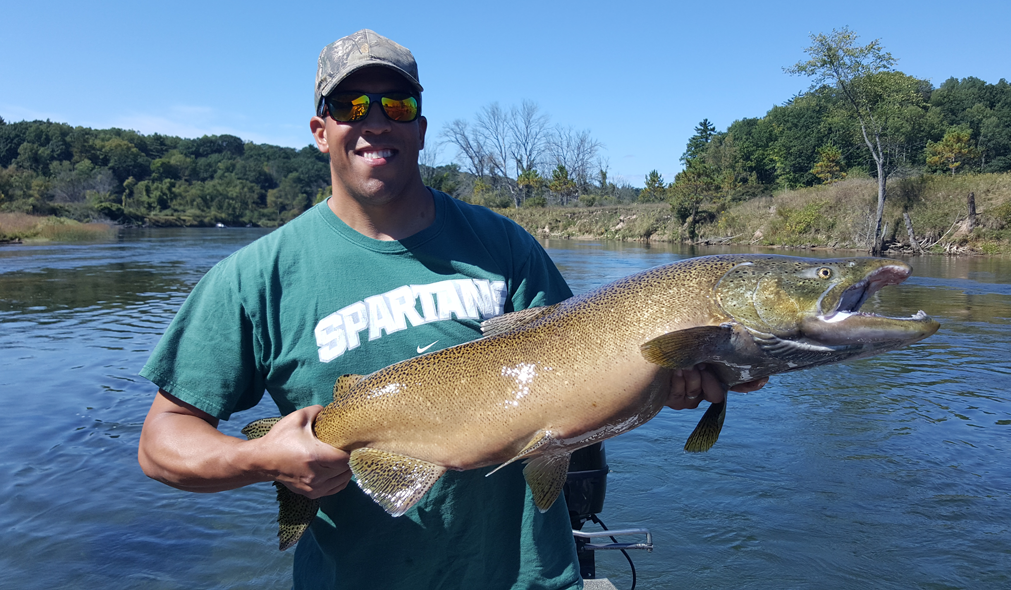
Brian Roth Salmon
Brian Roth shows off a Chinook salmon, a popular sport fish and top predator in the Great Lakes.

In Episode 13 of Illinois-Indiana Sea Grant’s podcast series Teach Me About the Great Lakes, titled “It Smells Like Science,” host Stuart Carlton interviews Brian Roth, an ecologist in the Department of Fisheries and Wildlife at Michigan State University. Roth studies food web structure and function to try to understand how fish management and harvest actions affects the food web and vice versa.
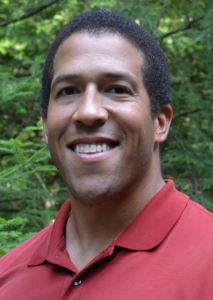
headshot of man wearing red polo, surrounded by trees

Brian Roth

Carlton, IISG assistant director, and Roth talk about predatory fish in the Great Lakes, the history of the Great Lakes salmon fishery, how native and invasive fishes interact within the ecosystem, and how the fish populations are changing as lake conditions change, as well. They also briefly discuss invasive crayfish and the nitty gritty detail of conducting a fish diet study.

Teach Me About the Great Lakes is a monthly podcast in which Carlton—a social scientist who grew up in the South near the Gulf of Mexico—asks people to explain the biology, ecology and natural history of the Great Lakes. A new episode is usually released on the first Monday of each month. The latest episode is embedded below.

Love this episode and want to hear more in the future? Subscribe on Apple Podcasts or Spotify, or use the RSS feed in your favorite podcast player.

If you have questions you want answered about the Great Lakes, reach out to Stuart Carlton at jsc@purdue.edu.


Illinois-Indiana Sea Grant is a part of University of Illinois Extension and Purdue Extension.
IISG Instagram

Located in Washington, D.C., the Sea Grant Knauss Fellowship provides a unique educational and professional experience to graduate students who have an interest in ocean, coastal and Great Lakes resources, and in the national policy decisions affecting those resources. This is a one-year fellowship open to any student, regardless of citizenship, who is enrolled toward a degree in a graduate or professional program on the day of the deadline.Students enrolled at an Illinois or Indiana university or college should submit their applications through Illinois-Indiana Sea Grant by emailing Angela Archer at amcbride@purdue.edu. Students in surrounding states without a Sea Grant program should contact the National Sea Grant College Program at oar.sg.fellows@noaa.gov for a referral. Application deadline: June 3, 2026.To learn more about the fellowship, visit the link in bio.
PD hours + Great Lakes science + hands-on learning? Yes please.Illinois-Indiana Sea Grant has five educator workshops lined up for spring and summer 2026, covering birds, watersheds, coastal science, earth systems, and engineering design.🐦 May 3 · 💧 June 10 · 🌊 July 16 · 🌍 July 31–Aug 1 · 🏗️ Aug 18Real-world connections. Field experiences. Takeaways your students will actually feel.🔗 Register at the link in bio.
Invasive crayfish are reshaping freshwater ecosystems, and there's a lot of new ground to cover. 🦞The Invasive Crayfish Collaborative is hosting two virtual lightning talk sessions packed with the latest on impacts, distribution, management, and policy.💻 Session 1: Mon, April 27 | 3 pm ET / 2 pm CT💻 Session 2: Tue, April 28 | 12 pm ET / 11 am CT🔗 Registration links in bio.
