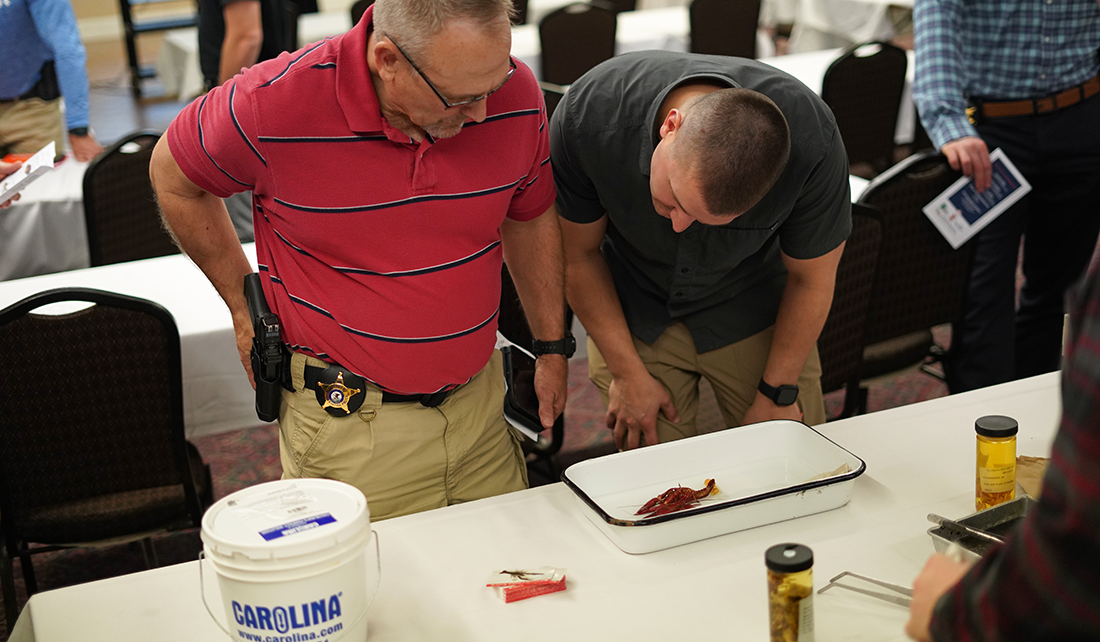
A group of 150 Illinois Conservation Police Officers (CPOs) gathered in Decatur for a hands-on workshop on aquatic invasive species (AIS) during their annual meeting this spring. Developed by the Illinois-Indiana Sea Grant (IISG) AIS team in collaboration with the lab of Carena van Riper, a conservation psychologist at the University of Illinois, the focus of the workshop was to educate and equip officers with the knowledge and tools to combat the spread of AIS and protect the state’s natural resources.
Spearheaded by Elizabeth Golebie, a post-doc in van Riper’s lab who has previous experience working with IISG as a grad student and extensive research experience related to AIS, in partnership with CPO Brandon Fehrenbacher, the workshop featured hands-on lessons that taught officers about the potential impacts of AIS and how to identify several species of invasive fish, crayfish, and aquatic plants. Modules were taught by Chris Taylor and Greg Spyreas of the Illinois Natural History Survey (INHS), who covered invasive crayfish and invasive aquatic plants, respectively, and Katie O’Reilly of IISG and INHS, who addressed invasive fish species.
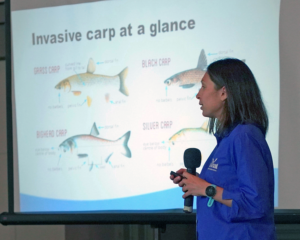
Katie O’Reilly prefaces a hands-on identification exercise with information about invasive fish species in Illinois.
“We know once invasive species are introduced and they become established, it’s really difficult to get rid of them,” said O’Reilly, “so prevention is one of the strongest tools we have. And part of that prevention is the enforcement of some rules that are on the books.
“The CPOs are on the ground enforcing the rules, writing tickets, doing the legwork to stop people from spreading AIS. They’re our first line of defense in a lot of cases, so by giving them knowledge and resources, we hope they feel more confident that if they see something in the field or they get a call about a weird fish somebody caught, they know what their next step can be or who to contact to confirm identification.”
CPOs play a crucial role in enforcing both state and federal AIS regulations to prevent the spread of harmful non-native species in Illinois and the Great Lakes region. The Illinois Department of Natural Resources funded this workshop through the Great Lakes Restoration Initiative as a result of officers expressing a need for information about AIS, wanting more resources in case they were out in the field and needed to enforce regulations. Questions such as “How do I identify this fish?” and “What are the impacts it may have on ecosystems?” were common during the workshop.
One highlight was the hands-on experience offered to the officers. They were able to directly engage with various AIS specimens, learning how to distinguish between native and invasive species—a skill essential for effective enforcement and conservation efforts. The workshop also emphasized the significance of outreach and education in AIS management, including a session by Greg Hitzroth of IISG. Officers received valuable resources to carry during fieldwork, enabling them to educate the public and colleagues about AIS and the importance of prevention measures.
“We provided the officers with an ID guide that featured a few key species that were taught in each of the modules, with identifying characteristics listed for each species,” said Golebie. “The goal was to have them practice using the ID guide at the workshop and then take it with them to reference in the field.”
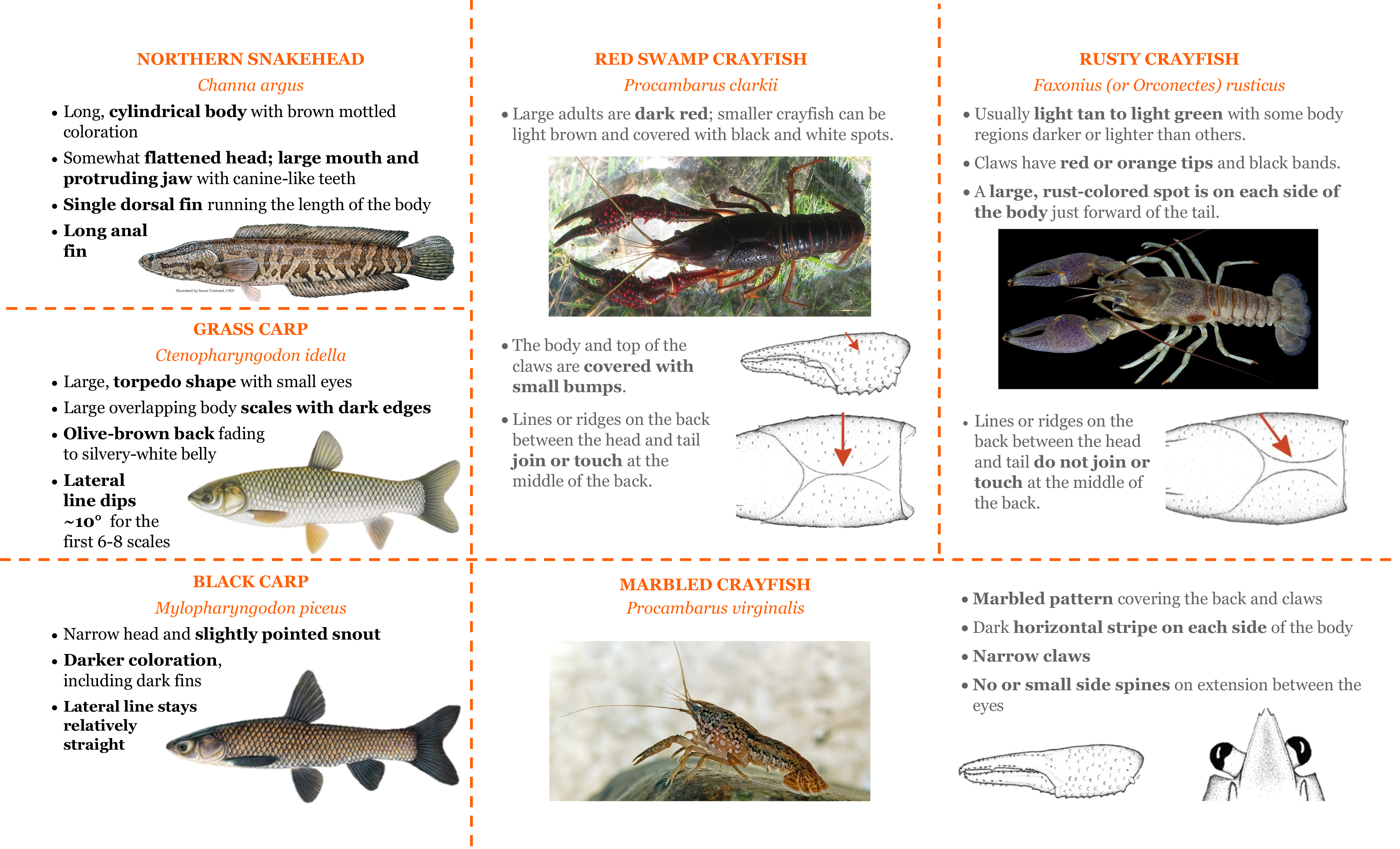
One side of the AIS identification guide provided to the CPOs covers some of the most common invasive fish and crayfish in Illinois.
In addition to outreach materials, participants received information on resources to review and who to contact if they have questions regarding a specific species or need legal assistance in court during a case. After participating in the workshop, these CPOs not only know which scientists they can contact but also how to best take a picture in the field to send to experts who can identify the species, making it easier for them to work together. By receiving education on the impacts of AIS, practical training on species identification, and resources to use in the field, the officers are now better equipped to detect and manage potential threats.
The workshop collaboration underscores the commitment of multiple agencies and institutions to address the threat of AIS and protect the ecological integrity of Illinois’ waterways and the Great Lakes ecosystem. Illinois-Indiana Sea Grant was able to connect experts with people on the ground who are enforcing the rules around AIS. By empowering Illinois Conservation Police Officers with knowledge, resources, and practical skills, this initiative is a significant step forward in safeguarding the state’s aquatic ecosystems from the detrimental effects of invasive species.
Resources:
- Aquatic invasive species
- AIS info for boaters, anglers, divers, and waterfowl hunters
- AIS info for hikers, campers, hunters, birders, and landowners
- AIS info for water gardeners, aquarium hobbyists, and teachers
- Become an AIS “Be A Hero” campaign partner and browse resources
- Invasive Crayfish Collaborative
- Aquatic Invaders in the Marketplace
- Report AIS or contact a CPO
Illinois-Indiana Sea Grant is a partnership between NOAA, University of Illinois Extension, and Purdue University Forestry and Natural Resources, bringing science together with communities for solutions that work. Sea Grant is a network of 34 science, education and outreach programs located in every coastal and Great Lakes state, Lake Champlain, Puerto Rico and Guam.