March 28th, 2025 by Angela Archer
Meet Our Grad Student Scholars is a series from Illinois-Indiana Sea Grant (IISG) celebrating the students and research funded by our scholars program. To learn more about our faculty and graduate student funding opportunities, visit Fellowships & Scholarships.
Lena Azimi is a fourth-year Ph.D. student in the School of Civil and Construction Engineering at Purdue University, specializing in geomatics with a background in environmental engineering. During her master’s program, Azimi encountered remote sensing technology, which provides a way to collect data from a distance, especially remote or hard-to-reach places. This experience led her to pursue a Ph.D. degree and dive deeper into remote sensing and tackle urgent environmental challenges.
My current research focuses on using synthetic aperture radar (SAR) data to estimate soil moisture with finer spatial and higher temporal resolution. Measuring soil moisture is a big deal for water resource management, irrigation scheduling, and even forecasting floods and wildfire risk assessment.
Sustainable agriculture hinges on knowing how much water is in the soil. Too little, and crops suffer. Too much, and you risk diseases, soil salinity, and wasted resources. With more precise soil moisture information, farmers can fine-tune irrigation schedules, boost yields, and save money.
Soil moisture data isn’t only about agriculture. It’s a critical input for flood forecasting. When soil is already saturated, it can’t absorb much more water, making flooding more likely. Knowing soil moisture also helps predict wildfire risks, track droughts, and support ecology research. The broader water resource management stakeholders include governments, NGOs, and industries that need reliable, high-quality data to make informed decisions. I hope that by improving these estimates, we can give decision-makers a powerful tool to plan for both current climate realities and future uncertainties.
Soil moisture measurements may sound simple, but it is a challenging problem due to the complexity involved in the phenomenon. While in-situ sensors can accurately measure soil moisture, they have limited spatial coverage and don’t always capture how much soil moisture can vary across different areas. In addition, the in-situ sensors need frequent maintenance and calibration. That’s where remote sensing steps in—offering a broader view and consistent data collection across wide regions.
SAR, in particular, provides data in nearly all weather and lighting conditions, making it ideal for soil moisture estimation. However, the existing models we use to convert raw radar data into soil moisture metrics often miss the mark compared to ground truth measurements. By refining these models, I hope to contribute more accurate and higher-resolution soil moisture estimates that can benefit many stakeholders, from farmers to policymakers.
My Ph.D. research focuses on improving soil moisture estimation methods, particularly in water-scarce regions. One exciting development is our use of drone-based SAR for ultra-high-resolution data. Drones can fly low, capture fine details, and offer a level of control that satellites can’t match. That means farmers and resource managers could one day receive near-real-time, high-quality data to inform water use, benefiting their bottom line and the environment.
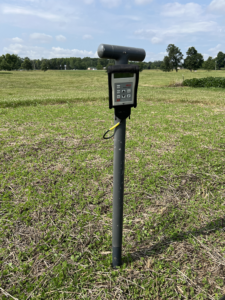
Handheld soil moisture probe used for ground reference soil moisture data collection – June 2024
To get the best results, we collect data from multiple angles – four flights around the field. We use SAR, LiDAR, and RGB imagery. LiDAR (Light Detection and Ranging) helps us measure soil roughness and gather structural information on crops. RGB (red, green, blue) imagery provides familiar, photo-like images. And, of course, we gather on-the-ground reference soil moisture data using handheld probes or permanently installed sensors.
Combining all these data demands an interdisciplinary mindset and a willingness to juggle different file formats, sensor limitations, and analysis techniques. But the payoff is huge: a clearer, more nuanced picture of how soil moisture changes over time and space.
As much as I love my research, I’m equally passionate about teaching and mentoring. I’ve worked as a teaching assistant for courses like Principles of Geomatics and Surveying, as well as Environmental Hydrology. There’s nothing quite like watching a student’s face light up when they grasp a new concept.
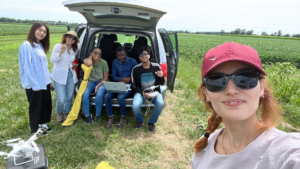
Collecting data in the Pinney Purdue Agricultural Center fields at the Agronomy Center for Research and Education.
I also mentor undergraduate students, helping them discover research topics, formulate questions, read scientific literature, dive into coding, and interpret their findings. My approach is scaffolding I guide them early on, then step back to let them learn independently. The ultimate goal is to instill confidence and competence, helping them become researchers in their own right.
My journey combines environmental sustainability, remote sensing, and education, and I believe these fields can unite to address global water challenges. By refining soil moisture estimation, collaborating with experts in other disciplines, and nurturing the next generation of scientists and engineers, we can protect our planet’s water resources and improve the quality of life worldwide.
I’ve shared some snapshots of our data collection adventures and the fun moments we enjoy in the Geospatial Data Science Lab (https://gdsl.org).
February 28th, 2025 by Angela Archer
Meet Our Grad Student Scholars is a series from Illinois-Indiana Sea Grant (IISG) celebrating the students and research funded by our scholars program. To learn more about our faculty and graduate student funding opportunities, visit Fellowships & Scholarships.
Haribansha Timalsina is a third-year Ph.D. student in Agricultural and Biological Engineering at the University of Illinois at Urbana-Champaign, under the guidance of Rabin Bhattarai in the Water Quality Lab. His research focuses on optimizing nature-based practices to mitigate non-point source nutrient pollution to improve water quality in the Great Lakes region and Mississippi River Basin. The funding from IISG supports broadening the scope of his research work on designing, experimenting, and scaling up the combined strategy for mitigating dual nutrients (nitrogen and phosphorus) from agricultural watersheds.
Nutrients like nitrogen and phosphorus are essential for agricultural productivity–they support plant growth and food production to meet the demands of a growing population. However, excessive nutrient runoff from agricultural landscapes has become a major environmental concern, contaminating water bodies and fueling harmful algal blooms. These blooms deplete oxygen levels, disrupt aquatic ecosystems, and threaten drinking water supplies, fisheries, and recreation.
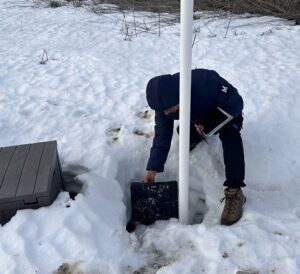
The Water Quality Laboratory monitors the woodchip bioreactor control structures in Galva, Illinois.
The Great Lakes and the Mississippi River Basin are particularly vulnerable to nutrient pollution due to intensive agricultural activity. Despite decades of regulations and conservation efforts, non-point source (NPS) nutrient pollution remains a persistent challenge, exacerbated by increasing food demands and climate change. Addressing this issue requires continuous innovation in conservation strategies that balance agricultural productivity with environmental protection.
At the Water Quality Laboratory at the University of Illinois at Urbana-Champaign, we take a systematic, multi-scale approach to tackling NPS nutrient pollution. Our research integrates controlled laboratory experiments, field-scale monitoring, and hydrological modeling to develop effective and scalable conservation practices.
One of the key conservation strategies under investigation is the use of woodchip bioreactors—a nature-based solution designed to remove nitrate from agricultural drainage. These bioreactors provide a carbon source that supports microbial denitrification, converting nitrate into harmless nitrogen gas. While effective for nitrate removal, woodchips do not efficiently remove phosphorus, which often coexists in drainage water and contributes to downstream water quality issues.
To better understand the efficiency of the system, our research group has been monitoring full-scale woodchip bioreactors across six locations in Illinois at high precision, treating drainage from 17 to over 50 acres, including one of the state’s largest bioreactors. By analyzing hydrological dynamics such as tile flow, temperature variations, and system design, we aim to better understand the systems, improve nitrate removal efficiency, and assess potential secondary environmental impacts, such as phosphorus leaching.
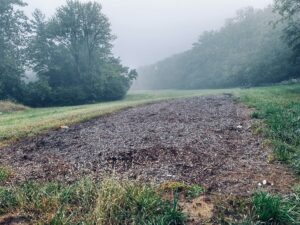
One of the largest woodchip bioreactors in Illinois is installed near an agricultural field in Springfield.
Building on these field-scale insights, I designed and evaluated an integrated system that combines woodchip bioreactors with waste-derived adsorbents, including modified bottom ash pellets. This system enhances phosphorus removal while maintaining nitrate removal efficiency. Through extensive laboratory investigations, I assessed the adsorption capacities of these materials and optimized system configurations for dual nutrient removal.
Moving forward, I aim to incorporate laboratory and field study results into watershed-scale hydrological models. By simulating nutrient transport and system performance under different environmental conditions, these models will help guide informed decision-making for regional conservation planning. This approach ensures that naturally based and waste-derived conservation practices can be effectively scaled up for large-scale nutrient loss mitigation, providing long-term environmental and economic benefits.
By advancing science-driven solutions and integrating green infrastructure, we can improve water quality, protect critical ecosystems, and promote agricultural sustainability, ensuring resilient food production and clean water for future generations.
February 27th, 2025 by Angela Archer
The Illinois-Indiana Sea Grant (IISG) program, in cooperation with the National Park Service at Indiana Dunes National Park and Urban Rivers in Chicago, is offering two internship opportunities to support conservation policy efforts. Sea Grant’s national Community Engaged Internship (CEI) program aims to broaden participation in coastal, ocean, Great Lakes, and marine sciences providing training and mentorship to the next generation of scientists, decision-makers, and citizens. The program will do so by recruiting, retaining and engaging students in place-based research, extension, education, and/or communication that respects and integrates local ways of knowing.
The IISG interns will be part of a national cohort of students. Each intern is expected to participate in all aspects of the CEI program:
- On-the-ground learning experience through an 8-10-week internship over the summer months, including:
- Completion of a project that extends the knowledge of community members to address a coastal, marine, or Great Lakes issue of environmental, economic, and/or social importance, and
- Participation in all CEI professional development and training opportunities
- Mentoring by Sea Grant professionals, Sea Grant-funded researchers, and Knauss Fellows
- Virtual professional development sessions
- Peer discussions with other interns in the cohort through virtual platforms
These paid, full-time summer internships will be ten weeks long, depending on the intern’s availability, starting no later than June 2, 2025.
The application deadline is March 17, 2025. For full internship details, eligibility criteria and how to apply, please visit the Community Engaged Internship page. For questions about this opportunity, email Angela Archer at amcbride@purdue.edu.
Illinois-Indiana Sea Grant is one of 34 Sea Grant programs supported by the National Oceanic and Atmospheric Administration in coastal and Great Lakes states that encourage the wise stewardship of our marine resources through research, education, outreach and technology transfer. In partnership with the University of Illinois Extension, and Purdue University Forestry and Natural Resources, Illinois-Indiana Sea Grant brings science together with communities for solutions that work.
February 24th, 2025 by Angela Archer
Meet Our Grad Student Scholars is a series from Illinois-Indiana Sea Grant (IISG) celebrating the students and research funded by our scholars program. To learn more about our faculty and graduate student funding opportunities, visit Fellowships & Scholarships.
Leah Turner is a second-year master’s student in the Department of Biology at Ball State University. Leah works in the Ward Lab, studying the effects of environmental contaminants on the behavior and cognition of fish at early life stages. The project funded by IISG is to study the developmental exposure of fathead minnows (Pimephales promelas) to citalopram, a common SSRI, to determine if citalopram alters development, behavior, or learning.
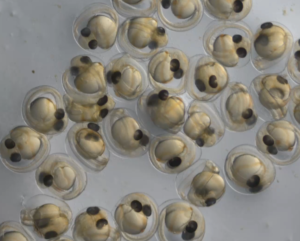
A close-up view of fathead minnow eggs under the microscope showing the early development stages with clearly visible eyes and body structure.
The Great Lakes have been a constant presence in my life—not just as a place of recreation but as a source of inspiration and now the foundation of my research.
As an Illinois-Indiana Sea Grant (IISG) scholar, I have the opportunity to merge my passion for these waters with my commitment to understanding the impacts of human activity on aquatic ecosystems.
My current research focuses on the behavioral effects of citalopram, a commonly prescribed antidepressant that makes its way into freshwater environments. Although intended to benefit human mental health, this pharmaceutical’s unintended presence in aquatic systems raises important concerns. How does citalopram exposure affect the development and behavior of aquatic organisms? What are the broader implications of exposure for freshwater ecosystem health?
To investigate these questions, I study fathead minnows (Pimephales promelas), a species frequently used in aquatic toxicology due to their ecological significance. My work examines how early-life exposure to citalopram influences critical behaviors such as embryonic activity, fear responses, social interactions, and learning. These behaviors are essential for survival and reproduction, making them important indicators of potential ecosystem-level impacts.
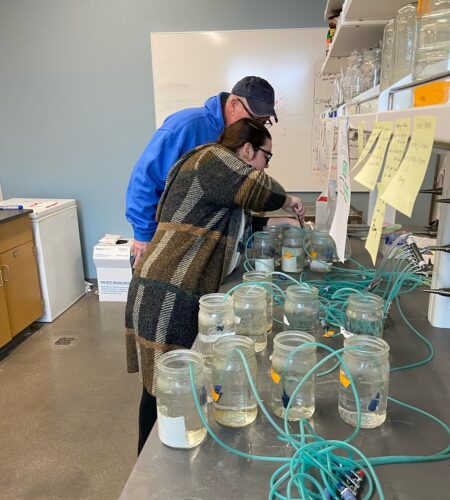
Leah Turner examines fathead minnow larvae in the lab, monitoring exposure conditions as part of her research on the behavioral effects of citalopram.
Pharmaceutical pollutants like citalopram are an often-overlooked threat to freshwater environments. By studying their effects on aquatic life, I hope to contribute to strategies that mitigate these impacts and preserve the biodiversity of ecosystems like the Great Lakes. This research also emphasizes the need for greater awareness and actionable solutions to reduce the introduction of such contaminants into our waterways.
The IISG Scholar Program has been instrumental in my growth as both a researcher and a communicator. Through this program, I’ve been able to engage with communities, share scientific findings, and advocate for sustainable practices that protect vital freshwater resources.
Looking ahead, I’m motivated by the potential to drive meaningful change—whether through advancing research, informing environmental policies, or mentoring future scientists. The Great Lakes are a resource worth protecting, and I’m proud to contribute to efforts that ensure their health for generations to come.
February 3rd, 2025 by Angela Archer
Meet Our Grad Student Scholars is a series from Illinois-Indiana Sea Grant (IISG) celebrating the students and research funded by our scholars program. To learn more about our faculty and graduate student funding opportunities, visit Fellowships & Scholarships.
Xiaoli Xiong is a Ph.D. student in the School of Construction Management Technology at Purdue University and a recipient of the Ross Fellowship. He works under the guidance of Chengcheng Tao in the Sustainable Infrastructure and Manufacturing Lab. Xiong’s research focuses on the sustainable manufacturing of cement and concrete materials. Xiong’s IISG project investigates the feasibility of incorporating dredged sediments from Lake Michigan into cement mortar, aiming to use waste materials to develop more environmentally friendly cementitious products.
Concrete is the most extensively used material created by humans, with 14 billion cubic meters produced annually to satisfy a wide range of construction demands. However, its widespread use has considerable environmental consequences.
To address these challenges, many organizations have committed to achieving a net zero industry by 2050. In response to the escalating depletion of natural resources, the construction industry is actively seeking alternative materials to replace conventional cement and aggregate in 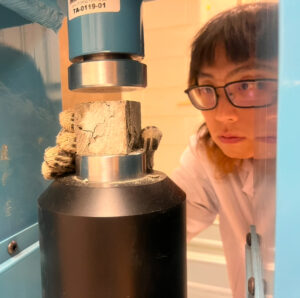 cementitious composites. Dredged sediments, consisting of inorganic and organic materials accumulating at the bottom of water bodies like the Great Lakes, offer a potential solution.
The rapid expansion of water transportation and port infrastructure in the Great Lakes region has led to the generation of substantial volumes of sediment. If left unaddressed, the accumulation of dredged sediments poses significant environmental risks, including water contamination, disruption of aquatic ecosystems, degradation of water quality, and adverse impacts on marine and human life.
Traditional methods of managing dredged sediments, such as dumping and landfilling, are inefficient and costly. As an alternative, researchers have proposed sediment solidification technology using cement and other binders. This method produces a solidified product with excellent mechanical properties that meet the standards for building materials.
Inspired by this approach, using dredged sediments in cementitious composites presents a promising opportunity. This not only mitigates the risk of secondary pollution from improper disposal but also reduces the construction industry’s reliance on natural resources, promoting a more sustainable future.
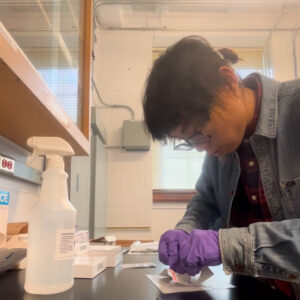 In October 2024, Xiong and his colleagues collected samples from the shores of Lake Michigan. Currently, experiments are being meticulously conducted. The performance of dredged sediments in both cement paste and cement mortar is being evaluated through macro-mechanical testing methods, such as static compressive strength tests, and advanced micro-investigation techniques, including X-ray diffraction, X-ray fluorescence, and scanning electron microscopy.
“By recycling dredged sediments as aggregates or even as a potential cement replacement, we aim to create a new type of sustainable concrete product,” Xiong said. “We believe the results of this research could greatly benefit Lake Michigan’s ecosystem and its surrounding communities, which is why this study is both important and exciting for us.”
___________________________________________________________________________
Illinois-Indiana Sea Grant is one of 34 Sea Grant programs supported by the National Oceanic and Atmospheric Administration in coastal and Great Lakes states that encourage the wise stewardship of our marine resources through research, education, outreach and technology transfer. In partnership with the University of Illinois Extension, and Purdue University Forestry and Natural Resources, Illinois-Indiana Sea Grant brings science together with communities for solutions that work.
January 16th, 2025 by Angela Archer
Meet Our Grad Student Scholars is a series from Illinois-Indiana Sea Grant (IISG) celebrating the students and research funded by our scholars program. To learn more about our faculty and graduate student funding opportunities, visit Fellowships & Scholarships.
Max Murray is a second-year PhD student in the Department of Ecology and Evolution at the University of Chicago. He works in the Pfister Lab studying aquatic microbial ecology. The project funded by IISG takes place in the Coleman Lab and investigates the effects of pollution on the activity of Lake Michigan’s nearshore microbial communities.
In August 2023, I packed a van and moved from Ann Arbor, Michigan to Chicago, Illinois to begin graduate school. While it wasn’t necessarily my highest priority, I was expecting to get a nice view of one of my intended study systems, Lake Michigan, along the way. However, as anyone who has driven westbound along the lake’s southern coast can attest, these views are haunted by ghosts of once-thriving industry and the resulting pollution. It can feel impossible at points to see the water through the steel mills and smokestacks. While disappointed, I filed this experience away until I began thinking about what my proposal for the Illinois-Indiana Sea Grant Graduate Scholars program would look like.
Given my background working on the ecological fallout of anthropogenic environmental impacts, I began to formulate some questions about industrial pollution along Lake Michigan’s south shore and decided to investigate further. Through some research and conversations with University of Chicago undergraduate Daniel Arad, I learned that parts of the existing lakeshore were actually artificially built to host the massive industrial campuses that reside there today. Much of the lake was filled in with slag, a byproduct of steel manufacturing that can contain toxic chemicals. So not only have manufacturers dumped industrial waste into the lake for over a century, but their plants themselves are built on acres of slag that constantly releases toxic alkaline leachate into the water column.
Any environmental matrix hosts microbial life, and the waters of Lake Michigan are no exception. The lake’s microbial communities exhibit bottom-up control on the ecosystem by acting as the base of the food web. As a result of their short generation times, sensitivity,
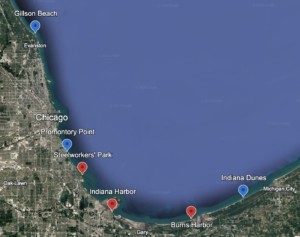
Map of sampling locations: clean sites in blue, polluted sites in red
and sheer quantity (one milliliter of lake water contains thousands of cells), aquatic microbes are a useful lens through which we can study the ecological effects of pollution.
With this in mind, Professor Maureen Coleman, Daniel, and I set out to study how the last century of industrial contamination affects Lake Michigan’s microbial life, and by proxy the broader ecosystem. We designed a “gradient of impact” by sampling at public beaches that vary in proximity to the south shore’s high concentration of lakefront manufacturing. Our “clean” sites are beaches in Evanston, Illinois, Chicago’s Promontory Point, and Indiana Dunes National Park; our “polluted” sites are near Indiana Harbor in East Chicago and at Burns Harbor (both in Indiana), and Steelworkers’ Park on Chicago’s south side.
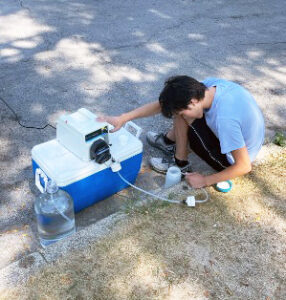
University of Chicago undergraduate Daniel Arad filtering lake water from Promontory Point.
At each site, Daniel and I collected water and sediment samples to analyze for alkalinity, toxic metals, and organic pollutants (like PCBs, a common “forever chemical”). We also used a pump to push several liters of lake water through extremely fine filters that collect the water’s microbes. Because we immediately froze those filters in liquid nitrogen (-320 ºF), we preserved each cell in the same metabolic state as when they were in their normal environment. This means that when we sequence the RNA (the intermediate step between DNA and proteins) on a filter, we will get a snapshot of how the water’s microbial community is reacting to its surroundings.
With metabolic activity information from each sample, we can then analyze the effect of pollution in many ways. We will ask which genes are more commonly expressed in the presence of certain toxins, which species are more active in contaminated water, and whether pollutants inhibit or encourage community metabolic activity. From there, we can extrapolate and form hypotheses about the broader ecosystemic effects of the south shore’s long history of industrial pollution.
While enormous damage has already been done to this region as well as the other Great Lakes, it is important to remember that we can still have success in restoring our ecosystems. The once ablaze Cuyahoga River, a Lake Erie tributary, now supports populations of dozens of fish species that are safe to eat. Charismatic piping plovers have returned to the Great Lakes’ shorelines, as have lake sturgeon to their waters. We hope to characterize the extent of the south shore’s industrial pollution in a novel manner, thereby jumpstarting a similarly successful ecological restoration effort to clean up the southern shoreline of Lake Michigan.
___________________________________________________________________________
Illinois-Indiana Sea Grant is one of 34 Sea Grant programs supported by the National Oceanic and Atmospheric Administration in coastal and Great Lakes states that encourage the wise stewardship of our marine resources through research, education, outreach and technology transfer. In partnership with the University of Illinois Extension, and Purdue University Forestry and Natural Resources, Illinois-Indiana Sea Grant brings science together with communities for solutions that work.
December 18th, 2024 by Angela Archer
Meet Our Grad Student Scholars is a series from Illinois-Indiana Sea Grant (IISG) celebrating the students and research funded by our scholars program. To learn more about our faculty and graduate student funding opportunities, visit Fellowships & Scholarships.
Chloe Ho is a third-year PhD candidate in the Department of Mechanical Engineering at Northwestern University. Ho works in the Park Lab, investigating a new approach to capturing microplastics in air and water. She is currently working on a project funded by IISG that uses 3D-printed, macrotextured surfaces to efficiently filter microplastics from waterways to support resilient and healthy ecosystems.
Plastics are one of the most revolutionary innovations of modern times. These materials play a critical role in the economy and daily lives of people. They can be found in many places like medical equipment, food packaging, clothing, and toys. Most plastics are durable and do not biodegrade in the environment. While not all plastic items become pollutants, all plastic items have the potential to enter the environment if improperly disposed of. During production or the breakdown of plastics, smaller pieces of plastic are made and released into their surroundings. Plastic debris less than five millimeters in length has been termed “microplastics.”
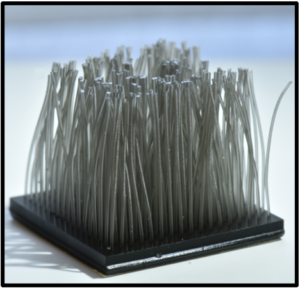
This 3D-printed array of hairs is inspired by baleen whales, which are filter feeders.
Microplastics pose a severe pollution hazard to the environment and health risks to humans and other organisms due to their ubiquitous nature. Sources for these small particles come from a wide range of sectors, touching almost all aspects of modern life. Primary pathways of microplastics to the environment include personal care products, shedding of synthetic textiles, stormwater runoff, and ultimately the breakdown of larger plastic material. These plastics are commonly found in the air and water, and filtering such plastics is challenging due to the expansive range of particle size, shape, and chemical composition. This combination of factors presents a serious risk of accumulation and exposure to these materials could lead to detrimental health risks to all things living.
Nearly 90% of samples taken from the surface of the Great Lakes exceeded safe levels of microplastics per kilometer for wildlife and people. This is increasingly worrisome due to 21% of the world’s surface freshwater is contained in the Great Lakes and nearly 40 million people depend on the Great Lakes for drinking water. However, due to the challenging characteristics of microplastics, they often make their way through water treatment facilities uncaptured.
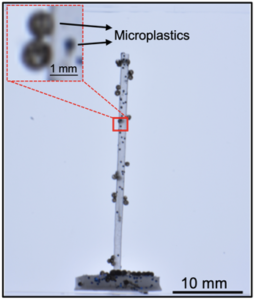
This 3D-printed single hair, coated with oil and placed in water, shows the performance of a single hair in capturing microplastics.
Motivated by Lake Michigan being in our backyard at Northwestern University, in the Park Lab, we have been excitingly working towards a hairy filter to capture and remove microplastics from waterways. The inspiration is filter feeders like baleen whales, whose main food source (krill) is many times smaller than the whale and its baleen, or filter, is used to capture the krill. The long fibers of the baleen provide large surface areas for increased contact and interaction between the capturing mechanism and its prey. This increased effective contact area and other surface characteristics is what inspired us to engineer hair-like structures for capturing microplastics. Remarkably, this technology provides several avenues for development that can suit a vast range of applications.
With commercial 3D printers, fabricating filters with hairs can be widely accessible and feasibly scaled up to an industrial level. This method of fabrication allows for precise sample parameters that can be easily modified to tune the filter for specific needs. The geometry, aspect ratio, number and density of hairs, size, etc. can all be edited to elicit certain requirements for the application.
Chloe Ho aims to continue a study that is focused on how to tune the filters for increased efficiency including testing filters in various environments. “It is a bit of a dance–I am learning to find the sweet spot between all the different variables (hair parameters, flow characteristics, particle composition, etc.),” she said.
So far, this work has shown results towards a promising technology that is low-cost, accessible, non-toxic, and reusable. Ho added, “I am excited to keep researching and understanding how hairs can be used to capture microplastics. I strive for a sustainable future for all and hope to provide support towards achieving this.”
___________________________________________________________________________
Illinois-Indiana Sea Grant is one of 34 Sea Grant programs supported by the National Oceanic and Atmospheric Administration in coastal and Great Lakes states that encourage the wise stewardship of our marine resources through research, education, outreach and technology transfer. In partnership with the University of Illinois Extension, and Purdue University Forestry and Natural Resources, Illinois-Indiana Sea Grant brings science together with communities for solutions that work.
December 11th, 2024 by Angela Archer
This funding opportunity will support promising research that addresses the 2025 Lake Michigan Cooperative Science and Monitoring Initiative (CSMI) priorities. Specific priorities of interest are nearshore dynamics and overwinter sampling. CSMI is an effort instituted under the Science Annex of the 2012 Great Lakes Water Quality Agreement (GLWQA) to coordinate science and monitoring activities in one of the five Great Lakes each year to generate data and information for environmental management agencies. The 2025 Lake Michigan CSMI priorities were developed by the Lake Michigan Partnership, a collaborative team of natural resources managers established under the Lakewide Management Annex of the GLWQA.
This competition will fund up to $75,000 a year for two years (maximum $150,000). Funded projects should start by July 1, 2025 and end by June 30, 2027.
View the full request for proposals for more information.
Applicants should submit materials via https://esg.iiseagrant.org/ by 11:59 p.m. Central Time on February 6, 2025.
Eligibility
We encourage individuals from all disciplines to apply to this RFP. Investigators from educational or research institutions including universities, museums, and NGOs, are eligible to serve as PIs for these funds. Researchers from around the Lake Michigan basin are welcome to apply.
Research Topics
IISG is seeking to fund projects that will address one or more of the following priorities to characterize very nearshore habitat (i.e. from shoreline to 20-m depth).
- Improve understanding of winter season physical processes (e.g., shelf ice, ice dams, open water ice cover) and the impacts on nearshore habitat and/or food webs.
- Investigate understudied but potentially important components of the food web, including nearshore (including shallow shorelines areas) and under-ice community structure, dreissenid veliger abundance and energy density during critical periods (e.g., first feeding post-yolk sac larvae) for key fish species.
- Measure and assess tributary sediment transport and nutrient dynamics on in-lake conditions (chemical and physical integrity) and determine impacts on lower trophic level productivity, both nearshore and offshore, as well as during winter and should seasons.
All proposed research projects should fit at least one of these topic areas. While IISG will prioritize projects that address multiple interests, projects in any of the topic areas are eligible for funding.
Questions regarding eligibility or submission requirements may be directed to Paris Collingsworth at pcolling@purdue.edu.
Illinois-Indiana Sea Grant is a partnership between NOAA, University of Illinois Extension, and Purdue University Forestry and Natural Resources, bringing science together with communities for solutions that work. Sea Grant is a network of 34 science, education and outreach programs located in every coastal and Great Lakes state, Lake Champlain, Puerto Rico and Guam.
December 10th, 2024 by Angela Archer
Meet Our Grad Student Scholars is a series from Illinois-Indiana Sea Grant (IISG) celebrating the students and research funded by our scholars program. To learn more about our faculty and graduate student funding opportunities, visit Fellowships & Scholarships.
Christian Chimezie Obijianya is a doctoral student in Purdue University’s Department of Environmental and Ecological Engineering. His current research is focused on water sustainability through reusing treated wastewater for irrigation. His research funded by IISG is based on his master’s thesis that examined the distribution of nitrate in the Mojave Desert. Building on this expertise, this study will use isotopic techniques to better understand the causes of nitrate pollution in the Great Lakes, improving his work on pollution control and water sustainability.
 Nitrogen appears predominantly as nitrate in natural ecosystems, but high nitrate concentrations pose considerable risks to water bodies globally. Excess nitrate disrupts ecosystems, resulting in soil and stream acidification, greenhouse gas emissions, and water eutrophication. These effects change the health of aquatic environments, often leading to hypoxia, a state in which low oxygen levels leave environments uninhabitable for local organisms, making them more vulnerable to disease. The loss of fish and other species due to hypoxia reduces biodiversity and ecosystem services that are necessary to keep nature in balance.
Nitrogen contamination is largely caused by human activity, particularly agricultural practices. The increasing use of synthetic fertilizers in agriculture is a major contributor, while fossil fuel combustion accidentally emits nitrogen oxides (NOx) into the atmosphere. NOx can be converted into nitric acid, which then deposits back on Earth, contributing to the nitrogen burden in lakes and rivers. However, determining the exact sources of nitrogen in huge lakes is difficult. This is especially true for southern Lake Michigan, which absorbs nitrogen from agricultural runoff, wastewater discharge and atmospheric deposition. Despite these established sources, their exact contributions to the lake’s nitrate budget remain unknown.
Christian Chimezie Obijianya is addressing this issue using a dual-isotope technique–isotopes are atoms that can be important markers. By analyzing nitrogen and oxygen isotopes in nitrate, he can trace the origins of nitrate in southern Lake Michigan. Through the analysis of distinct isotope signatures linked to each source, this dual-isotope approach has demonstrated efficacy in detecting nitrate sources in various environments.
“This research is of national interest because it addresses important environmental issues that affect the Great Lakes’ ecological health and water quality,” said Obijianya.
_________________________________________________________
Illinois-Indiana Sea Grant is one of 34 Sea Grant programs supported by the National Oceanic and Atmospheric Administration in coastal and Great Lakes states that encourage the wise stewardship of our marine resources through research, education, outreach and technology transfer. In partnership with the University of Illinois Extension, and Purdue University Forestry and Natural Resources, Illinois-Indiana Sea Grant brings science together with communities for solutions that work.