July 5th, 2013 by Irene Miles
Hundreds of endangered mussels originally residing in the Allegheny River in Pennsylvania have been relocated to the Vermillion river in Illinois over the last several years, and the project appears to be a great success.
From the Environmental Almanac:
“Over the past three years, scientists from the Illinois Natural History Survey have translocated hundreds of mussels from the Allegheny River in Pennsylvania (where they lived beneath a bridge slated for demolition) to sites on the Middle Fork and Salt Fork of the Vermilion River.
The two species of mussels involved, clubshells and northern riffleshells, are both classified as ‘endangered’ by the federal government, and by dint of that status they are subjects of recovery plans coordinated by the U. S. Fish and Wildlife Service. Those plans call for them to be reestablished throughout their historical range, which includes Illinois…
During the day’s work, a total of 286 tagged mussels were located, just over half of the ones placed there. ‘That’s about what we would expect,’ explained Jeremy Tiemann, the Natural History Survey field biologist who is leading the translocation effort in Illinois. ‘Others may have been so close together or so deep the reader didn’t pick them up. It’s also possible some moved up or downstream a little ways.’”
Follow the link above to learn more about the project.
July 3rd, 2013 by Irene Miles
If you’re headed out to enjoy the weather and the outdoors this holiday weekend, you may want to balance swim time with some time on the beach as water temperatures look to be below average in some areas of Lake Michigan.
“In contrast to air temperatures forecast in the 80s, Lake Michigan water won’t warm up in time for the Thursday holiday, according to the National Weather Service office in Grand Rapids.
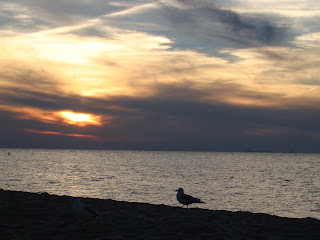 Water temperatures in Lake Michigan are 10 to 15 degrees colder than they were this time in 2012 and 5 to 10 degrees colder than they were in 2011, according to meteorologist Evan Webb. He said it’s a product of the cool spring this year.”
Water temperatures may be warmer or cooler at other points on the lake, and there are a number of sites to keep up to date on the conditions. If you’re planning to spend your time near the waters around Michigan City, Indiana, for instance, you can get current and recent nearshore conditions from the buoy operated by Purdue University and Illinois-Indiana Sea Grant.
However you spend time this holiday weekend, enjoy the sights and scenery safely.
July 2nd, 2013 by Irene Miles
The Great Lakes Ecological and Economic Protection Act was introduced by Senators Carl Levin (D-MI) and Mark Kirk (R-IL), co-chairs of the Senate Great Lakes Task Force, along with Senators Debbie Stabenow (D-MI), Amy Klobuchar (D-MN), Sherrod Brown (D-OH), Richard Durbin (D-IL), Al Franken (D-MN), Charles Schumer (D-NY) and Tammy Baldwin (D-WI).
 In addition to reauthorizing the Great Lakes Legacy Act, which provides support for communities to clean up waterways that are designated Areas of Concern (AOC) the United States and Canada, the new legislation would continue funding the Great Lakes Restoration Initiative and the EPA Great Lakes National Program Office.
The 10-minute video, produced by Illinois-Indiana Sea Grant and Wisconsin Sea Grant, explores Great Lakes waterways blighted by decades of industrial discharges like heavy metals, oil, and chemicals such as PCBs and PAHs. The 2002 Great Lakes Legacy Act created an initiative to clean up contamination in these AOCs. There are currently 29 AOCs in the United States. The habitat, water, and sediment quality have become severely degraded at these sites.
The video informs anglers, boaters, residents, and local businesses of the benefits that can come from a remediated AOC through the Legacy Act. The procedures and successes are the result of strong partnerships among states, municipalities, non-governmental organizations and businesses. Under this voluntary, collaborative program, the EPA and its non-federal partners have allocated almost $400 million toward sediment remediation.
As of September 2012, the program has removed or capped 2.1 million cubic yards of degraded sediment. But more waterways need to be cleaned up, and community involvement is essential.
Learn more about the Great Lakes Legacy Act at the EPA’s GLLA webpage.
July 1st, 2013 by Irene Miles
Illinois’ beach fronts got a bit of good news last week as a recent report pointed to improving water conditions and reduced contamination.
From The Chicago Tribune:
“The report compiles data on E. coli levels collected by local agencies and submitted to the U.S. EPA. E.coli, which can cause serious illnesses and infection, can be a predictor of other contaminants in the water, said Henry Henderson, Midwest director for NRDC.
 Chicago’s Montrose Dog Beach and Rainbow Beach were the most contaminated beaches along Illinois’ Lake Michigan shoreline, according to the report. A variety of factors can change how a particular beach might test on any given day.
The study also found that Illinois’ 65 Lake Michigan beaches saw a combined 334 closings and swimming advisory days last year, a decrease from 483 combined days in 2011. The majority of those closings and advisories were caused by unknown contamination sources, according to the report.”
June 27th, 2013 by Irene Miles
Illinois-Indiana Sea Grant’s summer interns are already hard at work assisting specialists in several areas, working directly on important issues and getting the public involved in problems facing the Great Lakes.
Alice Denny, one of the interns working with the aquatic invasive species team, has been working with AIS specialist Sarah Zack to bring important invasive species prevention information to fishing tournament organizers and participants. She just recently attended the first of several tournaments slated for this summer, and wrote in to tell us about the internship experience thus far.
“It has been a busy week for me at the AIS office. This summer I am primarily working with fishing tournament organizers and anglers to better understand their attitudes and practices in AIS prevention. Last weekend, I attended my first fishing tournament and had a great time. Although the weather was less than ideal at North Point Marina, Clean Boats Crew and I were able to reach out to the salmon and trout anglers in the Geoffrey Morris Memorial Tournament. Sarah and I attended the rules meeting Friday evening to talk about simple steps tournament anglers can take to prevent the spread of AIS. Then on Saturday I went to the weigh-in to speak with anglers one-on-one and hand out educational material. There were around 70 boats participating in the tournament, with multiple anglers per boat. The audience was receptive and I really enjoyed speaking with them about the importance of AIS prevention. I’ll be attending another tournament in Indiana next weekend, and I’m hoping for nice weather and lots of fish so I can reach as many anglers as possible! Overall I’m really enjoying working with this audience over the summer as I’m getting lots of experience with outreach.”
Several of our interns wrote about their experiences at the IAGLR 2013 conference, and there are many more events and projects they’ll be updating us on throughout the summer.
June 26th, 2013 by Irene Miles
Recent research has shown that pharmaceuticals and personal care products can cause significant problems for waterways, affecting not only water quality but also negatively impacting the processes that plants and animals need to survive and thrive.
One way that those products are causing pollution in the Great Lakes may not just be due to the chemicals they are made from, though.
From Scientific American:
“Rather, small plastic beads, known as micro plastic, are the offenders, according to survey results to be published this summer in Marine Pollution Bulletin. ‘The highest counts were in the micro plastic category, less than a millimeter in diameter,’ explained chemist Sherri ‘Sam’ Mason of the State University of New York at Fredonia, who led the Great Lakes plastic pollution survey last July. ‘Under the scanning electron microscope, many of the particles we found were perfectly spherical plastic balls.’
Cosmetics manufacturers use these micro beads, or micro exfoliates, as abrasives in facial and body scrubs. They are too tiny for water treatment plants to filter, so they wash down the drain and into the Great Lakes. The biggest worry: fish such as yellow perch or turtles and seagulls think of them as dinner. If fish or birds eat the inert beads, the material can deprive them of nutrients from real food or get lodged in their stomachs or intestines, blocking digestive systems.”
These latest findings help provide additional information on how these common products can cause environmental problems. For more information, read the complete article at the link above and visit our Unwanted Meds website.
June 25th, 2013 by Irene Miles
Aquatic invaders come in a number of shapes, sizes, and varieties, and aren’t limited to mussels or fish. In addition to our “Be A Hero – Transport Zero” campaign asking boaters and water users to be on the lookout for invasive species, IISG has helped fund “Hydrilla Hunt!,” a program to keep this invasive plant from overtaking Illinois’ waters.
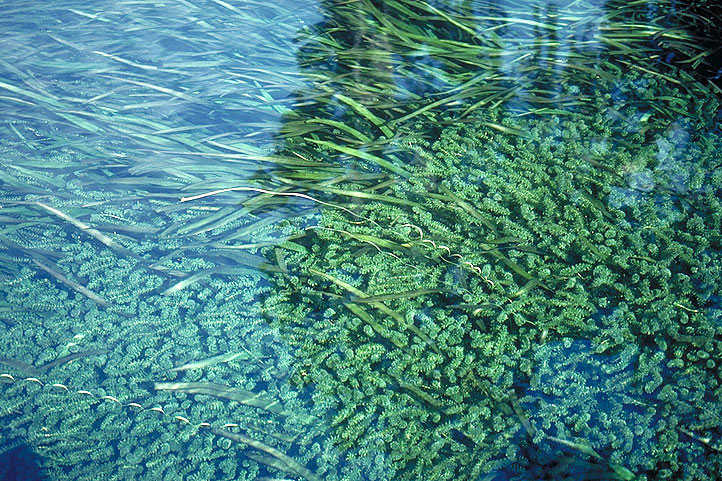
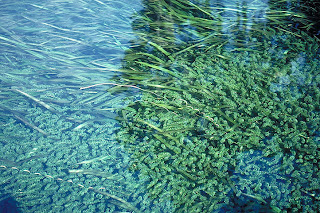 Hydrilla verticillata, commonly known as “hydrilla,” is an aquatic invasive “superweed” – a non-native plant that can grow quickly in waterways and cause serious environmental and economic damages. But before this species takes over, Illinois partners are asking water lovers for their help in preventing hydrilla’s spread.
From the press release:
“Recognized as one of the world’s worst weeds, hydrilla can grow an inch per day and form dense mats of vegetation at the water surface. Within the past few years, hydrilla has been discovered in Wisconsin and Indiana and it is expected to arrive in Illinois very soon. Our desirable native aquatic plants, sport fishing, native wildlife, waterfront property values, and recreational uses might all be seriously impacted.
‘Early detection of hydrilla could save Illinois millions of dollars in control costs,’ noted Cathy McGlynn, coordinator for the Northeast Illinois Invasive Plant Partnership (NIIPP). ‘Experience from other states shows that once a waterway becomes infested with hydrilla, it’s nearly impossible to control. Our hope in Illinois is to identify the plant at a very early stage when populations are still small enough to eradicate and manage,’ added McGlynn.”
Because this species can spread so quickly, the “Hydrilla Hunt!” program is asking boaters, fishermen, swimmers, sailors, and more to help locate it and notify them via e-mail with photos if possible.
*Photo courtesy of the Indiana Cooperative Agricultural Pest Survey Program
June 24th, 2013 by Irene Miles
Lake Erie, one of the Great Lakes that began to rebound significantly thanks to the Clean Water Act and several cleanup projects, is being threatened by toxic blue-green algae. Fed by fertilizers and runoff, the algae can deplete oxygen levels in the water and be detrimental to the lake’s health.
From The Plain Dealer:
“The Western Basin of Lake Erie, located roughly from Toledo to Huron, is becoming seriously affected with toxic blue-green algae. During the summer months, the algal blooms have been so bad that swimmers have emerged from Lake Erie covered in green slime. So far, swimming in Lake Erie has not been prohibited as it was in Grand Lake St. Mary’s, however, the thick algal blooms are not very inviting to swimmers and tends to affect the taste of our drinking water.
The enjoyment of Lake Erie for boating and fishing has also become hampered by the costs to repair clogged engines and the costs of reduced economic drivers, such as fishing charters and other recreational opportunities. We are dangerously close to severely restricting our use and enjoyment of one of the world’s greatest natural resources.”
Read the complete article at the link above to learn more about threats to Lake Erie, and read more about Great Lakes health issues and research at our web page.
June 21st, 2013 by Irene Miles
Allison Neubauer is IISG’s Great Lakes education intern working this summer with Kristin TePas, our community outreach specialist and a liaison to the U.S. EPA Great Lakes National Program Office. Both Allison and Kristin have been on Lake Ontario onboard the U.S. EPA R/V Lake Guardian this week.
Here is Allison’s post from Thursday, June 20, 2013:
Working aboard the Lake Guardian on Lake Ontario this week has been a blast! Interacting with the scientists and crew on the ship has been very fun and insightful. I even had the chance to lend a hand with some of Clarkson University’s contaminant surveillance sampling yesterday evening- so cool! Tonight I’ll be helping pick out mysids (small, shrimp-like crustaceans) from zooplankton net samples.
In this first photo, Clarkson University’s Tom Holsen is dumping sediment from Lake Ontario into the elutriation table (a device that helps scientists rinse organisms out of the mud so that they can be more easily collected).
Here, Kristin (right) and I are rinsing the collected organisms into a sample bottle.
My main focus has been working with Kristin to develop educational outreach materials to engage students and the general public in Great Lakes exploration and broaden their understanding of Great Lakes health. A crucial component in this quest has involved testing several methods of video casting from the ship with some very patient coworkers, friends and family back on shore. Our goal is to find a setup that would allow teachers and students in their classrooms to connect with the ship to see real-time research in action. Scientists would be able to explain the background behind their research, show live footage of sampling equipment and processes, and then field questions sparked in the curious minds of students.
After many trials and tweaks early on in the cruise, we finally found a successful setup and tested it with a fourth grade class in Detroit, Michigan this afternoon! It was awesome to hear how excited the students were to see the ship and learn about work and life onboard, as well as have their questions answered by U.S. EPA and Clarkson researchers and Guardian crew.
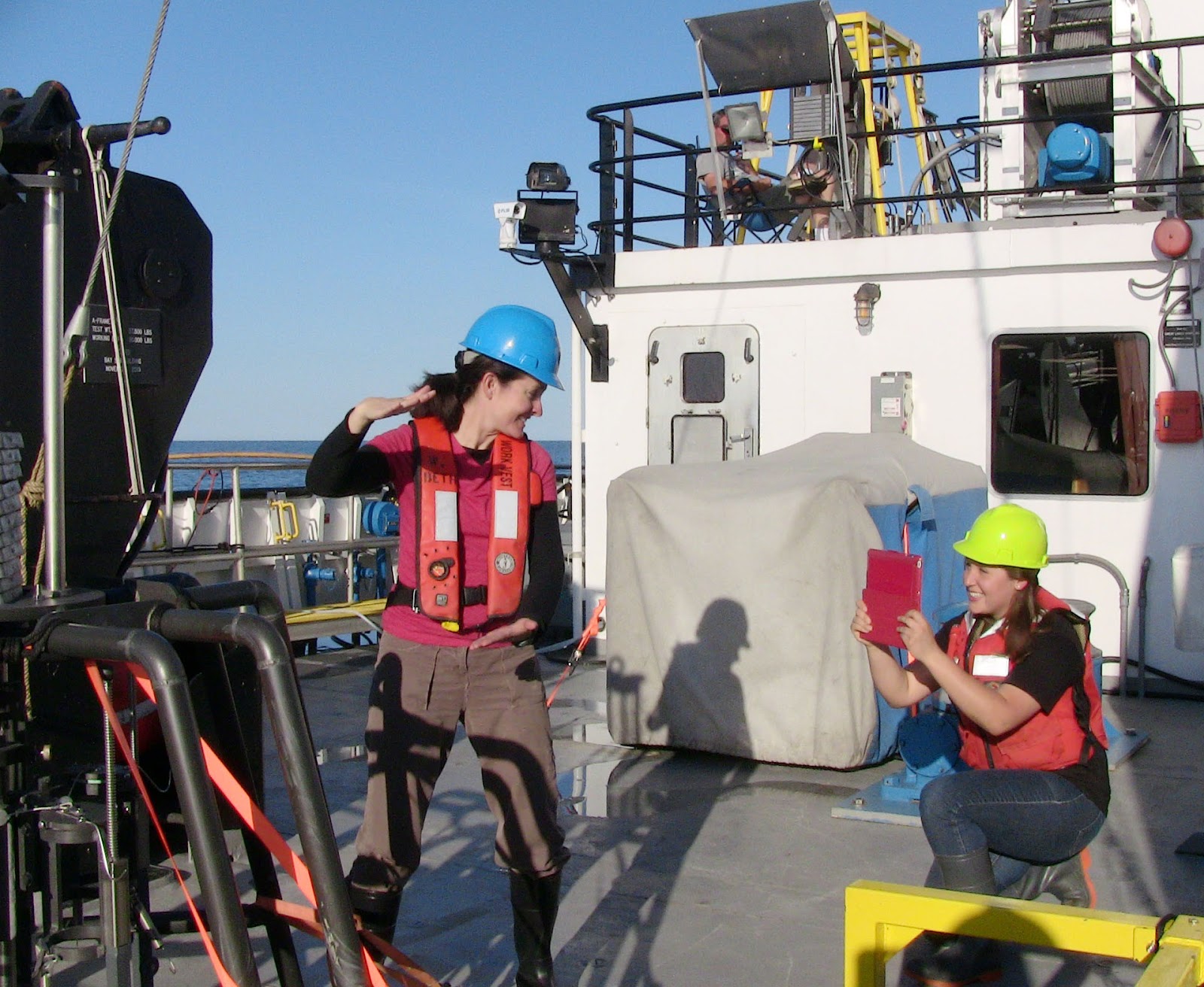
I’m videocasting in this photo as Beth Hinchey Malloy, U.S. EPA scientist, (left) talks to the students from Detroit. Beth is explaining how the multi-corer works, using terminology that would resonate with 4th graders.
Along with testing and conducting video casts, I was really excited to interview some of the crew and scientists onboard about how they got into their field of work and what they do in their position. These interviews were recorded and will be an excellent resource for students to learn about science and nautical careers that are available, with the inside scoop from people who know the ins-and-outs!
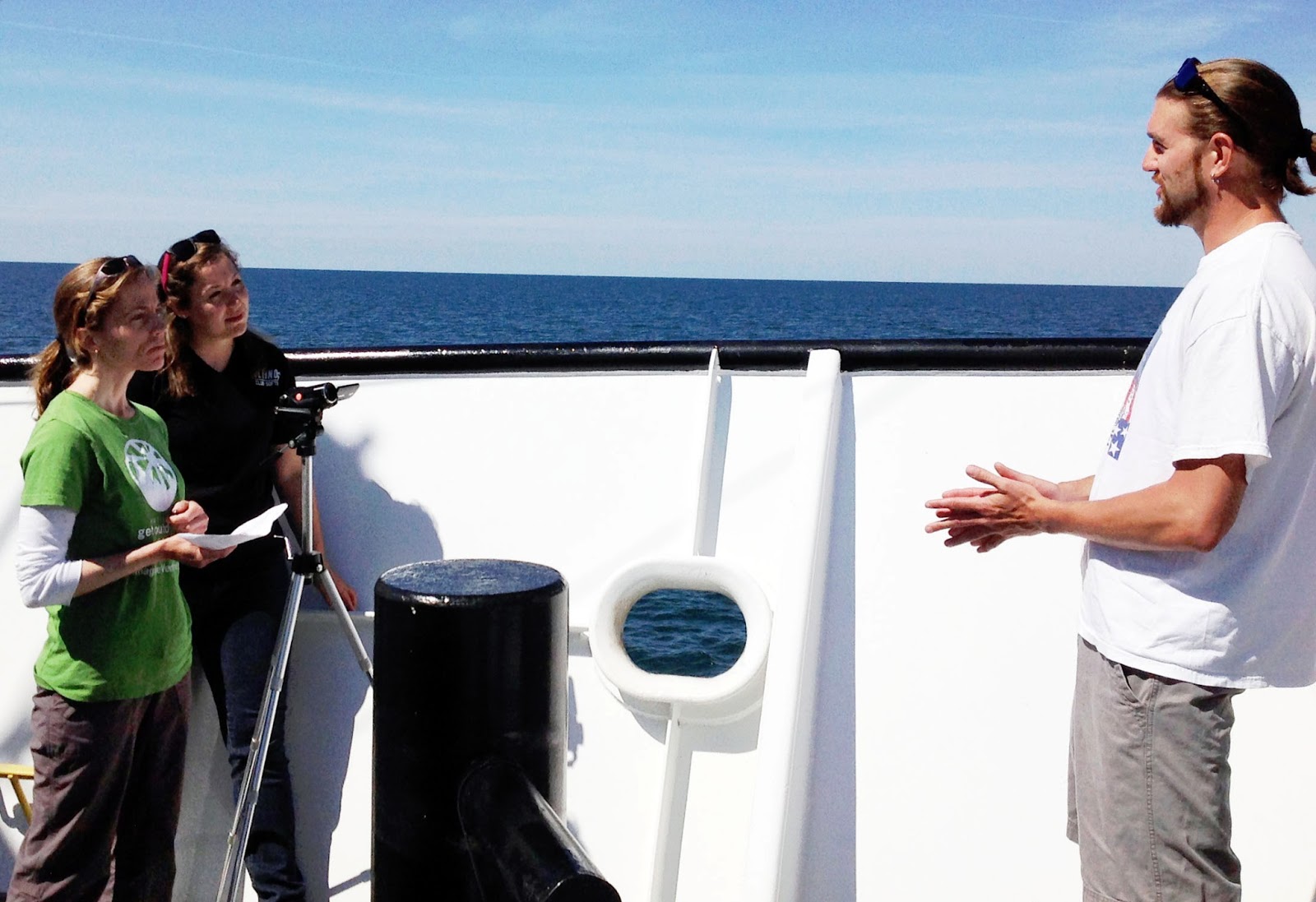
In this photo, Kristin and I are filming an interview with Max, a Lake Guardian marine technician.
So many awesome things are happening aboard the Lake Guardian, and I am really looking forward to finding other interesting and unique ways to share it all with folks back onshore.




.jpg)