
IISG Associate Director for Education Robin Goettel, Education Specialist Terri Hallesy, AIS Specialist Sarah Zack, and AIS Assistant Danielle Hilbrich attended the National Science Teacher Association’s 2012 Conference March 29-31, and got a tremendous response to the educational resources, tips, and information they offered to the many teachers in attendance.

“We had a fabulous turnout of over 5,000 classroom teachers and informal educators at the NOAA-Ecosystems booth,” said Robin Goettel, “which featured our Illinois-Indiana Sea Grant outreach and education resources on Great Lakes aquatic invasive species and marine invaders.”

 Visitors learned about how the “Nab the Aquatic Invader” website can be used as an excellent learning tool for grades 4-10, and how the GLRI “Stop Aquatic Hitchhikers” education and outreach initiative informs people what they can do to prevent the spread of aquatic “hitchhikers.” They also distributed brochures on Great Lakes Literacy principles, and CD-ROM copies of the COSEE/Sea Grant “Fresh and Salt” curriculum on important Great Lakes and marine issues.
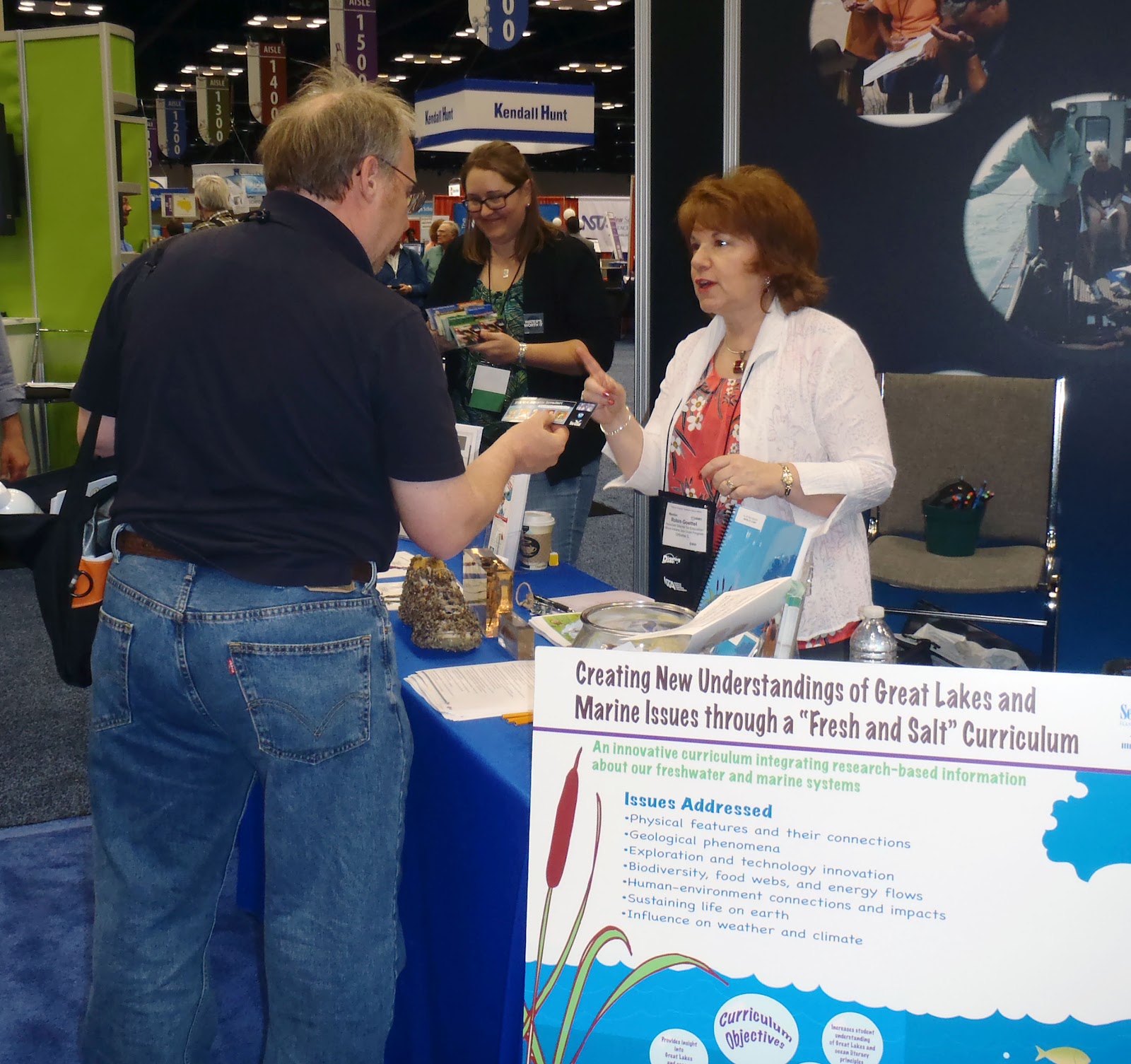
 
Danielle adds, “Our table was located in the NOAA booth on a very busy corner in their ecosystem section and had an extensive amount of traffic throughout the conference.  Our outreach materials included  the brand new “Don’t Let It Loose” poster, which promotes the safe disposal of classroom organisms.”
 

 The “Don’t Let It Loose” poster contains helpful information for teachers about properly disposing of unwanted classroom organisms. Smaller “tip-card” versions of the poster were available too, as well as an adoption pledge containing care tips for students and their families to use when adopting a classroom organism. Some of the highlights at the IISG table were the specimens available for teachers to look at, including a zebra mussel-encrusted shoe, which was a great catalyst to engage teachers in conservation about invasive species.

 
The response and turnout for the event were fantastic, and the event was instrumental in helping IISG spread the word about these important issues. The booth at the conference would not have been possible without the invitation from the National Oceanic and Atmospheric Association, and information and products provided and developed by U.S. EPA’s Great Lakes Restoration Initiative and NOAA Sea Grant’s Aquatic Invasive Species Program.
 
The Illinois-Indiana Sea Grant AIS outreach team is part of the Illinois Natural History Survey’s Lake Michigan Biological Station in Zion.

IISG Instagram

Find us at Chicago Comic & Entertainment Expo, March 27–29! We’re linking Subnautica with Great Lakes science through fun, hands‑on activities about food webs, invasive species, and aquaponics.Come geek out with us! 🔗 in bio for event info
Coastal protection is not limited to concrete, rocks, and steel. Coastal protection solutions exist on a spectrum, ranging from softer “green” solutions to harder “gray” structures.Nature-based coastal solutions fall between green and gray techniques, providing multiple benefits to people and habitats.Our three-part video series, Nature-Based Coastal Solutions in the Great Lakes, is now available to watch. Learn how nature-based coastal solutions, including nature-driven and hybrid approaches, can protect shorelines while supporting ecosystems and communities.Watch the 3-part video series at the link in bio.(Photo credit: Liz Spitzer, Illinois State Geological Survey, Coastal Research Group)
Managers and researchers can be faced with a need to classify the risk of new crayfish invaders. Rapid assessment tools, such as the Science-based Tools for Assessing Invasion Risk (STAIR), can assist in this process by providing a streamlined framework for analysis and decision-making.Join us for an ICC webinar with John Bieber from Loyola University Chicago to learn how rapid assessment tools are used to classify invasive species risk and how STAIR can support invasive crayfish management.Learn more at the link in bio.