When researchers and the media talk about Asian carp reaching the Great Lakes, they are typically referring to bighead and silver carp, the two voracious phytoplankton eaters that are wreaking havoc in places like the Mississippi and Illinois rivers. But the species most likely to establish in Lake Erie may actually be a third member of the Asian carp family: grass carp.
From The Voice:
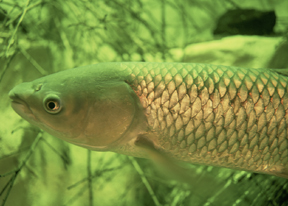
“Grass carp are a different kind of fish and pose different kinds of risk than bighead and silver carp,” said Jeff Tyson, administrator of the Lake Erie Fisheries Program Administrator for the Ohio Department of Natural Resources. Tyson addressed a meeting of environmental writers at Ohio State University’s Stone Lab in Lake Erie on Aug. 18. “We know we have some grass carp in the system. Grass carp impact the system through their impacts on structure and vegetation. They consume huge amounts of vegetation.”
Grass carp could put Lake Erie at risk “by damaging habitats and damaging fish in communities given the documented reproduction of grass carp in large rivers,” according to the Ohio Asian Carp Tactical Plan, 2014-2020. “Grass carp can also decimate submersed aquatic vegetation that is critical to migrating waterfowl and other water birds.” Read more.
**Photo courtesy of Eric Engbretson, US Fish and Wildlife Service, Bugwood.org.
 Sea Grant Illinois-Indiana
News Newsroom
Recent News
- Illinois-Indiana Sea Grant announces 2026 Graduate Student Scholars
- IISG and Purdue FNR Remember Carolyn Foley, Names Great Lakes Research Award
- 2026 IISG interns explore the field of environmental science
- Educators become students at Great Lakes Project WET workshop
- Registration now open for the 2026 State of Lake Michigan Meeting
IISG Instagram

What does a career in natural resources look like?
This month, a group of 4-H youth joined us at Martell Forest to find out! From tree climbing and birding to creating scent traps and dissecting owl pellets, participants spent three days exploring the many ways people work with and protect our natural resources.
Thanks to everyone who joined us! We can’t wait to see where your adventures take you next!


What does it mean to be Great Lakes literate?
It’s understanding how the Great Lakes shape your life and how your choices impact the lakes.
To be Great Lakes literate is to understand, communicate, and care for these special freshwater resources. 💙
Learn more about Great Lakes Literacy by visiting the Center for Great Lakes Literacy’s website at the link in bio.
#TeachingTuesday

Happy Juneteenth from all of us at Illinois-Indiana Sea Grant!

Got a research idea for southern Lake Michigan?
IISG’s 2026 Seed Grant Research Competition is open. Up to $150,000 total funding for pilot studies that could become your next big project.
💵 $10,000 to $50,000 per project
⏰ Applications due August 17, 2026
Two info webinars coming up: July 2 and July 21.
🔗 Full details at the link in bio.
