
Category:

Nearshore buoy coming to Illinois summer 2015

December 2nd, 2014 by

A new environmental sensing buoy will be placed north of Chicago this summer, making it easier than ever for Illinois boaters and beach-goers to spend a fun, safe day on the water. 
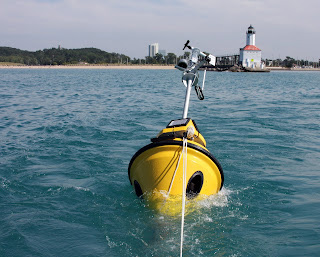
Michigan City Buoy


Like its counterpart in Michigan City, IN, the nearshore buoy will relay information on wave height and direction, wind speed, and air and surface water temperatures in near real time. A webcam will also make it possible to watch changing lake conditions first-hand.

 
This is the newest in a string of nearshore buoys along the Lake Michigan shoreline. In addition to allowing people track waves and temperatures, the data they collect will help officials warn beachgoers when contamination levels may make swimming unsafe. Researchers also rely on the real-time information to manage fisheries, monitor lake currents, and improve hazardous weather predictions.


The Illinois buoy, jointly operated by IISG and LimnoTech, is expected to go online in May. The project is funded by the Great Lakes Observing System through a grant from NOAA Coastal Storms. 

IISG Instagram

Celebrate Earth Day with freshwater science and good conversation! Join Illinois-Indiana Sea Grant, the Northwestern Center for Water, Loyola University researcher Tim Hoellein, and IISG’s Sarah Zack for Science Sips: Trash Talk about Chicago Waterways. Learn what research reveals about litter and trash in Lake Michigan and Chicago waterways and what we can do to help.Plus, enjoy Great Lakes trivia games!📅 April 22, 2026⏰ 7–9 PM📍 Sketchbook Brewing Company, Evanston Tap RoomCome curious and ready to test your Great Lakes knowledge!
Find us at Chicago Comic & Entertainment Expo, March 27–29! We’re linking Subnautica with Great Lakes science through fun, hands‑on activities about food webs, invasive species, and aquaponics.Come geek out with us! 🔗 in bio for event info
Coastal protection is not limited to concrete, rocks, and steel. Coastal protection solutions exist on a spectrum, ranging from softer “green” solutions to harder “gray” structures.Nature-based coastal solutions fall between green and gray techniques, providing multiple benefits to people and habitats.Our three-part video series, Nature-Based Coastal Solutions in the Great Lakes, is now available to watch. Learn how nature-based coastal solutions, including nature-driven and hybrid approaches, can protect shorelines while supporting ecosystems and communities.Watch the 3-part video series at the link in bio.(Photo credit: Liz Spitzer, Illinois State Geological Survey, Coastal Research Group)