June 27th, 2014 by iisg_superadmin
Last month, IISG’s Caitie McCoy held a workshop for teachers in the Buffalo River area of New York to debut a new curriculum, “Helping Hands: Restoration for Healthy Habitats.” This latest edition is specific to the Buffalo River area of concern, and offers a direct link to important environmental projects that are taking place in the students’ community.
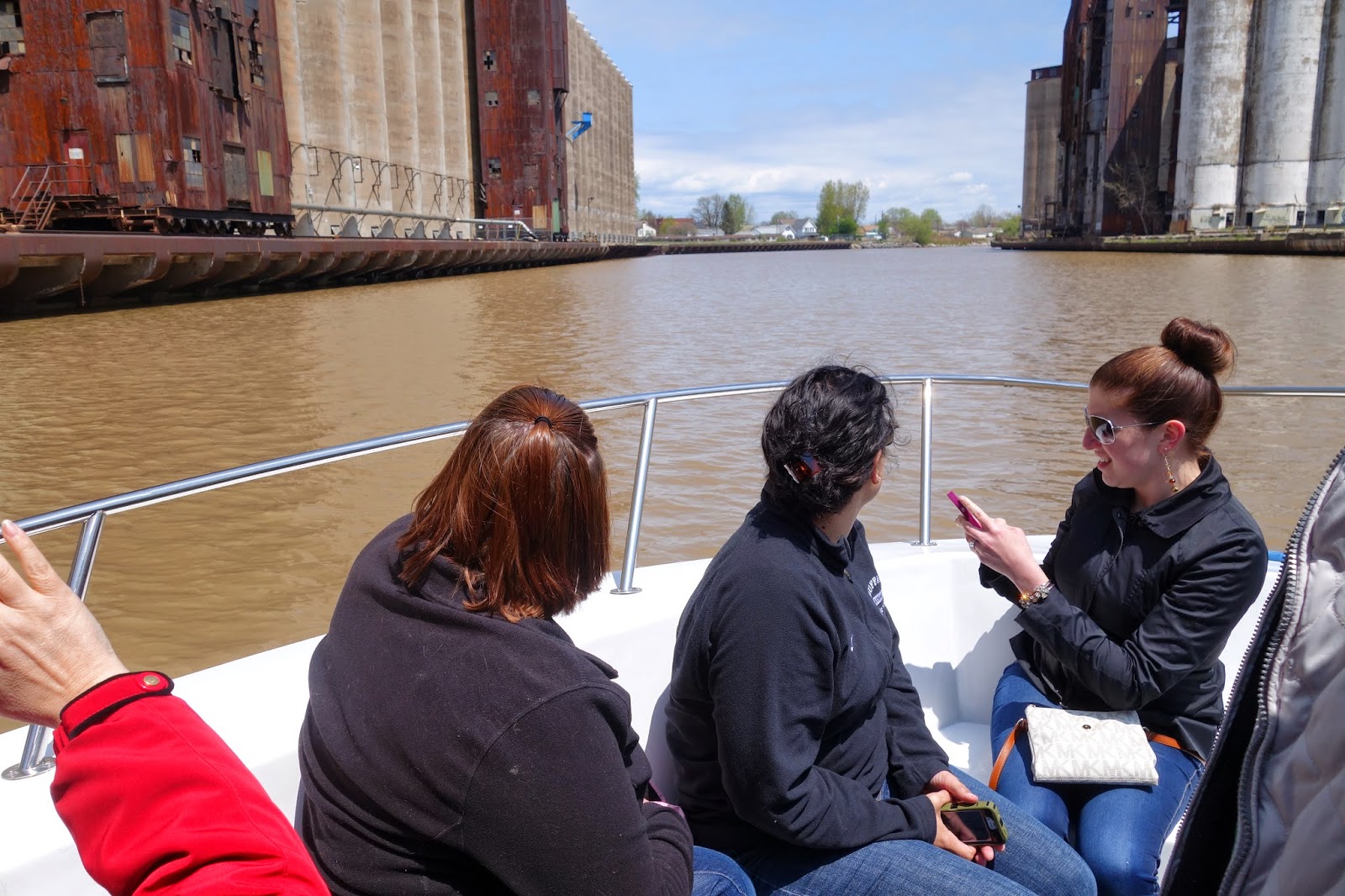 The Great Lakes Legacy Act remediation project on the Buffalo River resumed June 16, and will remove 500,000 cubic yards of contaminated sediment from the river, then replace native aquatic plants to help restore the local ecosystem.
18 teachers from grades 4-11 attended the workshop to learn more about the restoration project and the curriculum, and were treated to hands-on activities and a tour of the river area to help bring the project and its impacts into their classes.
 “It’s great to see so many educators come out to this kind of workshop,” Caitie said. “Many teachers want to incorporate place-based learning in their science curriculum, but may lack resources to do so. Now instead of using distant examples like rainforests to teach science, they can use their neighborhood rivers and lakes. These are places that students can visit and experience the science in person. They develop a love for these places and want to protect them.”
June 20th, 2014 by iisg_superadmin
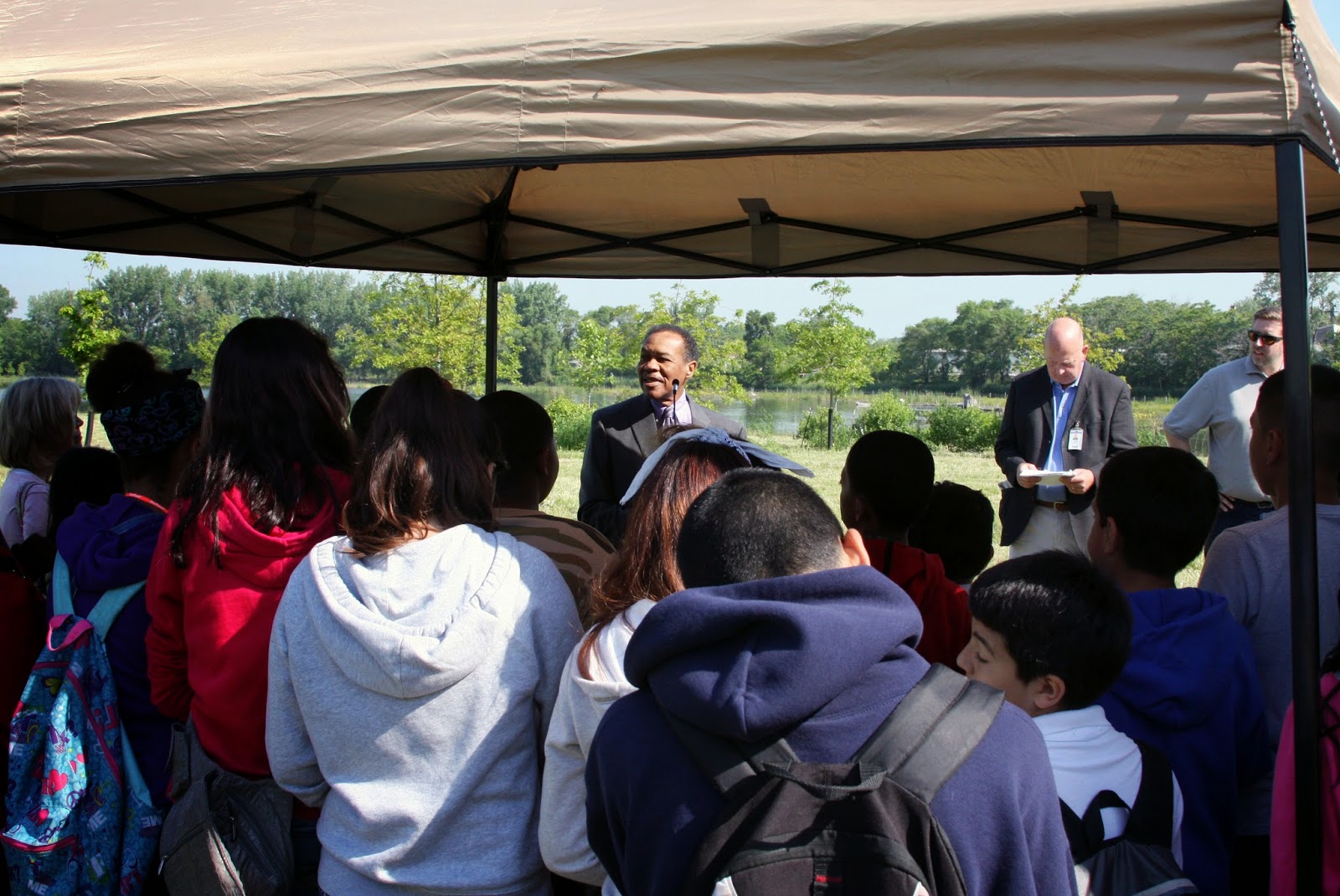
Two years ago, a group of middle school students planted native seedlings along the banks of Roxana Marsh to celebrate the successful cleanup of the waterway. On Monday, those same students returned for another day of learning and service to find the marsh in bloom – thanks in large part to their efforts.
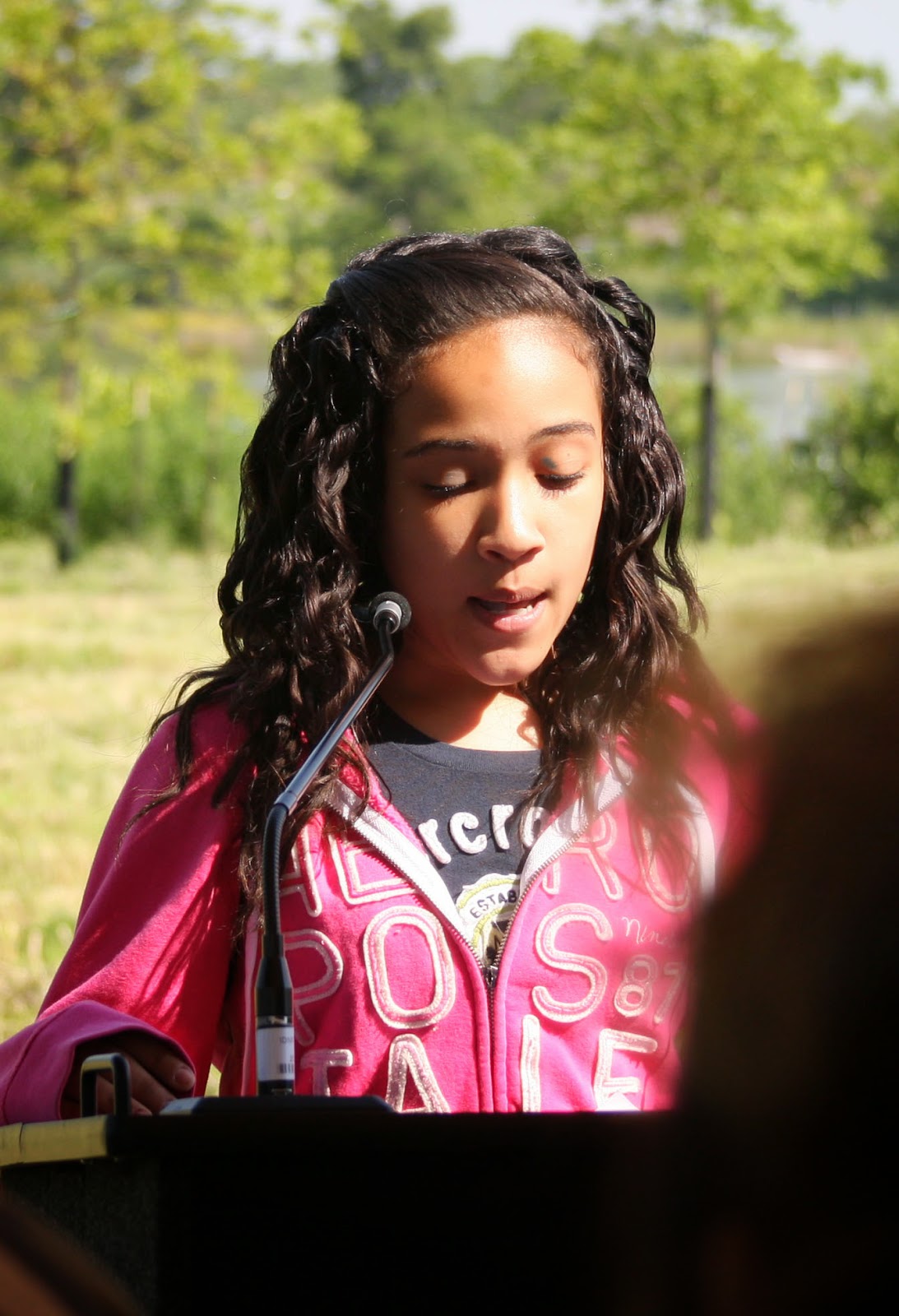
“It’s good to know that we did something phenomenal to help our environment,” said Sandra Olivarria, one of the East Chicago Lighthouse Charter School students participating in the event.
Monday morning’s stewardship began with speeches from state and local officials, including Indiana Representative Earl Harris, Senator Lonnie Randolph, and Mayor Anthony Copeland of East Chicago.
“We need to start to get everyone involved in this kind of project at an early age so that when you grow up, you become part of something that keeps you involved for the long term,” Representative Harris said.
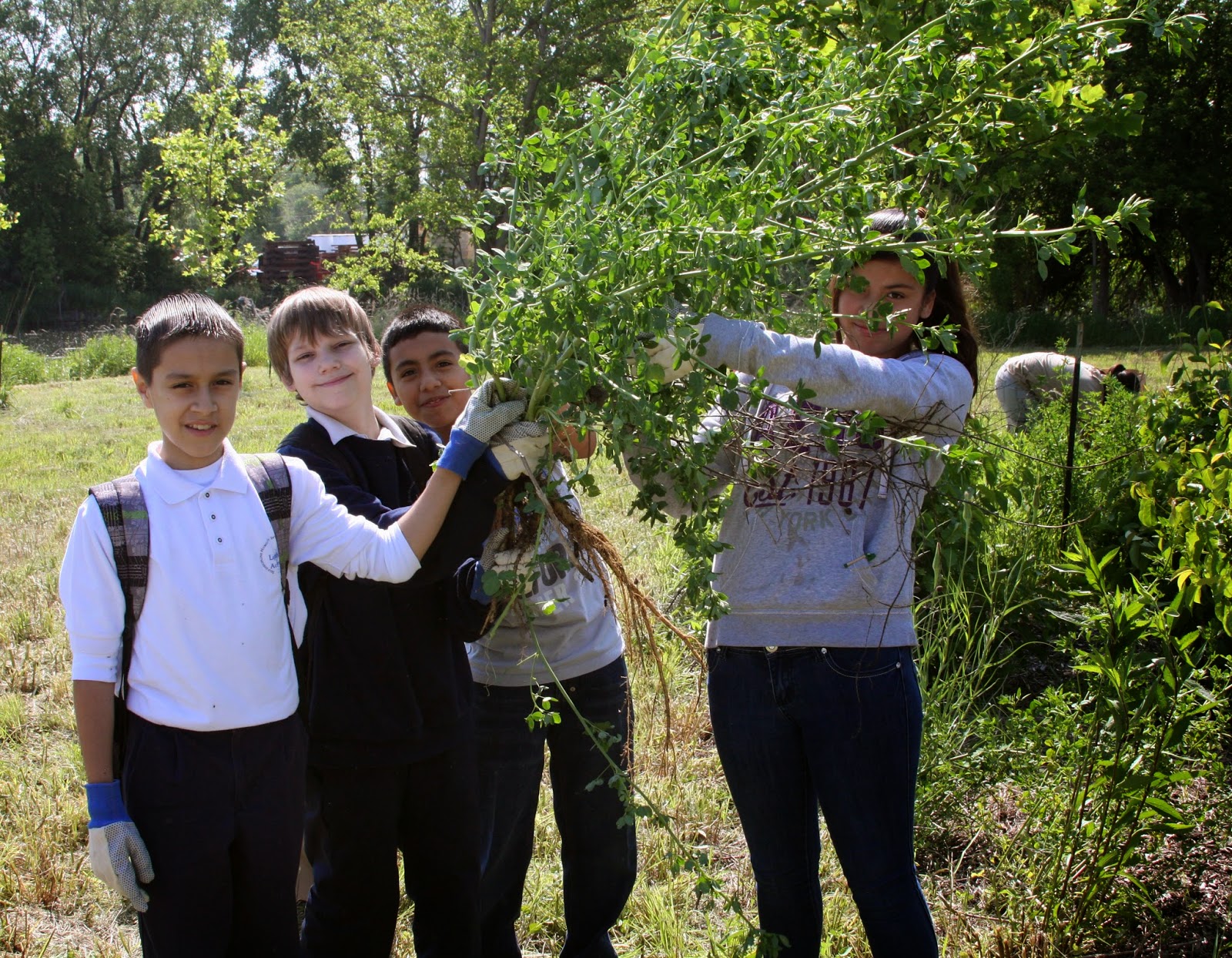
 The rest of the day was devoted to hands-on activities that encouraged students to get familiar with the plants and animals inhabiting the area. The class looked at native and non-native plant species growing around the marsh, then checked on the flowers they had originally sprouted in their classroom. The kids worked together to pull up the invasive clover that had grown around their plantings – a little tricky at times, they said, but “pretty fun, too.”
“It feels so good to come back and see what we did two years ago, and see it all grown and restored!” one student exclaimed.
 Down by the water, volunteer scientists helped students take samples of mud from the marsh to collect bottom-feeding aquatic animals that lived there. The students identified various species of worms, snails, larvae, and tadpoles, and were delighted at the chance to handle these small creatures.
The class also cleaned up trash from the marsh and along Roxana Drive, helping to beautify the area.
“I’m really proud of all the work the students performed today,” said IISG environmental social scientist Caitie McCoy. “It was thrilling to have them come back and take care of a beautiful environment that they helped create. Today, nature was our classroom, and I think the students learned a lot.”
Roxana Marsh is now home to blue herons, wild irises, and all sorts of aquatic life. But it wasn’t always that way. Located on the Grand Calumet River, the marsh was heavily polluted for more than a century with byproducts of heavy industry around East Chicago. Federal and state agencies worked to dredge the river, removing contaminated sediment and restoring the surrounding habitat as part of the U.S. EPA’s Great Lakes Legacy Act.
 Monday’s restoration activities and press event brought together partners from the US EPA Great Lakes National Program Office, US Fish and Wildlife, Indiana Department of Environmental Management, Indiana Department of Natural Resources, Illinois-Indiana Sea Grant, The Nature Conservancy, and Shirley Heinz Land Trust. The Roxana Marsh cleanup and Caitie’s work to improve community engagement here and at other Areas of Concern is possible because of the Great Lakes Restoration Initiative and the Great Lakes Legacy Act.
Teachers interested in integrating AOC issues into their classroom can find activities and other resources in our Helping Hands curriculum.
January 16th, 2014 by Irene Miles
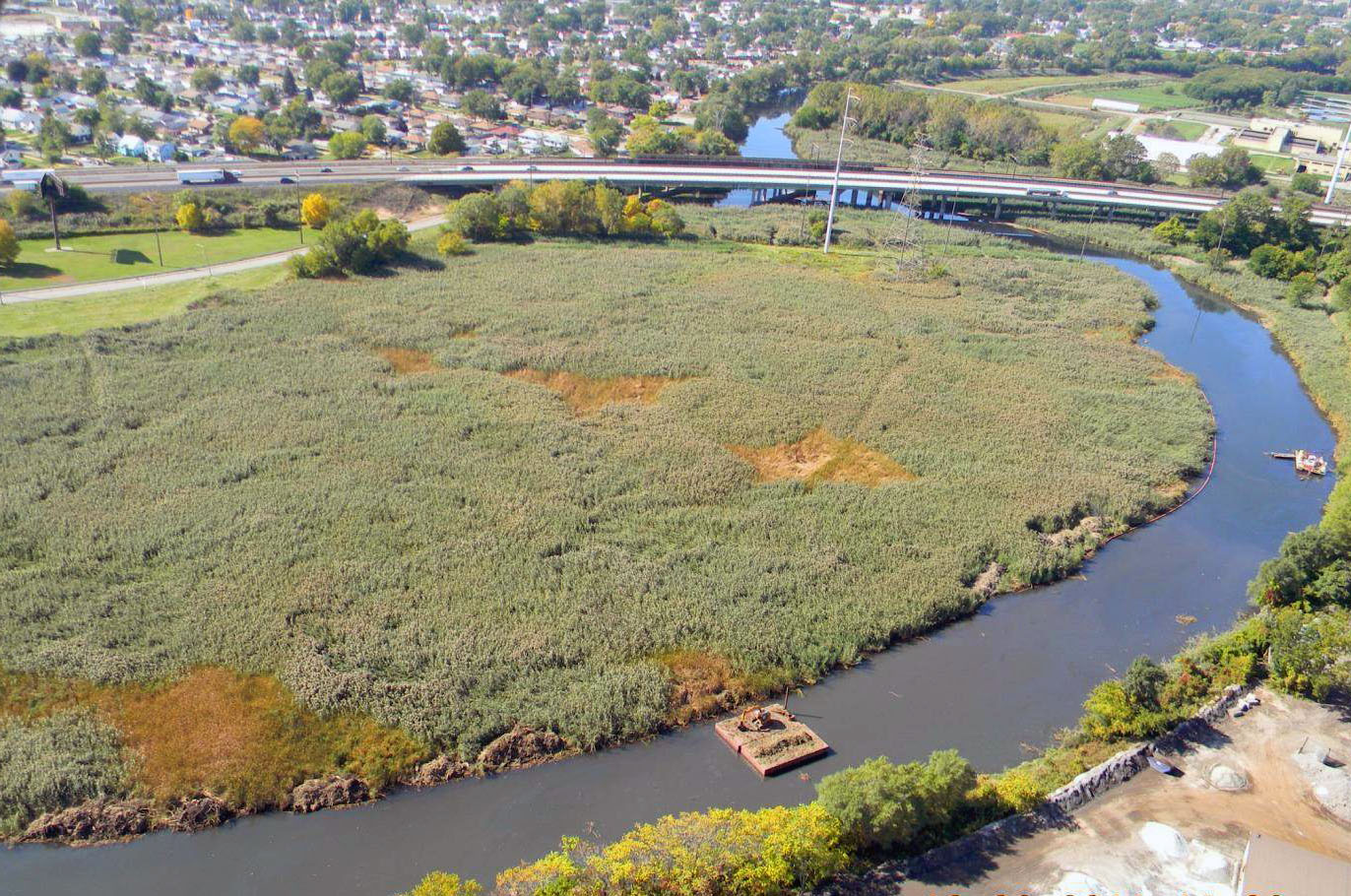
The future is looking bright for the Grand Calumet River. Completed and ongoing restoration projects along the heavily industrialized river have already removed or capped more than 2 million pounds of sediment ridden with toxins like PCBs and heavy metals. And late last year, the EPA took the first step towards cleaning up the final sections of river yet to be addressed.
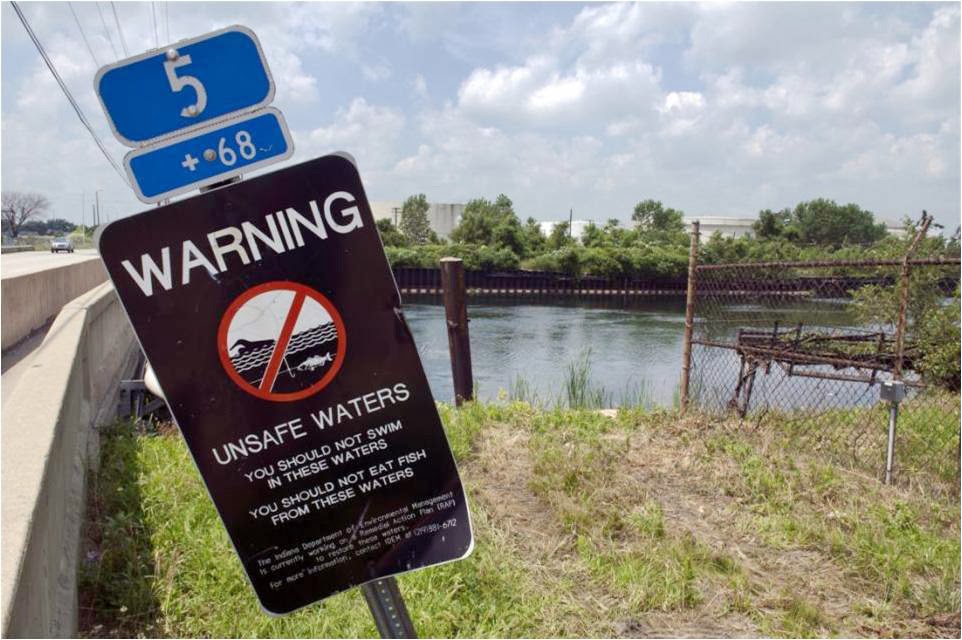 It will be a long road to restoration, but this step means those who live and work nearby can expect to see a clean river bottom with a vibrant plant community as early as 2024.
“This means a lot to the community,” said Caitie McCoy, IISG’s environmental social scientist. “I was recently at a meeting with community members in northwest Indiana who have been fighting for this river for over 50 years where the EPA announced their plans. Their reaction was almost a mixture of joy and disbelief. When you devote your whole life to something, making baby steps of progress along the way, it must be surreal to finally reach that moment. It is an honor to be a part of it.”
For now, efforts are focused on determining the feasibility of cleaning up four river segments: one in Gary, IN and three more in East Chicago, IN, where there is also funding to design a tailored cleanup plan.
Remediation projects are big undertakings. One common strategy, for example, requires contaminated sediment to be dredged, pumped to shore, dried, and trucked off to fill sites certified to handle this kind of waste. At the same time, the water pulled out during dredging has to be treated before it can be returned to the river.
To ensure the success of any new projects in these areas, the EPA is teaming up with the East Chicago Water Management District, the Gary Sanitary District and other local partners to take a closer look at restoration needs. In Gary, planning will likely be completed sometime this year, but it will be another year still before the group announces plans for the stretch flowing through East Chicago. Before any actual cleanup work can begin, though, additional funding and partners will be needed for both projects.
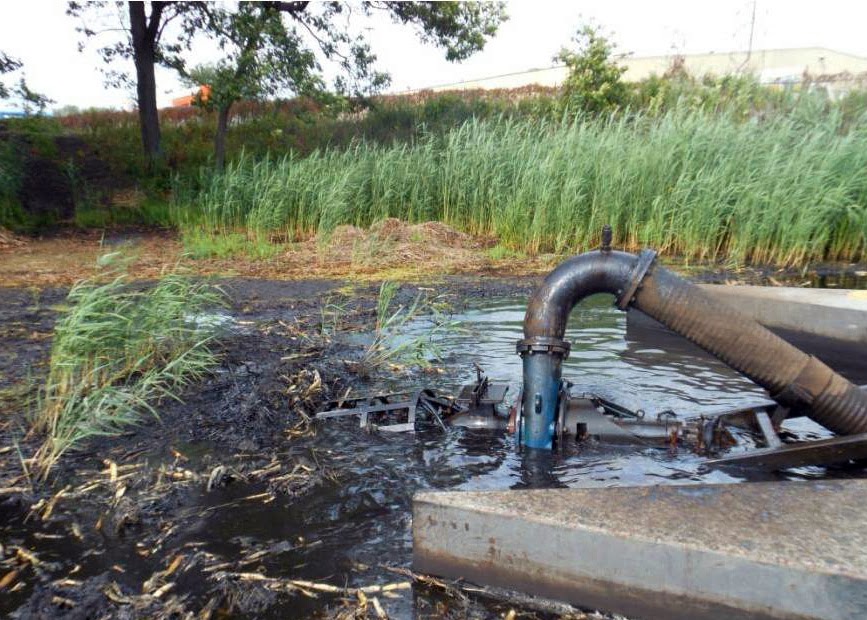 The next few years will also prove significant for two other sections of river. Cleanup efforts at the river’s westernmost end in Hammond, IN are expected to kick off this year. And work on a larger segment of the river just a few miles to the east is expected to wrap up in 2015. There, construction crews have already removed much of the contaminated sediment along the river bed and are now turning their sights to nearby wetlands. Project partners have also begun removing invasive plants along this stretch to make room for native species that will be planted in 2015.
Efforts to restore the Grand Calumet River are part of the Great Lakes Legacy Act, the Great Lakes Restoration Initiative, and the Resource Conservation and Recovery Act.
*Photo 1 courtesy of Lloyd DeGrane
*Photo 2 courtesy of U.S. EPA
December 17th, 2013 by Irene Miles
Residents of Sheboygan, Wisconsin are seeing their namesake river, and the opportunities it holds for the community, in a whole new light thanks to a suite of cleanup projects completed in 2012 and 2013. For decades, high concentrations of PCBs and other industrial pollutants lining the riverbed had kept river-goers and businesses at arm’s length. But with the contaminated sediment removed and habitat restoration well underway, the public is embracing the river with full force.
 “After nearly three decades of being a black eye of the community, we are thrilled that the Sheboygan River and harbor is being restored to reduce health risks to people, fish, and wildlife, and will greatly enhance opportunities for economic development,” said Adam Payne, Sheboygan County Administrator at a 2012 press event celebrating the project.
Perhaps the biggest boost so far has been to recreation. Dredging the equivalent of 15,000 dump trucks of contaminated sediment left boaters and anglers with a deeper river that is easier to access and navigate. With the contamination gone, the community has also started to see the Sheboygan River as a safe place to spend an afternoon. Just a few months after the project ended, residents reported seeing more and bigger boats navigating in and out of the river’s harbor, and they expect to see even more fishing and boating in the coming years.
“Anytime you have a healthy river going through a community, you have a better quality of life,” said one resident to IISG’s Caitie McCoy and Emily Anderson as part of a series of interviews about how community perceptions of the river had changed.
The deeper, cleaner river has also attracted local businesses. Everything from coffee shops to digital communications companies have opened along the river, and more businesses are expected to follow. It is too early to say just how much the cleanup project will impact things like property values, tourism, and redevelopment, but it is already clear that riverfront development is on the rise thanks to changes to the river and its newly restored status within the community.
“When it comes right down to it, those who would invest in the river and want to develop this property, they are really after the water access,” said another resident.
 There is good news for local wildlife too. With the dredging work completed, the Wisconsin Department of Natural Resources and other project partners have begun work to restore native habitats. Recently planted native plants have caught the attention of a variety of species, including cranes and blue birds. With this work done, the Sheboygan River will officially be taken off the list of most polluted places in the Great Lakes.
October 7th, 2013 by Irene Miles
Among the many Areas of Concern (AOCs) designated by the International Joint Commission, Illinois-Indiana Sea Grant has been involved in several providing research and reports on local stakeholders perceptions of cleanup operations and ways in which they are affected by the projects. This latest report details the St. Louis River AOC.
From IISG’s Caitie McCoy:
“A report on stakeholder perceptions of the St Louis River Area of Concern (AOC) and attitudes toward the cleanup and restoration work is now available. This summer, I traveled to the St Louis River with my intern Emily Anderson to perform social science research on community attitudes toward remediation and restoration. The river is located on the border between Duluth, MN and Superior, WI, and is the largest U.S. AOC. The report will help tailor efforts of the Spirit Lake Outreach Team toward local stakeholder needs and interests at the current Great Lakes Legacy Act site in the river, Spirit Lake.
Emily provided her thoughts on the experience – ‘Being part of the research team for this project allowed me to experience firsthand how social science contributes to environmental remediation and restoration. Conducting the interviews with Caitie, I met so many intriguing and knowledgeable people; I now see the direct implications that stakeholder input can have for both outreach and project design.’
This assessment is part of a larger effort to understand how AOC work influences stakeholder perceptions and use of waterways at a regional scale. A similar report on the Sheboygan River is available and a follow-up report on Sheboygan, post-cleanup, is coming soon.”
July 2nd, 2013 by Irene Miles
The Great Lakes Ecological and Economic Protection Act was introduced by Senators Carl Levin (D-MI) and Mark Kirk (R-IL), co-chairs of the Senate Great Lakes Task Force, along with Senators Debbie Stabenow (D-MI), Amy Klobuchar (D-MN), Sherrod Brown (D-OH), Richard Durbin (D-IL), Al Franken (D-MN), Charles Schumer (D-NY) and Tammy Baldwin (D-WI).
 In addition to reauthorizing the Great Lakes Legacy Act, which provides support for communities to clean up waterways that are designated Areas of Concern (AOC) the United States and Canada, the new legislation would continue funding the Great Lakes Restoration Initiative and the EPA Great Lakes National Program Office.
The 10-minute video, produced by Illinois-Indiana Sea Grant and Wisconsin Sea Grant, explores Great Lakes waterways blighted by decades of industrial discharges like heavy metals, oil, and chemicals such as PCBs and PAHs. The 2002 Great Lakes Legacy Act created an initiative to clean up contamination in these AOCs. There are currently 29 AOCs in the United States. The habitat, water, and sediment quality have become severely degraded at these sites.
The video informs anglers, boaters, residents, and local businesses of the benefits that can come from a remediated AOC through the Legacy Act. The procedures and successes are the result of strong partnerships among states, municipalities, non-governmental organizations and businesses. Under this voluntary, collaborative program, the EPA and its non-federal partners have allocated almost $400 million toward sediment remediation.
As of September 2012, the program has removed or capped 2.1 million cubic yards of degraded sediment. But more waterways need to be cleaned up, and community involvement is essential.
Learn more about the Great Lakes Legacy Act at the EPA’s GLLA webpage.
May 29th, 2013 by Irene Miles
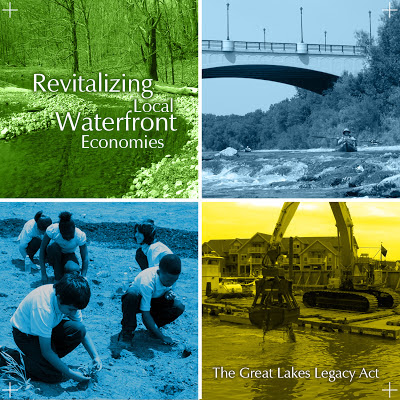
Revitalizing Local Waterfront Economies: The Great Lakes Legacy Act is a new video that welcomes people and partners to the benefits of restoring degraded rivers, harbors, and lakes.
Before modern-day environmental regulations, Great Lakes waterways became blighted by decades of industrial discharges. The Legacy Act was established in 2002 to clean up contamination in these places, known as Areas of Concern. The Legacy Act is helping to revitalize local waterfront economies through strong partnerships with states, municipalities, and businesses.
Altogether, the Legacy program has removed or capped 2.4 million cubic yards of sediment. But more waterways need to be cleaned up, and community involvement is essential. “This video can help simplify and personalize the sediment cleanup process, which at first glance may seem too complex and scientific,” said Caitie McCoy, IISG environmental social scientist. “The Great Lakes Legacy Act has been incorporating community values with technical science for more than a decade.
“Cleaner lakes and rivers improve human health, fish and wildlife health, recreation, tourism, and redevelopment so that residents can better capitalize on these opportunities,” added McCoy.
The 10-minute video was produced by IISG and Wisconsin Sea Grant with funding from U.S. EPA Great Lakes Restoration Initiative. You can view the video online here or at the Illinois-Indiana Sea Grant YouTube channel.
May 6th, 2013 by Irene Miles
Dredging and restoration work on another section of the Grand Calumet river is set to begin this spring, removing more than one million cubic yards of contaminated sediment from the river bottom and rebuilding local wetlands.
Caitie McCoy, IISG’s environmental social scientist, provides some more information about the upcoming work:
“Work will start April 22 on a project that will dredge (remove) or cap (isolate from the ecosystem) 1.2 million cubic yards of river bottom sediment contaminated with PAHs, oil & grease, PCBs, and heavy metals like cadmium and copper. Volume-wise, this would fill about 300 Olympic-sized swimming pools. Along with restoration of more than 50 acres of wetland habitat, this work will take place for approximately three years from Kennedy Ave to Cline Ave…
This work is funded by US Environmental Protection Agency, Indiana Department of Environment, and Indiana Department of Natural Resources, in partnership with US Fish and Wildlife Service, The Nature Conservancy, Shirley-Heinze Land Trust, Save the Dunes, municipalities, and other local and federal partners. The US Army Corps has also begun dredging in the Indiana Harbor and Ship Canal, and is on track to dredge 300,000 cubic yards through August this year.”
February 18th, 2013 by Irene Miles
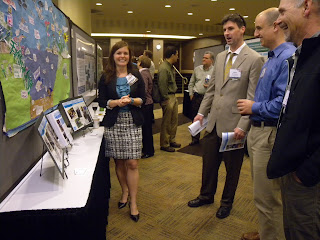 IISG’s Caitie McCoy attended the Seventh International Conference on Remediation of Contaminated Sediments last week to present her community outreach work with the Great Lakes Legacy Act (GLLA). The conference traditionally features environmental scientists and engineers, but that is changing. “We are starting to see more attention paid to community engagement at these types of conferences,” Caitie tells us. “Technical project managers realize that projects are easier to implement when the community understands and supports the work, and so they’re eager to learn from professionals who specialize in community engagement and stakeholder involvement.”
Caitie presented a poster on her educational program in northwest Indiana, which taught students about the GLLA sediment cleanup at Roxana Marsh on the Grand Calumet River. Instead of presenting a typical scientific poster full of text and graphs, Caitie displayed a mural that her fourth grade students made to represent the Roxana Marsh ecosystem.
“Some of my colleagues were a bit skeptical about me presenting a fourth grade mural to a bunch of technical folks, but I’m not afraid to shake things up,” Caitie said. “I wanted to use something eye-catching that would draw people’s attention toward my poster.” And it worked. Caitie was visited non-stop during the session and talked to more than 100 conference attendees about her program. When asked if she thought her poster made an impact, Caitie replied, “I would never have dreamed that someday engineers would be asking me how to replicate my educational program at their sites, so I take that as a big success.”
 Caitie will expand her programming throughout the Grand Calumet River community in 2013, as the Legacy program begins another phase of dredging this summer.