
Category:

Social science researchers help evaluate more effective weather warnings

May 14th, 2014 by
The National Weather Service’s Weather-Ready Nation initiative was begun to help communities throughout the country better prepare for and respond to severe weather events. Much of that preparedness has to do with increasing the speed, accuracy, and effectiveness of weather monitoring and warning mechanisms on the local level. And finding the strongest ways to communicate weather messages to residents is key. 
 
That is why, as part of the Weather-Ready Nation project, the Great Lakes Social Science Network conducted extensive research into the most effective impact-based warnings. Their report, “Evaluation of the National Weather Service Impact-based Warning Tool,” utilized interviews, focus groups, and surveys to determine the most and least effective ways for broadcast meteorologists and emergency managers to communicate these warnings to the public.
 
National Weather Service piloted an impact-based warning system in 2012 in five select offices, and expanded it to the central region’s 38 offices in 2013. The report offers a sort of mid-term evaluation of the system’s effectiveness and stakeholders’ perceptions of it, while also providing recommendations for further training and implementation improvements. 
 
This research was a team effort between representatives from five Great Lakes Sea Grant programs. Caitie McCoy and Leslie Dorworth from Illinois-Indiana Sea Grant were involved, as well as Dr. Jane Harrison (Wisconsin Sea Grant), Dr. Kathy Bunting-Howarth (New York Sea Grant), Hilarie Sorensen (Minnesota Sea Grant), Katie Williams (University of Wisconsin-Milwaukee), and Dr. Chris Ellis (NOAA Coastal Services Center). The report was presented earlier this year to the Social Coast Forum in Charleston, SC, sparking a number of other groups and agencies to inquire about the report and possible opportunities to expand on it with further research. 
 
For further information about the Great Lakes Social Science Network, as well as training and future research projects, visit the link above.
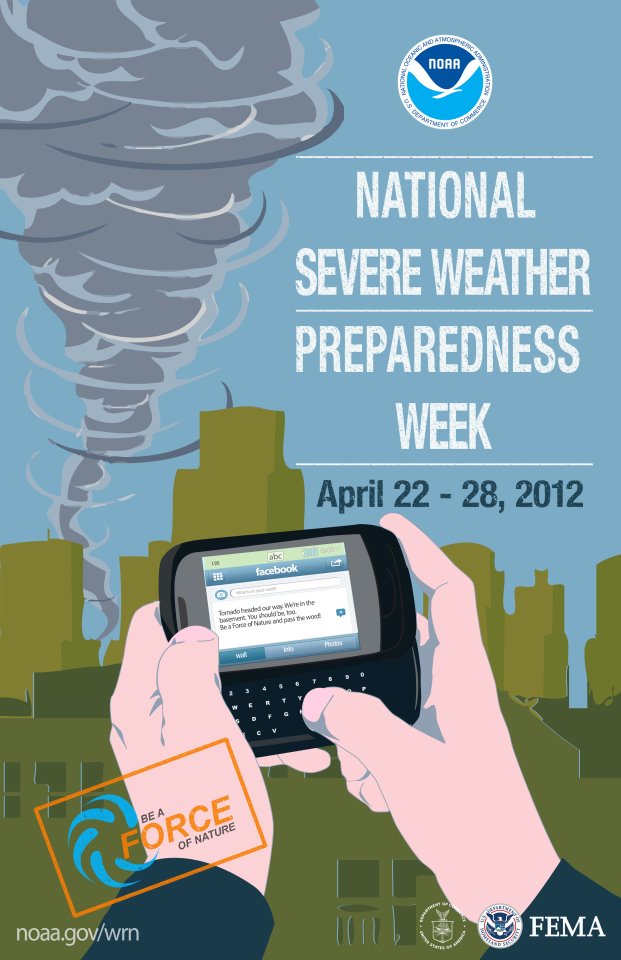

NOAA and FEMA partner to Build a Weather-Ready Nation

April 24th, 2012 by
Natural weather cycles, extreme conditions, and other issues can arise anywhere, and particularly in areas near coastlines. Residents near rivers and lakes are often aware of the potential for season flooding and other weather concerns, but may not be fully prepared for all of the possibilities. Additionally, each area of the country has the potential for unique weather concerns, such as flooding or tornadoes here in the Midwest.
 
As part of a campaign to Build a Weather-Ready Nation, the National Oceanic and Atmospheric Association and the Federal Emergency Management Agency are joining forces with Sea Grant programs across the country. The campaign invites everyone to Be a Force of Nature by taking certain steps that can help you and your community be prepared for inclement weather and the dangers associated with weather events.
 
Some important steps taken now can make a big difference later, including: 
 
Knowing your risk – Being aware of impending weather events and aware of risks associated with areas you live and work in (i.e. potential flooding, tornadoes, strong winds, etc.)
 
Take action – Develop an emergency plan that the whole family knows about. This can include information such as where to meet in the event of an emergency, ways to stay in contact with one another, and other important details. 
 
Be a Force of Nature – Once you have a plan, share the information, resources, and more with friends, family, neighbors, co-workers, and anyone else. You can visit the links above and share information directly from those Facebook pages, as well as spreading the word through other means. Sharing these simple steps with others is one great way to help everyone stay safe.


IISG Instagram

Join is in welcoming our new research and reporting coordinator, Laura Esman, to the team! In her new role, Laura will oversee research competitions and manage IISG’s research portfolio. She will also spearhead IISG data collection and lead the program’s annual reporting process.Esman brings over 30 years of experience in research, project coordination and grant administration. Her most recent positions include managing director of the Indiana Water Resources Research Center, and lab manager and research associate in the Natural Resources Social Science Lab in Purdue’s Department of Forestry and Natural Resources.Full story at the link in bio.
There’s still time to register! Educators are invited to join the Great Lakes Region Place-Based Education Institute starting this February and dive into hands-on strategies that connect students with their communities and local environments. Don’t miss this powerful professional learning opportunity!Learn more & register at the link in bio.
🎉 Congratulations to our IISG Knauss Fellowship finalists! We’re proud to announce Anupama Chandroth (@iubloomington) and Laura Gray (@illinois1867) as Illinois-Indiana Sea Grant’s finalists for the 2026 Sea Grant Knauss Fellowship.They’ll join a national cohort of 48 finalists placed in executive and legislative branch offices in Washington, D.C., contributing scientific expertise to federal decision-making on marine, coastal, and Great Lakes issues.Full story at the link in bio.