
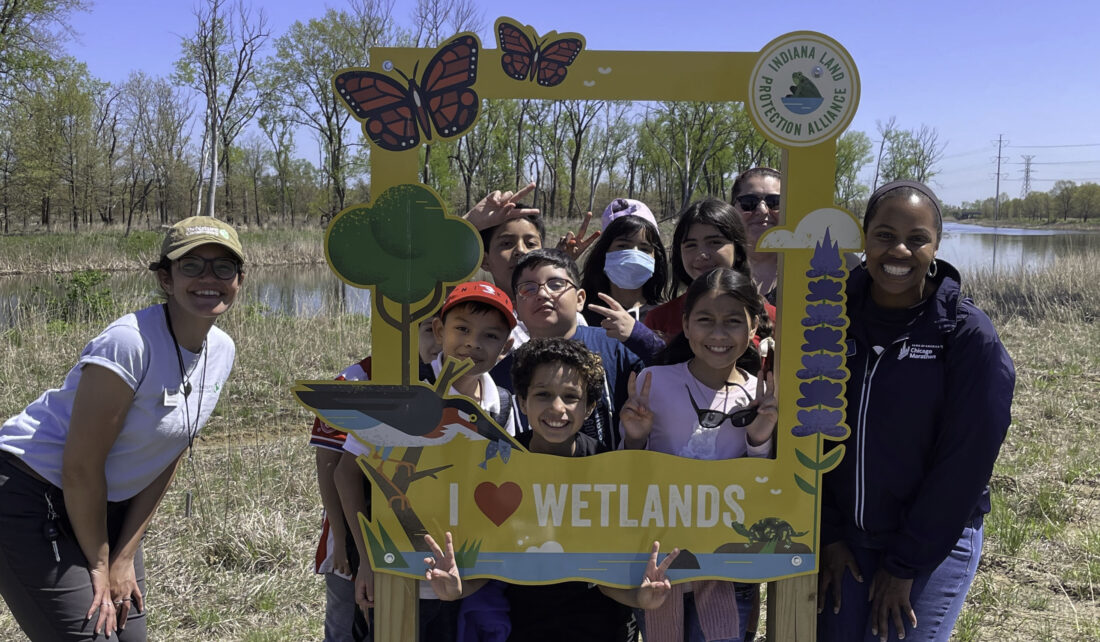
As last April wound down and the school year was nearing its final days, 70 fifth graders from McKinley Elementary School in East Chicago, Indiana spent a day in nature learning from a variety of scientists and experts about a range of topics.
The annual Calumet Stewardship Day took place on April 30, once again at Seidner Dune and Swale in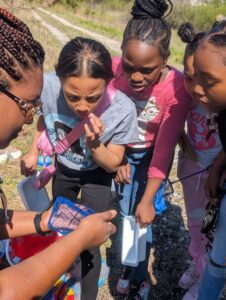 Hammond. This natural area sits along the Grand Calumet River, which has been designated an Area of Concern (AOC) and has been undergoing a cleanup and restoration process through the Great Lakes Legacy Act.
 Illinois-Indiana Sea Grant and The Nature Conservancy organize the event that helps connect grade school youth to their local environment. They learn about the health of the river and the remediation and restoration efforts of the Grand Calumet River.
“Stewardship Day activities engage youth in environmental education and build support for the long-term protection of natural resources,” said Ashley Belle, IISG Great Lakes AOC specialist, who led the planning of the event along with Jessica Fernandez of The Nature Conservancy.
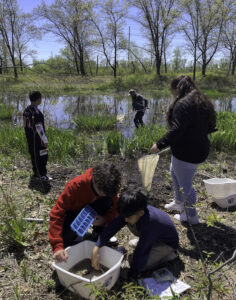
Over the course of the school day, the students had the opportunity to interact with professionals from a variety of environmental agencies and organizations as they rotated through hands-on activity stations, learning about topics such as dune and swale habitats, fish health in local waters, birding, and macroinvertebrate identification.
Teacher surveys showed that the event stimulated student learning and provided a valuable experience.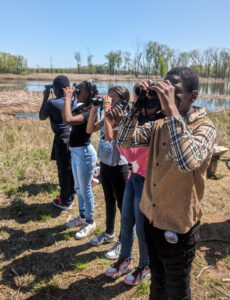 One teacher commented, “One of my favorite parts of the day was watching my students learn how to use binoculars and identify different types of birds. For some of them, this was their first experience with binoculars.”
Illinois-Indiana Sea Grant is one of 34 Sea Grant programs supported by the National Oceanic and Atmospheric Administration in coastal and Great Lakes states that encourage the wise stewardship of our marine resources through research, education, outreach and technology transfer. In partnership with the University of Illinois Extension, and Purdue University Forestry and Natural Resources, Illinois-Indiana Sea Grant brings science together with communities for solutions that work.