 Sea Grant Illinois-Indiana
Our Work Coastal Resilience Programs & Initiatives Nature-based Coastal Solutions In the Great Lakes: Video Series
Nature-based Coastal Solutions In the Great Lakes: Video Series
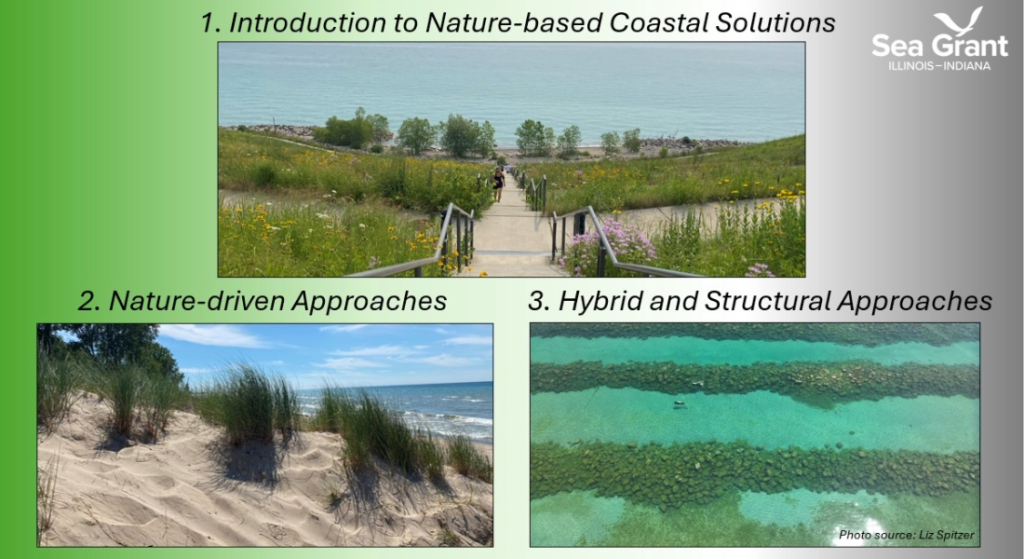
Coastal protection options exist on a spectrum, ranging from softer “green” solutions like native vegetation to harder “gray” infrastructure such as groins, revetments, and seawalls.
Nature-based coastal solutions, which are designed to enhance, integrate, or mimic natural features to protect the coast and support habitats, typically fall in between “green and gray techniques”. Leveraging visualizations and expert guidance, this video series helps communities learn about common types of nature-based coastal solutions in the Great Lakes, including nature-driven and hybrid approaches, knowledge of which is fundamental for informed coastal decision-making and enhanced community resilience.
-
Introduction to Nature-based Coastal Solutions
Coastal protection options are not limited to just hard armoring – they can range from “green” to “gray” techniques, including nature-based solutions. This video provides a brief overview of nature-based coastal solutions, application in the Great Lakes, and introduces common types, including nature-driven and hybrid approaches, information which can be useful to coastal decision-makers, managers, and communities.
-
Nature-driven Approaches
Nature-driven approaches are a type of nature-based coastal solutions that are centered on natural processes and work with the environment by utilizing or enhancing natural features and materials for coastal protection and habitat preservation. This video discusses common types of nature-driven approaches relevant to the Great Lakes, key opportunities and limitations, and considerations for application and long-term effectiveness.
-
Hybrid and Structural Approaches
Hybrid approaches are a type of nature-based coastal solutions that combine hard coastal structures with natural or nature-driven elements to protect the shoreline and provide ecological benefits. This video discusses common types of hybrid to structural approaches in the Great Lakes, including ecologically enhanced hard armoring and habitat enhancement features, important benefits and detriments, and considerations for application and long-term effectiveness.
Funding and Acknowledgments:
This project was produced by Illinois-Indiana Sea Grant in collaboration with Purdue University, with financial assistance provided by under award NOAA-OAR-SG-2022-2007253 from the National Sea Grant College Program, National Oceanic and Atmospheric Administration (NOAA), U.S. Department of Commerce.
Illinois-Indiana Sea Grant
Production team: Sarah Peterson, Natty Morrison, Joel Davenport
Purdue University Brand Studio Productions
Director/producer/editor: TJ Preston
We thank the participating communities, agencies, experts, and local collaborators featured in this video series.
Interviewees
- Dr. Cary Troy | Purdue University
- Dr. Rebecca Nicodemus | National Oceanic & Atmospheric Administration (NOAA), NOAA Office for Coastal Management
- Dr. Sarah Peterson | Illinois-Indiana Sea Grant/Purdue University
Reviewers
- Dr. Adam Bechle | Wisconsin Sea Grant
- Mark Breederland | Michigan Sea Grant
- Dr. Hillary Glandon | Illinois Natural History Survey, Illinois-Indiana Sea Grant
- Joe Exl | Indiana Lake Michigan Coastal Program
- Cody Eskew | Illinois Coastal Management Program, Illinois Sustainable Technology Center
Contributions
- Baird (special thanks to Nicole Rusek and Rory Agnew
- Ben Young, NEW Water
- Brian Majka, GEI Consultants
- Civil Air Patrol, Wisconsin Wing (special thanks to Capt. Dennis Carr)
- Chin Wu, University of Wisconsin-Madison
- David Mickelson, University of Wisconsin-Madison
- Erie Soil and Water Conservation District (special thanks to Breann Hohman)
- GeoData@Wisconsin
- Hillary Glandon, Illinois Natural History Survey
- Illinois Department of Natural Resources, Coastal Management Program
- Indiana Department of Natural Resources, Lake Michigan Coastal Program
- J. Sandberg
- Jim Killian, Wisconsin Department of Natural Resources
- Josh Sonnenberg, Operations & Facilities Director, Charter Township of Chesterfield
- Julie Kinzelman, City of Racine
- Littoral Services
- Liz Spitzer, Illinois State Geological Survey, Coastal Research Group
- Lyles School of Civil and Construction Engineering (special thanks to Muhammed Nedim Sahvelet)
- Marek Landscaping
- Michigan Department of Environment, Great Lakes, and Energy (EGLE), formerly Michigan Department of Environmental Quality (DEQ) (special thanks to Zach Chamberlin)
- Michigan Sea Grant (special thanks to Mark Breederland and Todd Marsee)
- National Oceanic and Atmospheric Administration, Office for Coastal Management
- National Wildlife Federation
- Noel B Pavlovic, USGS – Great Lakes Science Center
- Park District of Highland Park (special thanks to Liz Ricketts)
- Ramboll (special thanks to Tony Eallonardo, Miles Tyron-Petith, Dustin L. Tazelaar, and Craig M. Harley)
- Shoreline Oblique Photography Collection Courtesy of The Association of State Floodplain Managers. 2025. Wisconsin Shoreline Inventory and Oblique Photo Viewer. https://no.floods.org/wcmp. Photos by U.S. Army Corps of Engineers, Wisconsin Civil Air Patrol, and David Mickelson, with Association of State Floodplain Managers, GeoData@Wisconsin, and WisconsinView. Funded by the Wisconsin Coastal Management Program and the National Oceanic and Atmospheric Administration, Office for Coastal Management.
- Steve Seilo, Photodynamix
- Superior Watershed Partnership and Land Conservancy
- U.S. Army Corps of Engineers
- Waukegan Harbor Citizens’ Advisory Group
- Wayne Grady. (2007). The Great Lakes: The Natural History of Changing Region. Greystone Books.
- Wisconsin Coastal Management Program
- Wisconsin Sea Grant (special thanks to Adam Bechle)
- WisconsinView
Learn more about Illinois-Indiana Sea Grant (IISG)’s Coastal Resilience Work: https://iiseagrant.org/work/coastal-resilience/
Learn more about Illinois-Indiana Sea Grant: https://iiseagrant.org
Contact Info
Topic Specialist
Research Projects
Publications
Education & Training
Related News
- Meet our Grad Student Scholars: Wei Wu
- Research opportunities can lead to better informed resource management
- Mapping the sand on Chicago beaches and in nearshore waters provides management insights
- Spelling out nature’s benefits helps inform land use decisions
- New research predicts potential flooding impacts on critical infrastructure