June 14th, 2013 by Irene Miles
Illinois-Indiana Sea Grant and the Illinois Department of Natural Resources are collaborating on a new campaign to get boaters, fishers, divers, and everyone who loves spending time on the water involved in protecting the environment.
“Be a Hero – Transport Zero” is a multi-season message that strikes at one of the big problems facing our waterways – aquatic invasive species. With three simple steps, though, everyone can help stop the spread of these aquatic invaders. Each time you leave a body of water, just take a minute to go through these easy procedures:
– Remove any plants, animals, and mud from boats, trailers and equipment
– Drain everything (bait buckets, live wells, etc.)
– Dry everything with a towel
 From boaters and kayakers to waterfowl hunters, scuba divers, sea plane operators, and more, everyone can help prevent invasive species from taking over their favorite waterways with these three actions.
June 13th, 2013 by Irene Miles
Cities throughout the U.S., especially those with aging infrastructure and water management issues, are implementing more and more green features in their planning. Some simple changes and additions can help reduce the burden on older systems, reducing issues of flooding, runoff, and more.
From The Atlantic Cities:
“Portland, Oregon, Washington, D.C., and Seattle are just some of the cities that have pioneered green infrastructure projects. In Philadelphia, the city will spend some $3 billion over 25 years on such infrastructure as part of its Green City, Clean Waters program.
In the Midwest, Indianapolis is leading the way. Stormwater planters and bioswales with native grasses run almost the entire length of the city’s Cultural Trail, a state-of-the-art bicycle and pedestrian route built over the past six years that wends its way for eight miles through the downtown streets of Indiana’s largest city.”
June 11th, 2013 by Irene Miles
Governors of the Great Lakes states and Canadian officials have recently vowed to work more closely to combat aquatic invasive species that threaten the Great Lakes system, but disagreements over the best course(s) of action linger.
From The Detroit News:
“But the difficult balancing act of weighing the economic and transportation interests of the eight states and two Canadian providences against the long-term ecological stability of the Great Lakes and St. Lawrence Seaway was on full display Saturday at the Mackinac Island summit of regional officials.
Illinois Gov. Pat Quinn, whose state has faced criticism and lawsuits for moving too slow to combat the invading Asian carp, surprised fellow governors by shifting the state’s position to support the sealing off of the manmade Chicago waterways that connect the Mississippi River to the Great Lakes.
‘Ultimately, I think we have to separate the basins,’ Quinn said at the first meeting of the Council of Great Lakes Governors in eight years. ‘I really feel that is the ultimate solution. We have to do it.’
Quinn’s endorsement of separating the two basins, seen as a potential breakthrough by environmentalists, was criticized by neighboring Indiana Gov. Mike Pence, even as the Great Lakes leaders sought to appear united on other issues at the summit.
Pence said his state remains opposed to closing the Chicago Sanitary and Ship Canal’s connection to Mississippi River tributaries that provide a southern transportation route for freighters carrying $1.9 billion in goods annually from Indiana factories and farms.”
Read the complete article at the link above.
June 10th, 2013 by Irene Miles
Three of IISG’s interns were among the hundreds of scientists, researchers, educators, and more in attendance at last week’s IAGLR 2013 conference. Each of them wrote in to tell us more about their experiences at the conference, and some interesting things they took away from the sessions.
Emily Anderson, interning with IISG’s environmental social scientist Caitie McCoy, learned more about the major issues facing the Great Lakes:
“During the week I spent at the IAGLR conference I gained a greater understanding of how researchers, policy makers, and citizens alike have to be included in the conversation for the Great Lakes to be restored, conserved, and used sustainably. Through the talks I attended I learned a lot about how harmful algal blooms, personal medications, and impermeable surfaces can affect the health of the Great Lakes, but what I found most interesting was witnessing the cooperative efforts between the United States and Canada. I found it so encouraging to watch as representatives from the two countries shared data and other resources to face the challenges affecting the health of the Great Lakes region jointly. The IAGLR conference was a magical experience for me; I saw with my own two eyes the genesis of future policy and research. Most importantly for my position as an IISG intern, I now understand where Sea Grant fits into the equation of Great Lakes protection with research, education, and outreach.”
Allison Neubauer, a Great Lakes education intern working with IISG’s Kristin TePas, was aware of a number of environmental issues, but was still surprised to learn about the wide range of current and potential problems facing the Great Lakes:
“The greatest take-away from my week at IAGLR would have to be the myriad issues affecting the Great Lakes, and the critical importance of continued research and education to addressing them. In spite of my general understanding of environmental science and the Great Lakes, I was woefully under-informed about the more-than-50 different issues that had entire sessions devoted to them.
For this reason, my favorite part was sitting in on the educator-scientist roundtable discussion. The goal was to bring real issues into the classroom with place-based learning. Teachers and researchers alike proposed many exciting ideas for incorporating Great Lakes research into science lessons. It was awesome to see how enthusiastic educators were about collaborating with scientists and going the extra mile to make science more relevant and fun for students. In my mind this was the most important facet of the IAGLR conference because students need to be exposed to real, current issues surrounding them and affecting the vital resources of the Great Lakes. I think this collaborative effort could spark career-building education for future scientists and very possibly inspire them to be Great Lakes researchers giving their own talks at an IAGLR conference years from now.”
Cait Lackey, who will be working with Greg Hitzroth and the IISG aquatic invasive species team, was excited to learn more about the many areas where Sea Grant works to help protect and preserve the Great Lakes:
“Prior to the IAGLR conference my knowledge about the Great Lakes was limited. At the conference I learned that there are a multitude of issues facing the Great Lakes, many of which I wasn’t familiar with. Some of my favorites included the effects that the Great Lakes have on tourism, marketing strategies for invasive species in the Great Lakes, and the use of landscape architecture for restoration ecology.
At IAGLR I also learned about the various roles Sea Grant plays in protecting the health of the Great Lakes. Just from meeting other Sea Grant employees and interns and hearing some of their presentations, I learned that the Sea Grant staff works to educate many people and audiences including teachers, students, fisherman, local residents, and retailers. I also learned that Sea Grant staff works to research and present solutions to problems the Great Lakes currently face. I had the opportunity to see presentations given by Sea Grant Staff that involved a great deal of research and development, and attending the IAGLR conference showed me that the work Sea Grant participates in is detailed, diverse, and at times very challenging.”
June 7th, 2013 by Irene Miles
With such a rainy and flood-producing spring, one’s thoughts may just turn to something practical–rain barrels. Let’s look back on last fall’s rain barrel project in Blue Island.
Illinois-Indiana Sea Grant was one of five lead partners in the “Blue Island, Blue Water” community-based program designed to reduce stormwater overflows and flooding issues in the Chicago suburb. Over the course of the project, more than 140 volunteers installed rain barrels at 33 different residential locations and three institutional buildings. Additionally, more than 1000 plants and nearly 100 trees were planted to help improve water management and beautify neighborhoods at the same time.
From the Chicagoland H2O blog:
 “Keeping water out of sewers also reduces run-off, which in turn reduces pollution in the Cal-Sag Channel. The Cal-Sag is an increasingly popular destination for Chicagoland kayakers and nature lovers, but the channel requires a strong commitment to water quality, since it runs through densely built residential and industrial areas that are potential sources of pollution. Thus, stormwater management in Blue Island represents a key effort in which ‘local, state and county governments work together to really make an impact in our neighborhoods,’ according to (zoning administrator and director of special projects Jason) Berry.”
The “Blue Island, Blue Water” project was also chosen as a 2012 Millenium Reserve Model Project. The project’s inclusion also makes it part of the President’s “America’s Great Outdoors Initiative,” which helps align federal efforts and funds with conservation and recreation projects on the local level where they can make real and immediate impacts. You can learn more about the project at the links above and at this ABC 7 news report from earlier this year. And read more about the Millennium Reserve’s place within the initiative here.
June 5th, 2013 by Irene Miles
IISG’s science writer, Anjanette Riley, is at the 2013 International Association for Great Lakes Research conference at Purdue University. She’ll be blogging from the sessions all week providing an inside look at the newest research on the health of the Great Lakes. Here’s today’s post:
“The Great Lakes got their report card this morning during a three-part presentation by members of the State of the Lakes Ecosystem Conference (SOLEC). It wasn’t good. In two of the three categories used to evaluate the health of the basin—water quality, aquatic wildlife, and landscapes and natural processes—the lakes were declared ‘fair and deteriorating.’ It was only in the third category, which covers things like habitat restoration and land use, that the region showed clear signs of overall improvement.
Most of the drivers behind worsening water quality and wildlife health likely sounded familiar to everyone in the room. Clodophora, a green algae common in the region, is washing up on more and more shorelines and threatening drinking water. New contaminants are being introduced to aquatic ecosystems. Invasive species are out-competing native fish and permanently changing the food web. And coastal wetlands used by fish for spawning are disappearing.
What was not as familiar, at least to me, were concerns over the spread of nutrients throughout the lake. In recent years, nutrients that are carried into the lakes in stormwater runoff, like phosphorus, have built up along the coastline instead of being pushed to deeper waters. In nearshore waters, these trapped nutrients mean more algae; so much more that it can block sunlight and reduce oxygen that fish and other wildlife need to survive. Offshore, though, the loss of nutrients means that there is not enough phytoplankton for wildlife to feed on. Paul Horvatin, one of the presenters, told the room that it is still unclear why the nutrients are not moving as they should.
But there were some improvements over past years. The most notable to me was the growing number of restoration and dam removal projects that are opening up new waterways for fish to spawn, restoring the natural flow of rivers and tributaries, and reconnecting habitats, some of which have been divided for close to 100 years. The region has also seen improvements in land use practices, such as reforestation and increased reliance on green infrastructure. Extensive development and agriculture in the southern part of the Great Lakes basin, though, have caused enough damage in the past that more modern changes to land use practices and policies will take time to really show results. These ecosystems are more stressed then their northern counterparts and will require ongoing restoration and impact mitigation.”
June 4th, 2013 by Irene Miles
IISG’s science writer, Anjanette Riley, is at the 2013 International Association for Great Lakes Research conference at Purdue University. She’ll be blogging from the sessions all week providing an inside look at the newest research on the health of the Great Lakes. Here’s today’s post:
 “It was during a presentation today on the impacts of climate change to water levels that I learned a startling fact: Lake Erie’s water level trends have in essence made a 180 degree turn. Historically, water levels in the Great Lakes are at their highest in summer when increased rain and stormwater runoff add more water to the lakes than they lose to evaporation, and levels are lowest in the winter months. In recent decades, though, this trend has been reversing, leaving water levels higher in January than they are in June.
According to data collected by the Great Lakes Environmental Research Lab (GLERL), one of the biggest driving forces behind this shift is increased evaporation over the lake during the hot summer months.
Evaporation is also a primary culprit in Lake Superior’s falling water levels. Here, though, warmer water temperatures that mean less ice in winter are causing greater evaporation across seasons. And less water is entering the lake from rain and stormwater runoff.
The story is different still in Lakes Michigan and Huron, where water levels reached an all-time low in the 1990s and have largely stayed there since.
Of course, there is still some variation in water levels year over year. The water in Lake Erie, in fact, rose by almost 3 feet over the course of just four months in 2011. But these jumps, as the presentation attendees were told, appear to be the exception to the rule. In these three lakes, water levels are trending down.”
June 4th, 2013 by Irene Miles
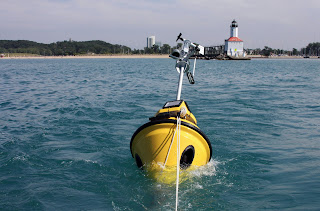
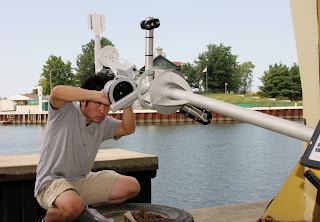 Swimmers, boaters, and anglers visiting Indiana’s coastline this summer will again be able to learn about conditions in Southern Lake Michigan thanks to real-time data collected by the Michigan City buoy. The buoy, launched for the first time last fall, returned to its post four miles from shore last week to collect data on wave height and direction, wind speed, and air and surface water temperatures. It will stay in the water until November.
The relaunch comes just in time to help make summer trips to Michigan City and the Indiana dunes safer. Throughout the season, scientists at the National Weather Service (NWS) in northern Indiana will use wave height and frequency data collected by the buoy to better anticipate likely locations of strong waves and rip currents that cause dangerous swimming conditions. The only one of its kind in the Indiana waters of the lake, the Michigan City buoy gives forecasters access to historically unavailable nearshore data where conditions are much different than at the center of the lake. Real-time data from the buoy has already helped NWS improve their wave height forecasts.
 “This information is vital for NWS forecasters to access and accurately forecast the potential for dangerous swimming and boating conditions along southern Lake Michigan,” said John Taylor, a meteorologist with the NWS office in northern Indiana. “Our hope is that by accurately forecasting when high waves and rip currents along the shoreline will result in dangerous swimming conditions, we can reduce the number of tragic drownings that occur in these waters every summer.”
The site lets visitors see real-time snapshots of lake conditions—updated every 10 minutes—as well as trends over 24-hour and 5-day periods.
And this year, the Michigan City buoy joins the ranks of environmental monitors that contribute to NOAA’s National Data Buoy Center. The addition makes it possible for people to easily access data older than five days and track trends over longer periods of time. This archived data is particularly important for researchers and natural resource managers who rely on the buoy’s data to improve weather forecasts, protect water quality, and predict where best to fish.
The buoy launch also coincides with Rip Current Awareness Week, and is just one piece of a larger effort to protect people from the dangers of rip currents. Visit the Rip Current Awareness Week website to learn more about rip currents and what you can do to protect yourself this summer.
June 3rd, 2013 by Irene Miles
IISG’s science writer, Anjanette Riley, is at the 2013 International Association for Great Lakes Research conference at Purdue University. She’ll be blogging from the sessions all week providing an inside look at the newest research on the health of the Great Lakes. Here’s today’s post:
“There is more food for Asian carp in Lake Michigan than people thought. In a morning filled with new insights into these invasive species’ biology and potential impact in the Great Lakes, this fact rang the loudest for me. I have read some of the research in recent years speculating that Asian carp could not survive in much of the Great Lakes, which have less of the phytoplankton and zooplankton than the ravenous eaters need. What my fellow session attendees and I learned this morning, though, is that the plankton population has been underestimated. There are more–much more–of the smallest species living in the nearshore waters of Lake Michigan than previously believed.
According to researchers from the Illinois Natural History Survey, the cause of the miscalculation is a common testing method that uses a filter too large to trap many of the microscopic species in the lake. Additional testing measures show that the number of some plankton species found in the lake is roughly the same as in rivers where Asian carp are known to thrive, like the Ohio and Missouri Rivers. And there are plankton species in the lake that are not found in many of these waterways. Taken together, this means that likelihood that Asian carp can make Lake Michigan their home may be higher than previous data has indicated.
The session this morning also taught me that carp will branch away from their favorite dish to eat the particulates from decomposed animals and plants that line the floors of lakes and rivers. These exist in much higher numbers than plankton and their stock is continuously replenished as aquatic matter dies. Although it is still unknown whether Asian carp would choose this food over others (or eat it only when there is nothing else), this could mean that plankton in the Great Lakes may not have to bear the brunt of the carp’s huge diet alone if the invasive fish were ever to take up residence.”


 From boaters and kayakers to waterfowl hunters, scuba divers, sea plane operators, and more, everyone can help prevent invasive species from taking over their favorite waterways with these three actions.