
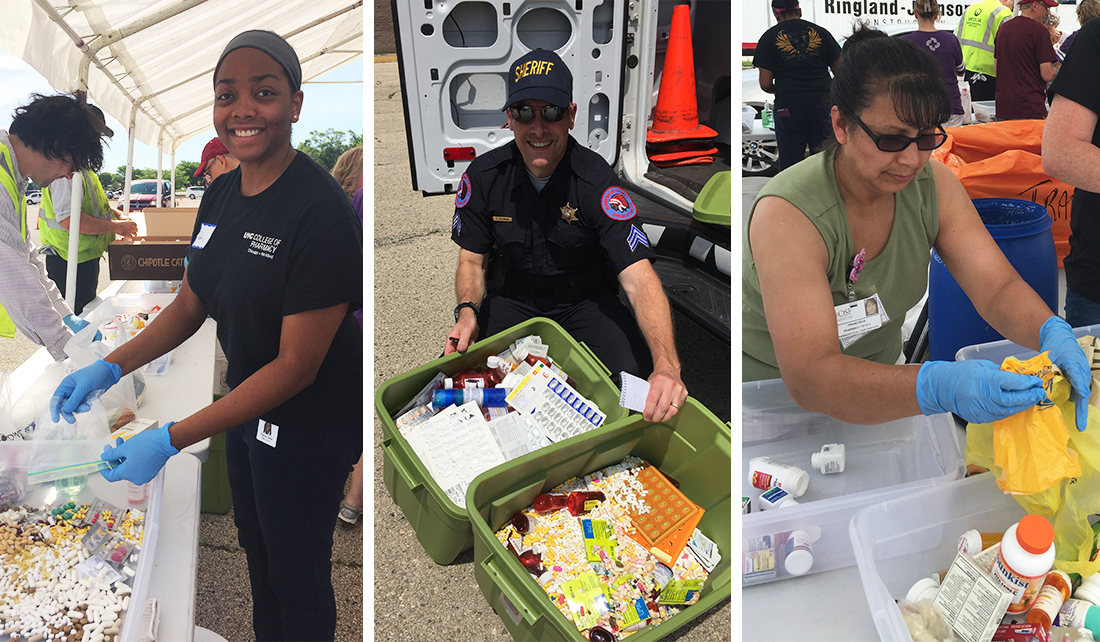
Improper disposal of unwanted medicine is both a public safety and environmental hazard. It can lead to poisonings from children and pets accidentally ingesting them, illegal use or theft, and drinking and surface water contamination. One of the best solutions to prevent improper disposal is to take unwanted medicine to a take-back drop box or collection event.
Since 2008, Illinois-Indiana Sea Grant (IISG) has helped communities organize permanent local medicine collection programs in 53 Great Lakes communities, including new collection box installations in the past year at police departments in four communities in three states: Gibson City and Farmer City in Illinois; Shiocton, Wisconsin; and Bloomfield, Indiana.

Chief Adam Rosendahl (left) and Lieutenant Tony Row worked with IISG’s Sarah Zack to organize a take-back program and install a medicine collection box at the Gibson City Police Department. (Photo Illinois-Indiana Sea Grant / Sarah Zack)
Chief Adam Rosendahl from Gibson City installed a take-back box this past August. “One of the reasons I wanted to join the program was so that the medications did not end up in the wrong hands,” said Rosendahl. “We have had a couple different instances where children have taken medications from their parents’ or grandparents’ medicine chests.” The Gibson City Police Department wants to make sure that unwanted medications are disposed of properly.
Sarah Zack, IISG pollution prevention specialist, worked directly with police officers in Illinois and Indiana to organize the four new medicine collection programs. “I’m very proud of the legacy of the unwanted medicine take-back program started at IISG, and am thrilled that the program continues to grow,” said Zack. “The success of this program is dependent on having dedicated community partners, and collaborating with folks like Chief Rosendahl to help communities is one of the most valuable services IISG provides.”
IISG plans to install more collection boxes in the next year, continuing to prevent unwanted medicine from threatening public safety and entering the water supply through improper disposal. Interested communities can reach out to Sarah Zack at szack@illinois.edu or (217)300-4076 about obtaining a collection box or starting a medicine take-back program. For more information on proper disposal of unwanted medicine, visit unwantedmeds.org.
National Take Back Day
Keep unwanted meds out of the wrong hands and help protect the environment from improper medicine disposal by taking part in National Prescription Drug Take Back Day on Saturday, October 27, 2018. Go to TakeBackDay.com to find a medicine collection location near you.