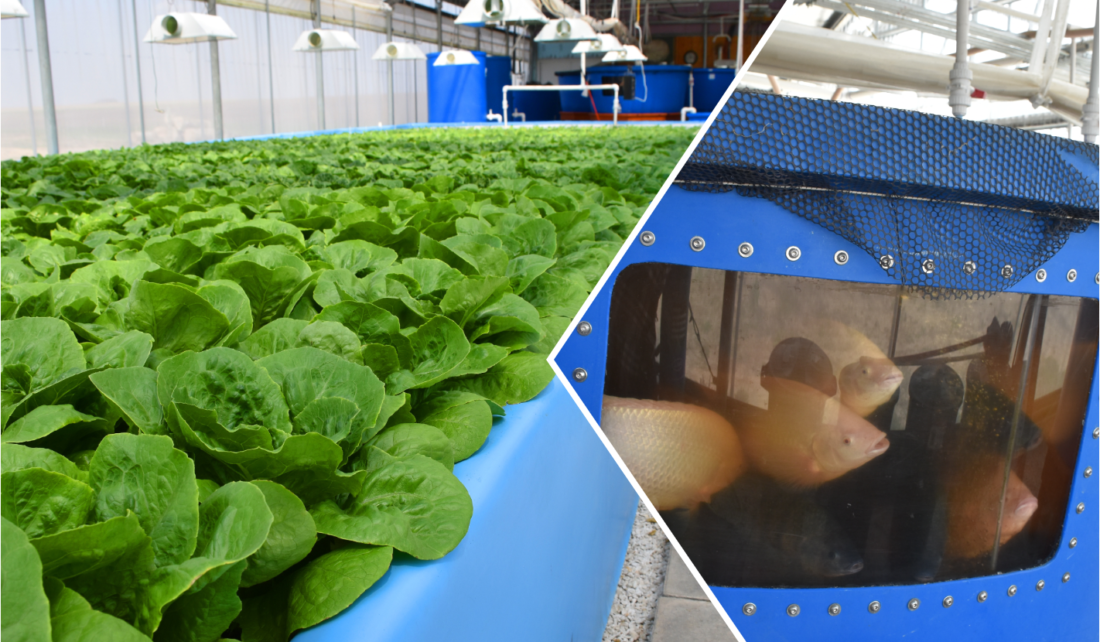
Aquaponics, a method for raising fish and plants together, can provide a hands-on way for students to learn scientific concepts while they are introduced to sustainable agriculture. Illinois-Indiana Sea Grant (IISG) announces a new aquaponics curriculum to help educators make these connections.
“By equipping Great Lakes students with the knowledge and skills needed for careers in sustainable agriculture, we are opening doors to future opportunities and helping to shape the next generation of environmental stewards and innovators,” said Julie Fiorito, IISG Great Lakes K-12 education specialist.
In an aquaponics system, fish are raised in tanks, and the nutrient-rich wastewater is circulated to plants growing hydroponically. The plants take up the water and nutrients, thereby cleaning the water, which is then returned to the fish tanks. Because it is a closed system, water and waste are used efficiently.
For teachers that have an aquaponics system already established or those who are interested in this learning approach, the curriculum—Aquaponics: Farming Fish, Growing Greens—offers 10 lessons that walk students through the ABCs of aquaponics.
“As educators and students work their way through the curriculum, they will learn about water quality and environmental science through the lens of a water-based agricultural system that they can grow their own food with,” said Amy Shambach, IISG aquaculture marketing outreach associate.
Aquaponics offers a hands-on way to learn STEAM—science, technology, engineering, agriculture, and math. The curriculum incorporates activities that involve reading comprehension, data analysis and basic math skills, plus includes lessons, PowerPoints and YouTube links. It is aligned with Next Generation Science Standards.
Aquaponics: Farming Fish, Growing Greens covers aquaponics comprehensively, but it is also designed so that an educator can pull out a single component to reinforce classwork while connecting to the school’s aquaponic activities, although not necessarily.
At this point, six high schools in Illinois and Indiana are raising fish, and in some cases, plants too, in classrooms, greenhouses, or other school spaces using donated equipment from commercial operations. IISG’s Andrew Coursey worked closely with educators in Illinois and Indiana to help design and set up aquaponics systems and then provided support to help engage students. Coursey has since moved on to another position, but IISG’s school support is ongoing.
You can find more information about the curriculum on the IISG website. A related resource, Know Your H2O provides the opportunity for educators to borrow water monitoring equipment used by commercial aquaculture producers.
____________________________________________________________
Illinois-Indiana Sea Grant is one of 34 Sea Grant programs supported by the National Oceanic and Atmospheric Administration in coastal and Great Lakes states that encourage the wise stewardship of our marine resources through research, education, outreach and technology transfer. In partnership with the University of Illinois Extension, and Purdue University Forestry and Natural Resources, Illinois-Indiana Sea Grant brings science together with communities for solutions that work.