
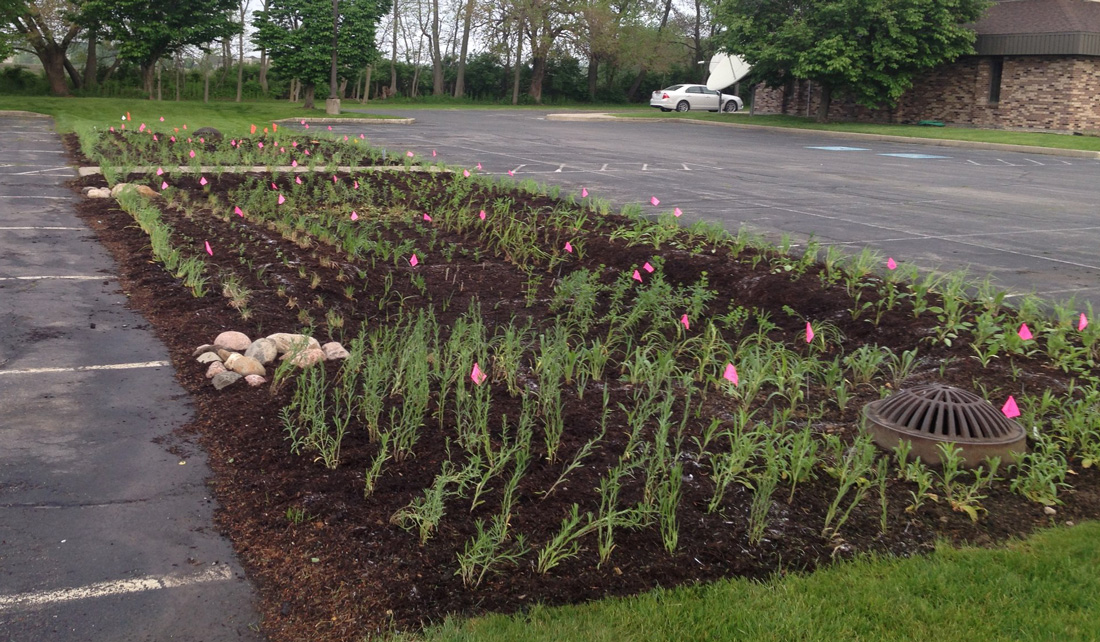
Update 4/18: We’ve hit our 300-person limit for this free webinar series, so we have to shut down registration early. What a great response from everyone interested in stormwater management and green infrastructure! We’re excited to help you learn more about rainscaping.
The Purdue Rainscaping Education Team is offering a free webinar series called Introduction to Rainscaping and Rain Gardens. The four-part series, comprised of one-hour webinars, will take place on April 21, 23, 28 and 30. Registration is required.
“Since we cannot offer in-person spring workshops due to COVID-19, the Rainscaping Education Program’s short webinar series brings you a way to learn more about rainscaping and rain gardens in your own home,” said Kara Salazar, assistant program leader and extension specialist for sustainable communities. “We hope the series inspires attendees to establish rainscaping practices on their landscape. Additionally, we encourage participants to join us when we can offer the next round of in-person workshops to learn more in depth information and also take tours of existing raingardens and participate in the construction of a demonstration rain garden.”
The four-part series will cover topics ranging from an introduction to rainscaping and rain gardens, to site selection, plant selection and installation and maintenance.
Attendees must register two days before the start of the first webinar (April 19) and should plan on attending all four parts of the series. An email containing the access link will be sent to registrants prior to each session.
Webinar Series Schedule
Introduction to Rainscaping, Rain Gardens and the Purdue Rainscaping Education Program
Tuesday, April 21
Noon – 1 p.m. CT / 1 – 2 p.m. ET
Presenter: John Orick, Purdue Master Gardener State Coordinator
Introduction to Rain Garden Site Selection and Analysis
Thursday, April 23
Noon – 1 p.m. CT / 1 – 2 p.m. ET
Presenter: Curt Emanuel, Boone County Purdue Extension Educator, County Extension Director
Introduction to Rain Garden Plant Selection and Design
Tuesday, April 28
Noon – 1 p.m. CT / 1 – 2 p.m. ET
Presenter: Rosie Lerner, Purdue Extension Consumer Horticulture Specialist
Introduction to Installation and Maintenance
Thursday, April 30
Noon – 1 p.m. CT / 1 – 2 p.m. ET
Presenter: Laura Esman, Managing Director, Indiana Water Resources Research Center and Research Associate & Lab Manager, Natural Resources Social Science Lab
For questions, please contact Kara Salazar, Assistant Program Leader and Extension Specialist for Sustainable Communities, Purdue Extension and Illinois-Indiana Sea Grant at salazark@purdue.edu.
Resources
Rain Gardens Go with the Flow, Indiana Yard and Garden, Purdue Horticulture
Rainscaping Program
Master Gardeners Program
Rainscaping Education Program Highlighted in NOAA Annual Report, Got Nature? Post, Purdue Extension
What is Rainscaping? Purdue Rainscaping Education Program Video, Purdue Extension
Q&A About Drainage Water Recycling for the Midwest, The Education Store, Purdue Extension resource center
Become a Purdue Master Gardener, The Education Store
Climate Change: How will you manage stormwater runoff?, The Education Store
Plan Today For Tomorrow’s Flood, The Education Store
Illinois-Indiana Sea Grant is a part of University of Illinois Extension and Purdue University Extension.
Contact: Kara Salazar, Assistant Program Leader and Extension Specialist for Sustainable Communities, Illinois-Indiana Sea Grant and Purdue University Department of Forestry and Natural Resources




