Results

Page 34 of 37
Found 219 Results
Sort By: Alphabetical | Newest | Oldest
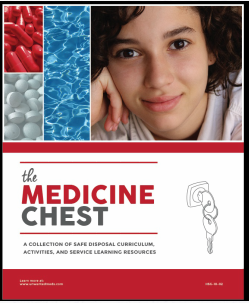
The Medicine Chest: A Collection of Safe Disposal Curriculum Activities and Service-Learning Resources Thumbnail

Year: 2015

This 4-H curriculum, designed for informal education audiences, provides five inquiry-based lessons to help high school youth understand the harmful effects of improper disposal of medicines and what they can do to help. Each lesson contains a complete instruction plan, centered on a hands-on activity for the students. Our goals for The Medicine Chest are to: Offer comprehensive curricula on the issues surrounding pharmaceuticals and personal care products disposal; Incorporate a variety of educational approaches for instructing high school-level students; Support community stewardship by offering creative project examples and guidance that will inform the public about appropriate disposal practices; and Explore a variety of careers that work with pharmaceuticals and personal care products. We dedicate The Medicine Chest to our youth who are working to make a significant difference in their communities as they develop important lifelong learning skills, including leadership and civic responsibility.

To use these resources, visit: http://iiseagrant.org/medicinechest/.


The Southern Lake Michigan Rain Garden Manual Thumbnail
File Type: pdf
File Size: 2.98 MB
Year: 2014

This manual was developed for those interested in protecting rivers and lakes through the usage of rain gardens. The manual will benefit the homeowners, landscape architects and city planners.

Download File

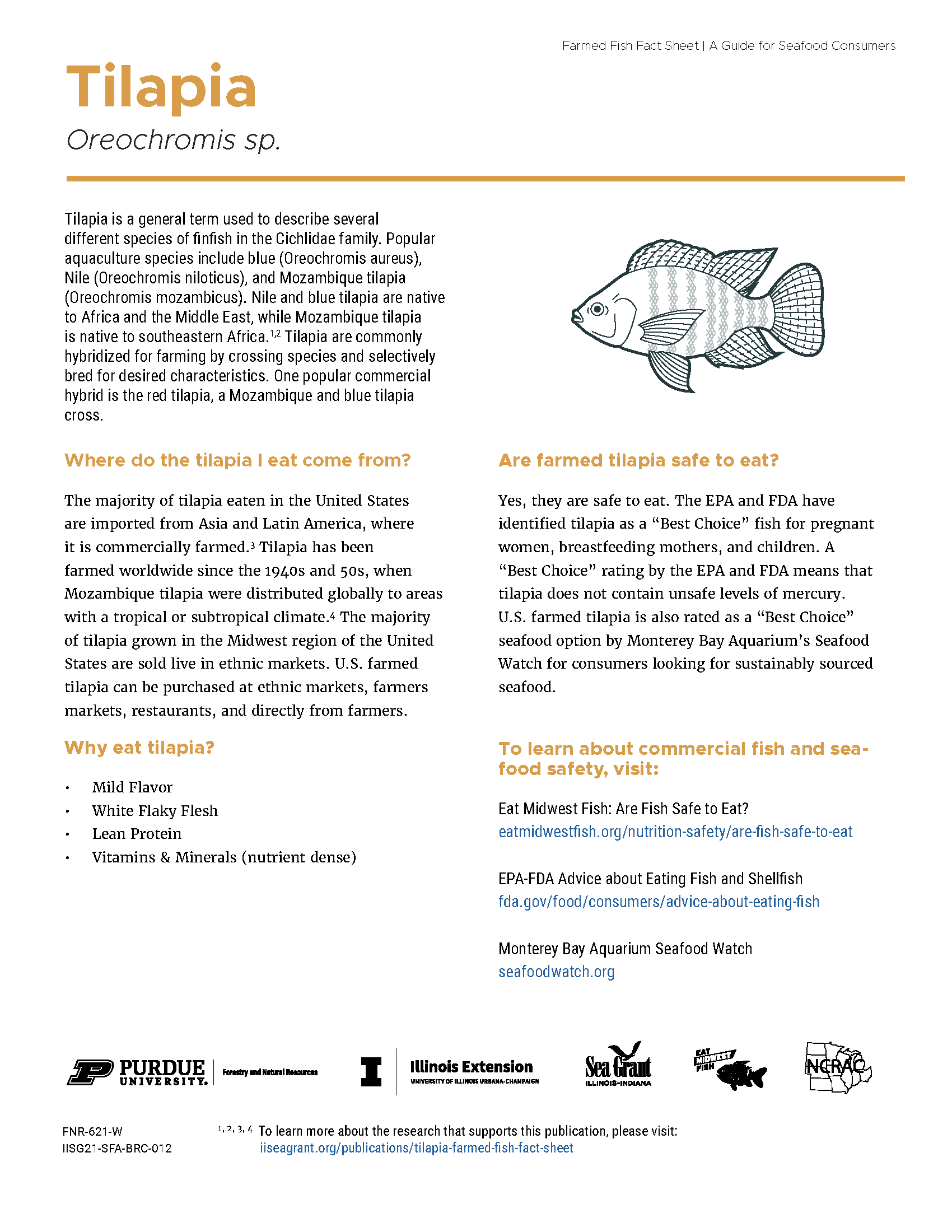
Tilapia Farmed Fish Fact Sheet Thumbnail
File Type: pdf
File Size: 4.35 MB
Year: 2021

This is the third in a series of consumer guides that describe fish and shellfish farmed in the Midwest region of the United States. The fact sheet also includes culinary characteristics, cooking tips and a recipe for Sautéed Tilapia.

References:


  1. Wohlfarth, G.W. and G. Hulata. 1983. Applied Genetics of Tilapias, ICLARM Studies and Reviews 6, 26 p. International Center for Living Aquatic Resources Management, Manila.
  2. Nico, L.G., Schofield, P.J., and Neilson, M.E., 2021, Oreochromis niloticus (Linnaeus, 1758): U.S. Geological Survey, Nonindigenous Aquatic Species Database, Gainesville, FL, https://nas.er.usgs.gov/queries/factsheet.aspx?SpeciesID=468, Revision Date: 1/8/2020, Peer Review Date: 12/18/2013, Access Date: 2/16/2021
  3. National Marine Fisheries Service (2020) Fisheries of the United States, 2018. U.S. Department of Commerce, NOAA Current Fishery Statistics No. 2018 Available at: https://www.fisheries.noaa.gov/ national/commercial-fishing/fisheries-united-states-2018
  4. FAO 2005-2021. Cultured Aquatic Species Information Programme. Oreochromis niloticus. Cultured Aquatic Species Information programme. Text by Rakocy, J.E. In: FAO Fisheries Division [Online]. Rome. Update 18 February 2005. [Cited 16 February 2021]. http://www.fao.org/fishery/culturedspecies/Oreochromis_niloticus/en
Download File

Tipping Points Planner Thumbnail

Year: 2006

This collaborative program gives watershed planning groups across the Great Lakes the information they need to protect natural resources and enhance local economies.

For more detailed information, visit Tipping Points Planner


Understanding Conservation Pricing Thumbnail
File Type: pdf
File Size: 3.00 MB
Year: 2017

What is the right price for water? It depends on whom you ask. Every community has unique needs and must decide what it wants to achieve with water rates—revenue recovery, revenue stability, affordability, economic development, encouraging efficient use of water, to name a few. This factsheet discusses rate design to encourage efficient water use, in other words, conservation pricing.

Download File

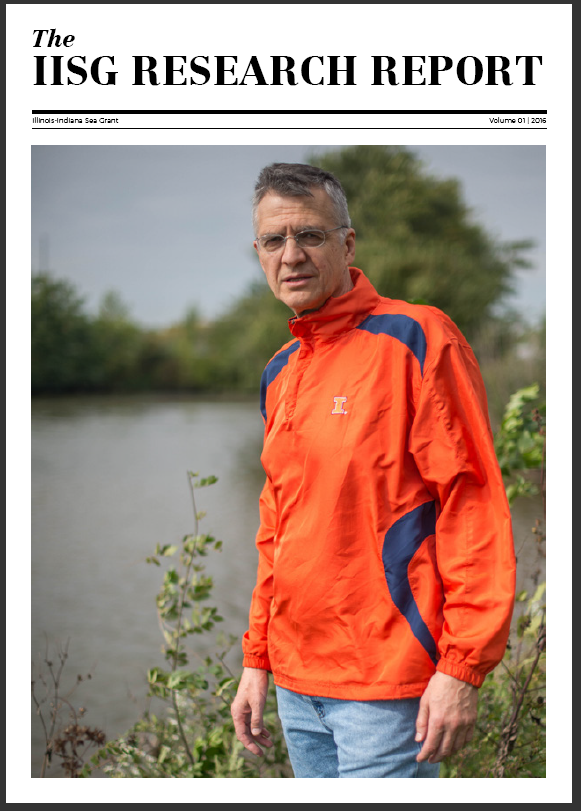
UpClose Publications Thumbnail

Year: 2012-2016

Learn about aquatic pollution by hearing directly from the people doing the research. From the field to the lab, UpClose takes you behind the scenes with the scientists working to make sense of this complicated topic.

Volume 1: Timothy Strathmann

In this issue:

Dr. Timothy Strathmann, an environmental engineer at University of Illinois Urbana-Champaign, has dedicated more than a decade to understanding the chemical principles at work behind environmental challenges such as ensuring long term water quality and developing renewable energy.

Publication Number: IISG-12-49

Volume 2: Maria Sepulveda

In this issue:

Dr. Maria Sepulveda works from her lab at Purdue University to uncover the impacts of environmental contaminants of fish and other wildlife.

Publication Number: IISG-13-02

Volume 3: John Kelly

In this issue:

Dr. John Kelly, a microbiologist at Loyola University Chicago, is working to shine a light on the impacts that human activities have on aquatic microbial communities, especially those that make their homes in rivers or lakes.

Publication Number: IISG-13-77W

Volume 4: Melody Bernot

In this issue:

Dr. Melody Bernot, an ecologist at Ball State University, is probing deeper into some of the biggest questions in pharmaceutical and personal care produce (PPCP) research.

Publication Number: IISG-13-81

Volume 5: Rebecca Klaper

In this issue:

Dr. Rebecca Klaper, an ecologist at the University of Wisconsin-Milwaukee is searching for practical solution for the design, use, and management of pharmaceuticals and other emerging contaminants found in the environment.

Publication Number: IISG-13-87

Volume 6: Sam Mason

In this issue:

Dr. Sherri “Sam” Mason, a chemistry professor at State University of New York Fredonia, has documented the quantity of plastic in the Great Lakes, putting a spotlight on microplastic pollution in freshwater systems and the potential impacts.

Publication Number: IISG-14-25

Volume 7: Steven Mauro

In this issue:

Dr. Steven Mauro from Grannon University discusses research on the ways pharmaceuticals are changing the bacterial communities that help keep aquatic ecosystems healthy.

Publication Number: IISG-14-87

Volume 8: Dana Kolpin

In this issue:

Dana Kolpin, head of the U.S. Geological Survey’s Emerging Contaminants Project, discussed the first-ever nationwide study that discovered trace amounts of emerging contaminants in streams across the country.

Publication Number: IISG-14-100 E

Volume 9: Barbara Mahler

In this issue:

Dr. Barbara Mahler, research hydrologist at the U.S. Geological Survey, discussed her work investigating the toxic chemicals associated with pavement sealants impact local environments.

Publication Number: IISG-15-011 E

Volume 10: Lorena Rios Mendoza

In this issue:

Dr. Lorena Rios Mendoza from the University of Wisconsin Superior talks about her work to identify the chemicals that build up on the surface of microplastics and how photodegradation may alter the way they react to one another.

Publication Number IISG-15-028 E

Volume 11: Michael Lydy

In this issue:

Dr. Michael Lydy from Southern Illinois University Carbondale, investigates the complex chemical and biological factors affecting pesticide toxicity in urban streams.

Publication Number: IISG-15-16-008

Volume 12: Tim Hoellein

In this issue:

Dr. Tim Hoellein from Loyola University Chicago, investigates the interactions between common pollutants and organisms in rivers and streams.

Publication Number: IISG-16-021


Page 34 of 37

Note: Some older Illinois-Indiana Sea Grant publications have not yet been restructured into ADA compliant formats. We are actively working on this. If you are having difficulty accessing a particular item in one of our databases, please contact iisg@purdue.edu with the name of the item and its URL for further assistance.

Search All IISG Publications and Products