Loyola University in Chicago is committed to the environment in a number of ways, and one of their approaches holds benefits for Lake Michigan as well.
<span”>The University recently installed their seventh green roof system, this one on Cuneo Hall. Green roof systems provide a number of benefits, but one of them is the reduction of rainwater runoff. By providing natural materials to absorb, filter, and utilize the water, it reduces pollution and runoff volume that can wind up negatively impacting the Lake.</span”>
From the article on Earth Techling:
“A green roof acts like a natural sponge that absorbs stormwater and curtails runoff,” Aaron Durnbaugh, the university’s director of sustainability, explained in a statement. He went on to note that the university’s Chicago campus is located on the shores of Lake Michigan, which makes reduced runoff a real priority for protecting local water quality.”
Much like a gardener hopes that the seeds they plant will eventually bloom into a lush garden, Illinois-Indiana Sea Grant awards Discovery Grants, or “seed” grants, to a number of projects in the hopes that the initiatives will grow into something larger. In recent years, IISG has funded 35 projects focused on key concerns the program is committed to address; here are six new projects for 2012:
– Charles Werth, a civil engineer at the University of Illinois at Urbana-Champaign, will study the potential benefits and cost-effectiveness of installing green roofs in urban areas, considering effects on runoff, water quality, and other factors.
– Nandakishore Rajagopalan of the Illinois Sustainable Technology Center will explore the feasibility of establishing saline aquaculture in Illinois – in other words, a saltwater fish farm. This initial study will focus on the economics of establishing such an industry and explore the possibilities for a few key species.
– Daniel Larkin, a conservation scientist at the Chicago Botanic Garden, will establish a network of researchers and professionals who manage phragmites, an invasive reed grass, to discuss recent advances in control and collaboratively develop management plans to reflect the newest science and best techniques available.
– Maria Sepulveda, an ecotoxicologist at Purdue University, will build on previous IISG studies that looked at the distribution of pharmaceuticals or personal care products in Lake Michigan by examining the effects that these chemicals have on species throughout the food chain, both individually and in potentially toxic combinations.
– Marcelo Garcia of the University of Illinois at Urbana-Champaign will use results from an Asian Carp egg survival model to develop a tool that identifies where and how to implement targeted control methods. The tool would help decision makers prevent the spread of the invasive species.
– Brian Murphy of the University of Illinois Chicago will examine Lake Michigan as a potential source of bacteria that might be used in new medicines.
These Discovery Grants provide funding for initial research that has the potential to grow into larger future projects, or for projects that bring research results to a broader audience and could be expanded on by fellow researchers and agencies.
Invasive species, as you probably know, can have devastating effects when they take hold. They can negatively impact, and in some cases permanently alter, entire ecosystems, disrupting industry and tourism, and affecting home and business owners near those areas.
With summer on the way, there’s no better time than now to spread the word about invasive species and how we can stop them. And that is why May is Illinois Invasive Species Awareness Month.
Now is the perfect time to get people involved in the work of preventing the damage they can do right here in Illinois.
In addition to the links above, don’t forget to visit our Clean Boats, Clean Waters web page for simple and useful ways that boaters can join in the fight to prevent invasive species from spreading. You can also find information on how to volunteer for our Clean Boats Crew and provide in-person advice and tips at local boat ramps and marina.
Following up on our post from March 12, Caitie McCoy and Terri Hallesy visited with students in East Chicago to see how their projects studying the Roxana Marsh area were going. Terri sent along some details:
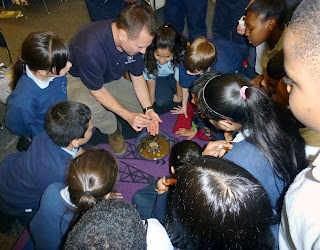
On April 19, Caitie McCoy invited Education Specialist Terri Hallesy, to visit Andrea Bock’s 4
th grade science classrooms at East Chicago Lighthouse Charter School. The students have been learning about the Great Lakes Legacy Act cleanup project at Roxana Marsh and how to design a habitat. Jack Brunner, an EPA contractor whose employees work on-site at Roxana Marsh, was invited as a guest speaker to share his restoration work with the students. Caitie McCoy and colleague, Nishaat Yunus, actively engaged students in a discussion about key concepts associated with habitats and restoration projects. Students participated in a hands-on activity to design their own Roxana Marsh habitat by constructing a colorful classroom mural. Students were divided into groups and provided with photos depicting various elements contained within a habitat. Selected photos included nonliving elements, such as the sun and oxygen; above water living plants like black-eyed Susan and wild bergamot; and above water living animals such as the great blue heron and Peregrine falcon. Using various art tools, students designed and illustrated some of the components that comprise the Roxana Marsh habitat. Caitie McCoy and Terri Hallesy affixed the students’ creative illustrations onto a mural, which is now proudly displayed in their classroom. As a culminating event, Jack Brunner surprised the students by presenting a painted turtle that was found on the Roxana Marsh site and has been kept as a pet during the cleanup. The next step in this exciting restoration project will involve the students actually visiting Roxana Marsh to plant natives they’ve been cultivating in their classroom.
All of the students had a great time getting involved and learning about the marsh, and they’re looking forward to planting the native species they’ve been growing in the class.
The term “food web” is used to describe the intricate relationships between the many different plants, animals, and organisms that can exist in small or large areas. Understanding food webs in specific environmental locations, such as in one or more of the Great Lakes, can help researchers and communities better respond to changes in those delicate systems. Invasive species are just one example of a potential influence that can drastically alter a food web and have substantial impacts on native environments.
On April 3 and 4, 2012, Illinois-Indiana Sea Grant (IISG) and GLRRIN Lake Michigan
partners from Wisconsin Sea Grant(WISG), Michigan Sea Grant, the NOAA Great Lakes Environmental Research Laboratory, the US EPA Great Lakes National Program Office, and the USGS Great Lakes Science Center hosted a research meeting in Ann Arbor, MI. Approximately 60 researchers from federal, state, university, tribal, and non-profit organizations gathered to discuss their current understanding of food webs in Lake Michigan. Food web structure and function can be affected by many variables, including changes in water temperature, water quality, and/or habitat loss. Recent aquatic invaders, including zebra and quagga mussels, have drastically altered the Lake Michigan ecosystem, leaving researchers with new questions about what variables most affect commercial and recreational fishing, bird populations, non-toxic algal blooms, and overall quality of life for humans and animals.
GLRRIN Lake Michigan hosted a similar meeting in 2008, which helped launch the 2010 Lake Michigan Intensive Monitoring Field Year. Findings presented during the 2012 meeting highlight the inherent variability of Lake Michigan, especially in areas that are less than 20 m deep. Researchers also stressed the need to further understand how the lowest levels of the food chain, such as microbes and nutrient cycling, operate. Understanding these basic levels will help create better tools for decision makers like fishery managers or watershed planning committees. A full report on the meeting presentations and discussions will be made available through the GLRRIN Lake Michigan and IISG websites.