December 19th, 2012 by Irene Miles
Activities associated with the purchase, sale, and use of commercially available organisms or “organisms-in-trade” can potentially result in the introduction of aquatic invasive species (AIS) to waterways such as the Great Lakes. Preventing these introductions is a much more cost-effective way to protect waterways, as opposed to the cost and effort involved in controlling or managing them once they become established.
Building on a University of Notre Dame-led project to examine the environmental risks posed by certain “organisms in trade” (OIT), Illinois-Indiana Sea Grant has been awarded grant funding through the Great Lakes Restoration Initiative (GLRI) for a project titled “GLSGN OIT Initiative – Expanding Risk Assessment Outreach.”
By creating an opportunity to remove these potentially invasive species from circulation, risk assessment is one way to prevent non-native species from becoming invasive. Risk assessment information is also important to AIS education, because studies have shown that education and outreach encourage and shape the behavioral changes necessary for preventing species introduction. For example, horticulturists decided against purchasing a given species once they learned it had the potential to become an invasive species.
This new GLRI grant provides for the creation of new risk assessment and OIT outreach tools including webinars, a training video, non-technical summaries of state laws and regulations, and publications for people involved with fish, reptile, and amphibian commerce. Development of these tools will be guided by a survey that assesses the needs and preferences of OIT user groups. The goal of all these efforts is to reduce the introduction of potentially invasive species, thereby helping to protect and preserve waterways from invasive threats.
This initiative, a collaboration among the Great Lakes Sea Grant Network, North Carolina State University (NCSU), the National Sea Grant Law Center at the University of Mississippi School of Law (NSGLC), and IISG, will also help educate and inform the public about alternatives to high-risk aquarium, water garden, bait, live food, and classroom species.
For more information, visit our webpage about aquatic invasive species.
December 6th, 2012 by Irene Miles
While it may not be lawn care season in many parts of the country, it’s never too early to look ahead to next year and the best methods, tools, and information that are available to ensure healthy lawns and healthy ecosystems.
The University of Illinois’ website “Lawn Talk” is a useful and popular site offering an abundance of information to homeowners, property managers, and landscape professionals throughout northern Illinois.
Now updated and redesigned, the website’s new look and content were made possible in part by the Great Lakes Restoration Initiative and Illinois-Indiana Sea Grant’s Lawn to Lake program. Incorporating information and resources from these two entities has made it possible for the site to move beyond traditional, chemical-heavy lawn care advice by recommending natural lawn care resources. Additionally, the relationship between lawn care and water quality is better represented and respected by the up-to-date information on the site, creating a resource that helps protect the environment while ensuring the health and beauty of lawns and landscapes.
 This site update also allows University of Illinois Extension to offer even more multimedia content, including instructional videos, interactive activities and features, and more.
December 5th, 2012 by Irene Miles
University of Illinois Junior Lainey Pasternak, who interned this past summer with IISG’s Aquatic Invasive Species (AIS) Outreach Team, wrote a guest blog about her experience working with IISG and, more importantly, about an award she received for her work.
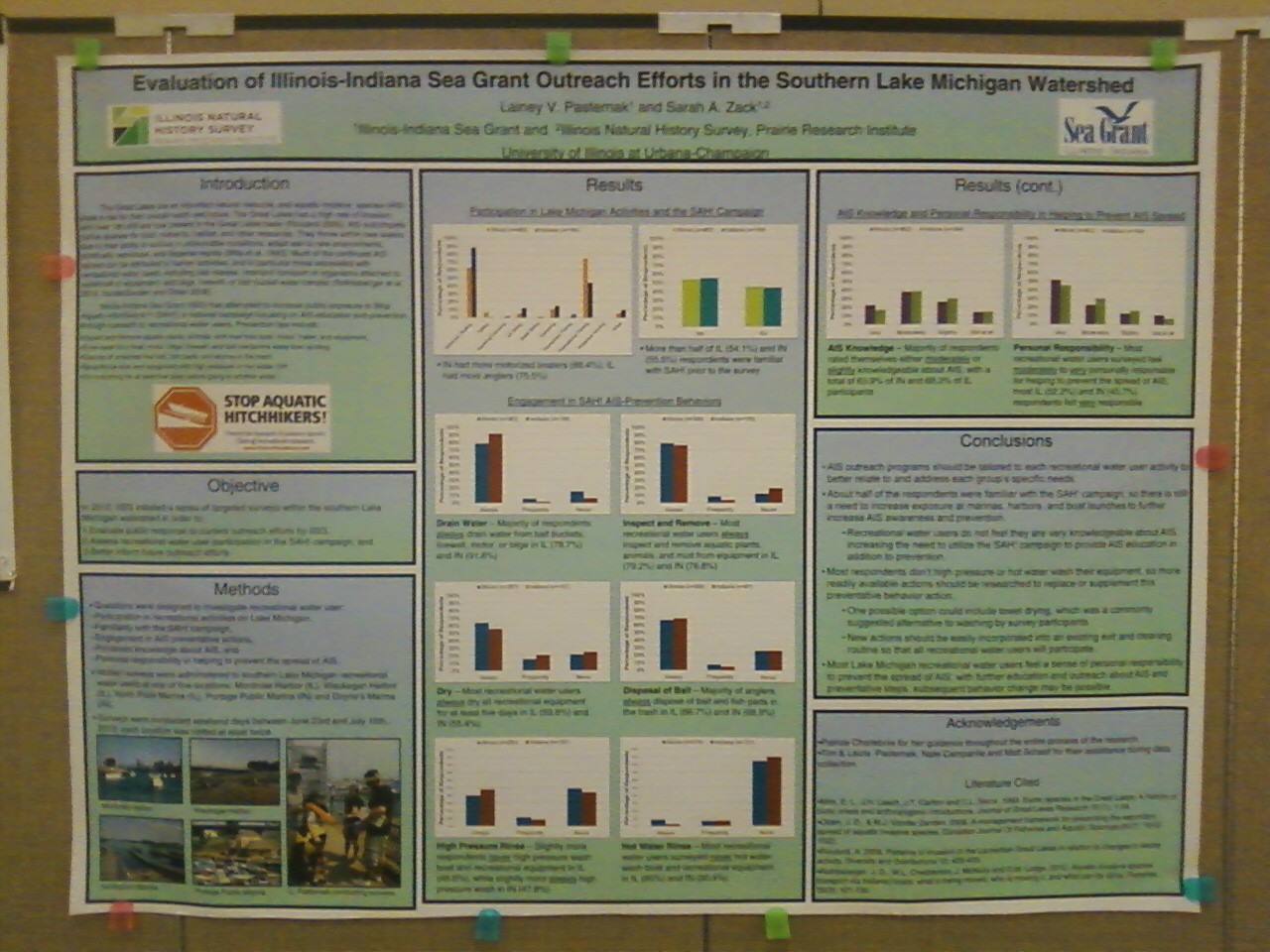
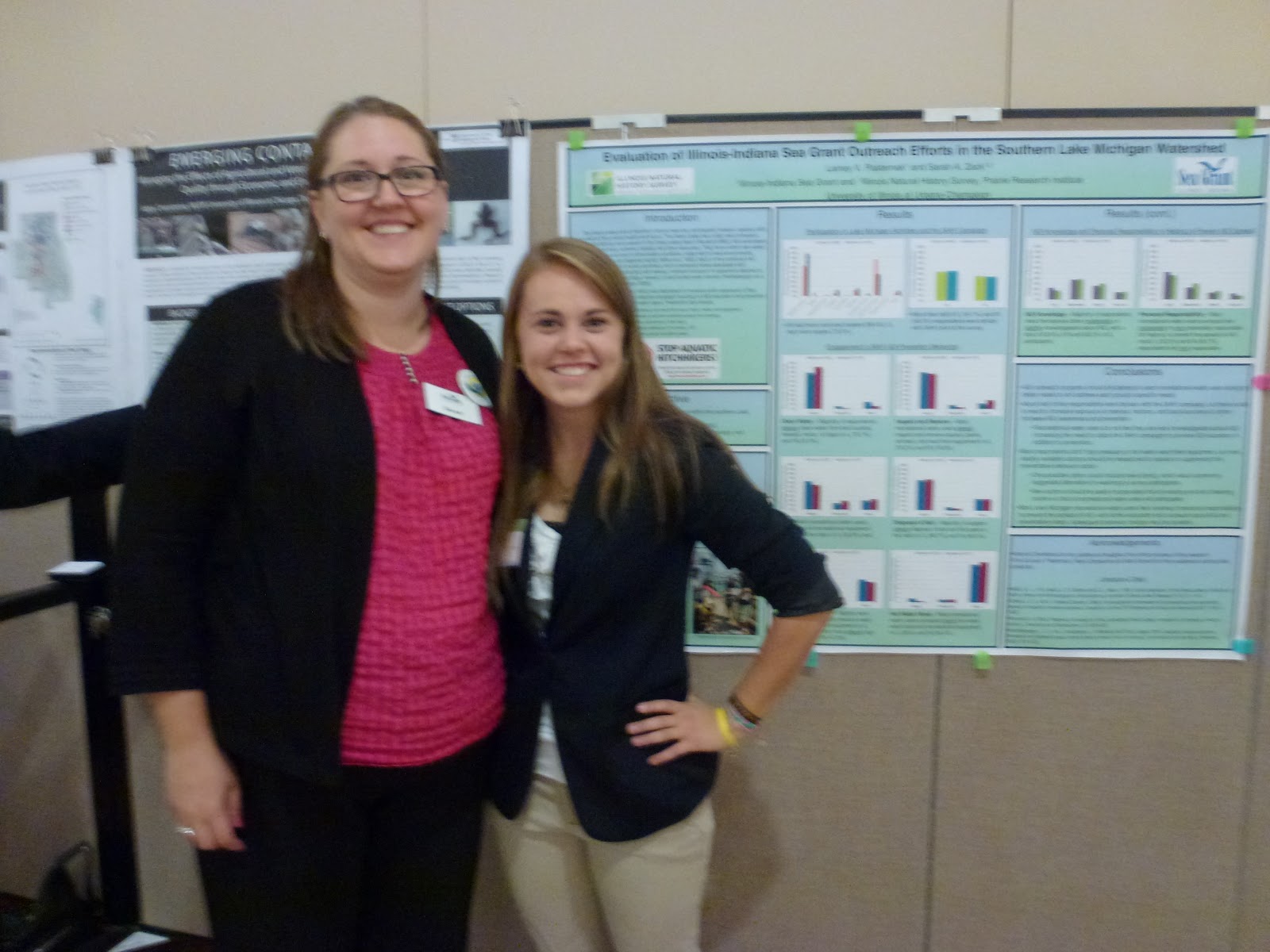
Lainey writes, “Over the summer I worked to help increase recreational water user knowledge of AIS through survey research and outreach. I designed and conducted a survey to help investigate the prevalence of AIS-preventative behaviors among boaters and anglers, a key demographic in the effort to prevent AIS spread. By the end of the summer, I had formulated a formal research report and academic poster presentation based on the final survey results. All efforts in the research and poster presentation were collaborated with my internship supervisor and coauthor, Sarah Zack. The final project of the internship was a presentation of my poster “Evaluation Illinois-Indiana Sea Grant Outreach Efforts in the Southern Lake Michigan Watershed” at the 2012 Illinois Water Conference.
 On September 24-25, I attended the Illinois Water Conference at the University of Illinois. After submitting my research abstract and poster at the conference, I was awarded a student scholarship and honorable mention award for an undergraduate student poster. I had the opportunity to present my summer research at the student poster session throughout the duration of the Illinois-Indiana Sea Grant 30th Anniversary Reception, courtesy of the Illinois Chapter of the American Water Resources Association. Among the 30 registered students of the poster competition, I was one of the two conference award recipients, and the only undergraduate to receive mention.
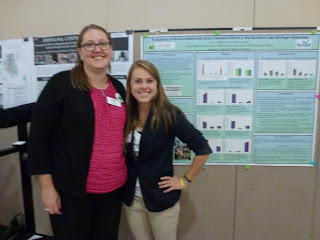 My internship with Illinois-Indiana Sea Grant marked an important beginning step in my environmental science career. Attending the Illinois Water Conference not only provided me the opportunity to display my research project, but also emphasized AIS as an important issue affecting Illinois’ waters. I was immersed in a learning atmosphere of networking and the active exchange of new ideas to utilize in possible future research. This conference was the first research opportunity I participated in, and I consider it a major scholarly, professional, and personal success. Receiving a student scholarship and undergraduate honorable mention at the 2012 Illinois Water Conference marked the end to a very rewarding and fulfilling student internship with Illinois-Indiana Sea Grant. I will be continually proud of all my work and the impact I was able to make.”
Congratulations to Lainey on her award, and we look forward to your continued research and outreach efforts to keep our waters safe.
November 30th, 2012 by Irene Miles
Communicating with people far and wide about the importance of the Great Lakes and the work that we do to ensure safe, healthy, and vibrant economies and ecosystems around Lake Michigan is one of our most important jobs. By informing and involving more people in our efforts, we can continue working to keep the Great Lakes great.
The latest addition to our effort is the Wikipedia entry for Illinois-Indiana Sea Grant. The IISG Wikipedia page is an important piece of our overall communications because it provides an encyclopedic explanation of IISG as well as references and links to additional information.
The page that you are visiting right now, our Newsroom, is another way to communicate with our audience, and to share timely information about workshops, seminars, fellowships, community projects and events, and more. And of course our Facebook page allow us to offer even more immediate interaction with individuals and organizations that care about the lakes.
Feel free to share our pages and help us spread the word about what makes Lake Michigan, and all of the Great Lakes, just so great, and how together we can keep them that way.
November 28th, 2012 by Irene Miles
Educators from Illinois, Indiana, and Wisconsin attended IISG’s workshop Nov. 9-10 to increase the presence of Great Lakes science in their classrooms and to improve student awareness of issues related to the Lakes.
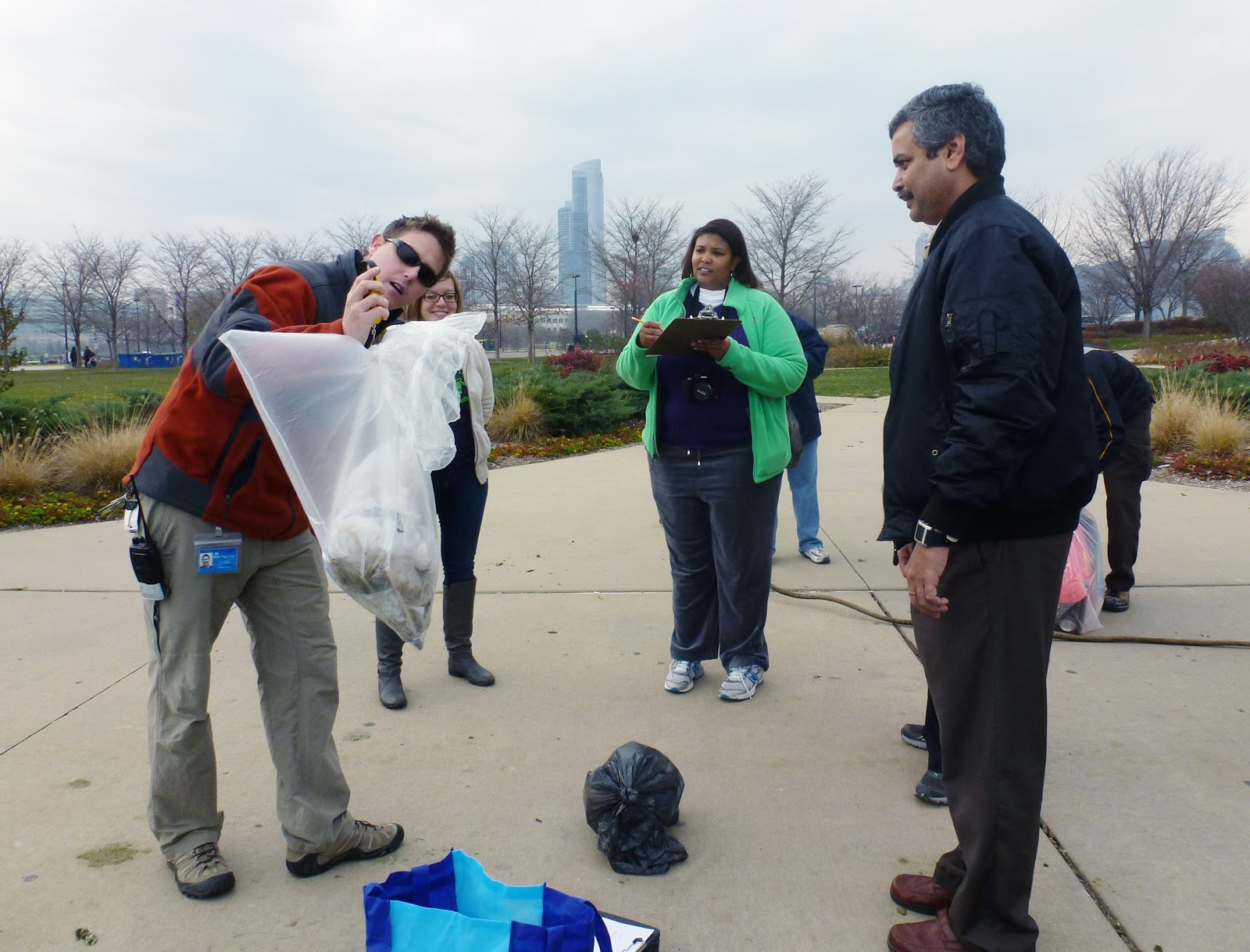
Illinois-Indiana Sea Grant partnered with Chicago’s Shedd Aquarium and the National Park Service Great Lakes Research and Education Center and the Dunes Learning Center to host the workshops, which provided opportunities for teachers to engage in science and math data collection and hands-on field work. Educators previewed Sea Grant’s Greatest of the Great Lakes and Fresh and Salt curricula to familiarize themselves with the diverse range of learning formats to enhance their science, math, and engineering units, as well as activities from Great Lakes in My World by the Alliance for the Great Lakes. Also, as part of the new Center for Great Lakes Literacy, workshop attendees learned how to help protect and restore coastal areas in the Lake Michigan watershed through a variety of teaching methods.
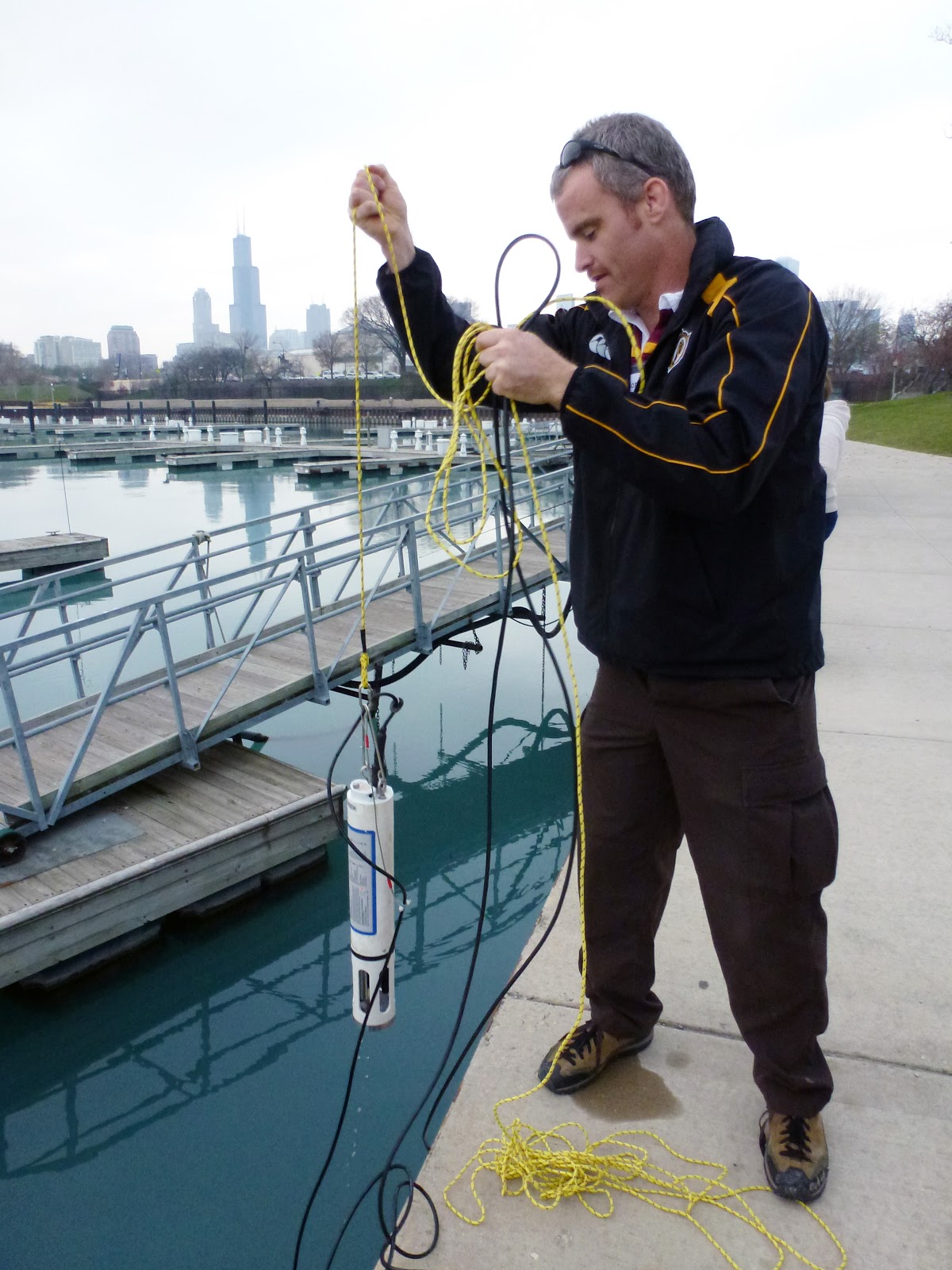
All of the teachers who attended this year’s workshop were excited to learn about programs like the Alliance for the Great Lakes’ Adopt-a-Beach, as well as the many exciting student stewardship activities offered by the Shedd Aquarium, the Dunes Learning Center, and the Indiana Dunes National Lakeshore botanists. They also enjoyed the hands-on activities, including using the Enviroscape model to learn about point source/non-point source pollution, and learning how to use GLNPO’s Hydrolab water quality monitoring instrument.
The feedback and comments from teachers was especially positive. Said one attendee, “You’ve given me great ideas about water quality, drinking water, invasive and noninvasive species, habitat restoration, and stewardship projects I can provide for my kids to become ‘Great Lakes literate.’”
To learn more about IISG’s educational programs and resources, visit our education webpage, and follow us on Facebook for more events, workshops, and information.
This Center for Great Lakes Literacy project was funded through a grant from the U.S. EPA Great Lakes National Program Office.
November 26th, 2012 by Irene Miles
Lake Erie is under attack, but from threats that we may be able to fix.
“The major threats to all the lakes include invasive species that throw a delicate ecosystem out of balance. In Erie, more so than the other lakes, toxic algae threaten the health of visitors and create “dead zones” where no aquatic species can survive.
At least 136 invasive species — plants, fish and mussels — have forever changed the lakes. But it’s the potential 137th invader that officials fear the most. The Asian carp wants nothing more than to spread through the Great Lakes and continue its feeding frenzy. Though a live fish has yet to be found, DNA tests suggest that they might already have infiltrated Lake Erie.”
Follow the link above to read the complete article, which includes interesting information about dead zones, toxic algae, and other growing threats to the delicate ecosystems of the Great Lakes.
November 6th, 2012 by Irene Miles
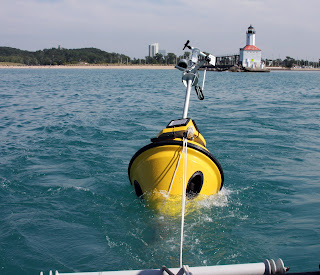
.JPG) The research buoy launched off the coast of Michigan City, IN earlier this fall has been brought inland for winter, but will return to the water next spring for its first full season monitoring environmental conditions in Lake Michigan’s nearshore waters.
The research buoy launched off the coast of Michigan City, IN earlier this fall has been brought inland for winter, but will return to the water next spring for its first full season monitoring environmental conditions in Lake Michigan’s nearshore waters.
It has been less than two months since the buoy began feeding real-time data to the IISG website. In that short time, though, the data has been used by scientists, anglers, and boaters alike to better predict weather conditions, target where to fish, and identify the safest times to be out on the lake. Many of these users have reached out to IISG with feedback on the buoy and the website.
“We have heard from so many different groups of people, from recreational paddlers to research scientists, and the response has been overwhelmingly positive,” said Carolyn Foley, IISG assistant research coordinator. “People are grateful to have data for an area that was previously not being monitored.”
More than 500 people have visited the website since it went live in early September to see real-time snapshots of lake conditions or to examine trends shown over 24-hour and 5-day periods. IISG staff members have heard from sailors, kayakers, anglers, and local residents who say they plan to regularly use the information collected on wave height, water temperatures, and wind speed before venturing from shore. Sailors from Indianapolis told IISG that the up-to-date information on lake conditions will help them more safely make their seasonal trip from St. Joseph, MI to Michigan City. The same data will also be used by fisheries researchers at the Purdue University West Lafayette campus to determine when to make the two-hour drive up to the lake for sampling trips.
The collected data has also been used by researchers to improve models used to predict weather and current changes. For example, the National Weather Service (NWS) office in Northern Indiana was able to adjust its forecast for wave heights by several feet in mid-October based on the real-time data from the buoy. Engineers from other federal agencies have also requested data to use in models designed to examine the movement of water and heat in lower Lake Michigan.
The buoy’s launch also attracted regional press coverage that continued well after it was placed in the water. Indiana TV and newspapers were joined by news outlets from Illinois and Michigan—including the Detroit Free Press—in their coverage. The launch was also featured in trade blogs such as the Environmental Monitor and recreational forums like the Great Lakes Angler Forum.
Although real-time data will not be available while the buoy is in winter storage, an archive of the information collected from early September to late October of this year will be released in the coming months. Visit www.iiseagrant.org/buoy for more information.
November 2nd, 2012 by Irene Miles
Lakes Michigan and Huron almost set records for low water levels in October, as the long-term effects of this summer’s drought are still being felt.
From the Detroit Free Press:
“The U.S. Army Corps of Engineers, which tracks Great Lakes ups and downs, recorded Michigan-Huron at 576.6 feet above sea level for October. That’s an inch-and-a-half above the lowest point for that month since the agency began keeping records in 1918, and about 6 inches above the all-time low recorded in March 1964.
Michigan and Huron are considered one lake from a hydrological perspective because they have the same surface level and are connected at their northern ends by the 5-mile-wide Straits of Mackinac.”
Read the complete article at the link above for more information about the lake levels and their causes.
October 11th, 2012 by Irene Miles
Chicago area waters will be searched again beginning next week for indicators of Asian carp presence near Lake Michigan.
From WTAQ.com:
“Over 170 samples were taken from Chicago’s North Shore Channel from June through September – and 10-percent had the carp’s DNA. The same was true for 17 of 57 samples last month in the nearby Chicago River.
As a result, an actual search for the bloated carp will take place next Tuesday through Friday on the North Shore Channel and a six-mile stretch of the Chicago River west of the city.”
Read the complete article at the link above.




.JPG)