November 5th, 2015 by iisg_superadmin
A new version of the award-winning curriculum The Medicine Chest is now available! This updated and revised version includes new lessons and new teaching approaches. Here’s the story of how this edition came to be.
In 2012, I started in a new position at the University of Illinois and was introduced to the issue of pharmaceuticals and personal care product (PPCP) pollution. I thought it was fascinating and realized that past instructions to flush medicine down the toilet probably weren’t based on research.
I was interested even then in developing a curriculum on this emerging issue, but it wasn’t until I joined IISG that an opportunity materialized. It was then that I came to learn about the compendium of lessons known as The Medicine Chest that includes wonderful place-based stewardship lessons. I felt I could enhance the content by emphasizing the “Why should I care?” factor. I was asked that exact question by suburban high school student about 10 years ago while teaching a lesson on isotopes. It was the best question I ever received. And from that point on, all the materials I have created have been based on that pivotal query.
For The Medicine Chest, I wanted to approach the issue from a number of different perspectives. The updated curriculum connects ideas that aren’t really thought of as connected. For instance, nobody really thinks about items that are flushed down the toilet after the handle has been pushed, so why not explore wastewater treatment plants to see what they can filter and what products pass through the system and out to waterways? The lesson named “Wastewater treatment 101: What happens to PPCPs?” does just that. I have also created a lesson using recent research on how PPCPs are changing the normal functionality of aquatic ecosystems. Once the problems are laid out, the curriculum moves on to show how individuals can help reduce the impacts of PPCPs. Finally, as sort of an interesting twist, we look back into the not-so-distant past—turn of the 20th century—to see what kinds of products were used to cure illness and create beauty and how they compare to today’s standards.
I decided to incorporate new teaching techniques into the curriculum. First, the curriculum gives teachers the option to teach each lesson in the conventional way—information gathered in class and followed up by homework—or through a technique called “flipped classrooms.” This model asks students to learn the information, with guidance, the night before and be ready to discuss the topic in class for more in-depth exploration. Second, I applied meta-cognitive thinking to the vocabulary. Third, I abandoned the standard method of testing in favor of essay responses. This technique pairs well with metacognitive thinking and true knowledge because it allows students to express in their own words what they know about the questions being asked. Finally, I aligned the lessons with the Next Generation Science Standards. These new lessons can all be used to lead into the many stewardship-based projects already provided in The Medicine Chest.
One of the challenging aspects of writing curriculum on any emerging topic is that the research is still very new and ever evolving. Once the research is located, many times there are gaps of information about the issue. Then, of course, you have to make the information accessible to different audiences. That is often the most challenging aspect of the work, but it’s all worth it. It’s pleasure to write about emerging issues, and I already have my sights on another topic. I’m excited for the possibilities.
May 18th, 2015 by iisg_superadmin
It was a chilly May 12th, cloudy and windy as well. But 29 sixth graders from West Side Middle School in East Chicago, Indiana came to nearby Roxana Marsh to experience what the outdoors has to offer, learn new things, help with the cleanup and restoration of the natural area, and enjoy the afternoon.
Roxana Marsh is part of the larger Grand Calumet River Area of Concern, which has been undergoing dredging through the Great Lakes Legacy Act over the past six years. The marsh section of the project was completed three years ago with the removal of 600,000 cubic yards of sediment.
This accomplishment was celebrated with a press event attended by government officials and local school children. Those middle schoolers left their legacy in perennial plants that are now thriving along the marsh. This year’s class is the third group of gardeners in what may well become an annual tradition.
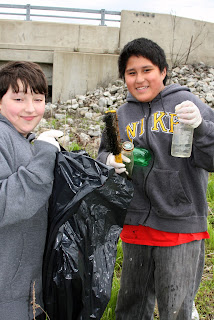
In addition to planting natives, the students learned the basics of birding, explored the small community of life in sediment, and manned trash bags for garbage detail. There were water beetles, egrets, killdeer, toads, dragonfly nymphs, and more to experience.
Throughout their afternoon tour, the 6th graders were guided by experts from Audubon Chicago Region, U.S. EPA, The Nature Conservancy, Shirley Heinz Land Trust, Indiana’s departments of Natural Resources and Environmental Management, Northwest Indiana Regional Planning Commission, Dunes Learning Center, and Illinois-Indiana Sea Grant.
The first surprise for the students was just how close the natural area is to their school and their world. “They had no idea that this was here or about the dredging and restoration, said teacher Linda Padilla. “They were sure we would be going someplace farther away.”
Last June, she took part in a one-day workshop at Purdue University Calumet, which introduced the Helping Hands curriculum to 25 local educators. Helping Hands activities are ideally suited to schools in Areas of Concern that are going through the cleanup process—they provide opportunities to directly engage students in the larger project. The workshop also included a visit to several sites on the Grand Cal to see the dredging work in progress as well to walk around a finished site—Roxana Marsh.
Caitie McCoy, IISG environmental social scientist, has been helping keep residents informed during the dredging. She saw the Grand Cal project as an opportunity to connect students with their environment.
 “The cleanup and restoration of the Grand Calumet River is brightening the northwest Indiana landscape,” she explained. “This work transforms space into places that students can visit, perform stewardship work, and develop pride in their local environment. Environmental educators teach students that nature is in their backyard, but for these students, high quality nature is in their backyard, right here in East Chicago, Indiana.”
At one point, the Grand Cal was referred to as the most polluted river in the country. Through the remediation process, more than 2,000,000 cubic yards of sediment have been removed from this waterway, which runs through a highly-populated region. If funding from the Great Lakes Restoration Initiative continues and non-federal cost share partners are secured, the river work could finish as early as 2019.
January 14th, 2015 by iisg_superadmin
A closer look at web tools and sites that boost research and empower Great Lakes communities to secure a healthy environment and economy.
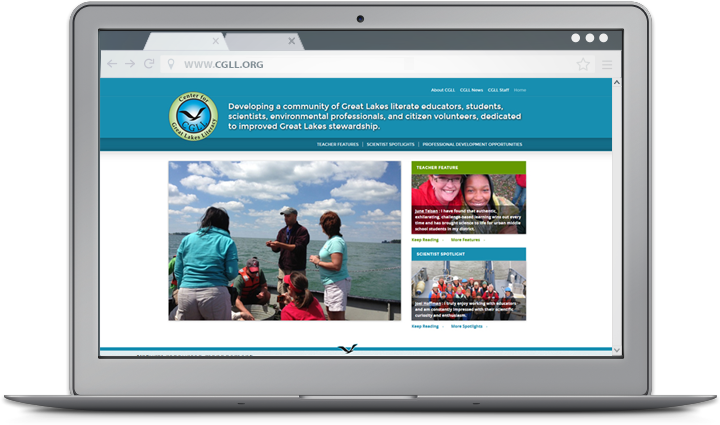.png) Educators interested in strengthening aquatic science programs and encouraging Great Lakes stewardship—look no further than the new Center for Great Lakes Literacy (CGLL) website.
Educators interested in strengthening aquatic science programs and encouraging Great Lakes stewardship—look no further than the new Center for Great Lakes Literacy (CGLL) website.
Created by Sea Grant educators throughout the region, the site is a one-stop-shop for classroom activities designed to boost Great Lakes literacy. Educators will find information on and links to teacher-tested curriculum like Fresh and Salt and Estuaries 101. And the Teacher Feature allows visitors to hear about education success stories directly from colleagues across the region.
Visitors to the site can also learn about the latest professional development opportunities available throughout the region. For example, teachers interested in the annual Shipboard Science Workshop, held this year on Lake Michigan, can find workshop information and application deadlines. Featured blogs also make it possible to read about teacher experiences at past CGLL workshops and follow along with the latest projects.
For more information on upcoming educator workshops and available curriculum, contact Terri Hallesy.
January 13th, 2015 by iisg_superadmin
Real-world, hands-on activities are bringing Great Lakes science alive for a group of Wisconsin middle school students. Our friends at Wisconsin Sea Grant have the story.
Two Wisconsin teachers have made exceptional use of the educational resources that Sea Grant has to offer. And not just resources from Wisconsin Sea Grant—the teachers have found valuable support from the Center for Great Lakes Literacy, a collaborative effort by educators in the Great Lakes Sea Grant Network funded through the Great Lakes Restoration Initiative.
The teachers are Lynn Kurth and Cindy Byers. Kurth works as a science teacher for Prairie River Middle School in Merrill, Wis. Just a 50-minute drive away, Byers works as a science and reading teacher for Rosholt Middle School in Rosholt, Wis.
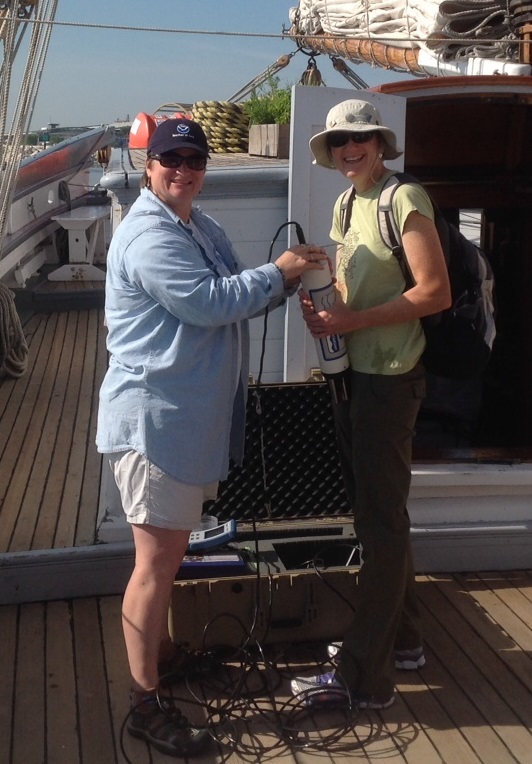
They met in 2011 during a week-long voyage on the Lake Guardian, a research vessel owned by the U.S. Environmental Protection Agency (EPA). They were participating in a Shipboard and Shoreline Science Workshop, a program conducted by the Great Lakes Sea Grant programs through the former Centers for Ocean Sciences Education Excellence (which has become the Center for Great Lakes Literacy). They were part of a team of five colleagues who worked on a research project together. Kurth and Byers bonded over a Hydrolab—a large, tubular piece of water testing equipment—and it’s led to bigger and better things for both them, their students, and other teachers across the country.
The Hydrolab takes various water quality readings. Kurth and Byers were drawn to it because both of their schools are near rivers and the EPA was providing the device on loan for use with their classrooms after the cruise. They saw the opportunity to partner in the future.
It worked. “We supported each other’s teaching and enriched each other’s classrooms by having this collaboration,” Byers said. “We had the kids Skype with each other a couple of times and present the Hydrolab data they collected. Even though our schools are not that far apart, it seemed quite exotic to the kids and they were excited to use a piece of equipment that scientists use. A lot of the reasons we’ve been able to do so much with the program is that we’ve been supporting each other all along.”nce-in-a-lifetime learning experiences for students. In fact, 26 classes across the Great Lakes region took a break from their regular activities over the last year to video chat with the scientists behind the EPA Lake Guardian‘s annual monitoring cruises. Some students even took a guided virtual tour of the boat.
And now a new group of teachers and non-formal educators have an opportunity to work with Sea Grant specialists to introduce activities like these into their aquatic sciences sections during the 2015 Shipboard Science Workshop on Lake Michigan. Applications for the 15 available spaces are due February 10.
November 24th, 2014 by iisg_superadmin
Several IISG staff members were in Grand Rapids, MI earlier this month to share some of our education resources and curricula during the Great Lakes Place-based Education Conference. For Allison Neubauer, the experience had an unexpected twist.
Stewardship and place-based education are nothing new to us educators at Illinois-Indiana Sea Grant. In fact, the IISG education team has been leading efforts in these initiatives throughout southern Lake Michigan communities for years. For this reason, going into the conference, I thought it was a great opportunity for us to share our models of stewardship and place-based education. I didn’t plan on gaining much insight into how and why these objectives were critical. Boy, was I wrong.
IISG undoubtedly has an arsenal of exemplary stewardship models, and a jam-packed room of eager educators at our Friday afternoon session was an indication of their desire to hear how we’ve extended learning beyond classrooms and into communities.
But as much as I enjoyed sharing our examples of student stewardship as a means of combatting invasive species, promoting proper disposal of unwanted medication, and teaching about benefits and risks of fish consumption, the best part of the conference was actually hearing others share their stories.
The opening keynote address by Kim Rowland, a middle school science teacher, detailed how her students have been able to use their surrounding environment in Grand Rapids as a resource for exploration and learning. What was most captivating and exciting to hear was how this time spent investigating the outdoors was a way to reach students that are not typically high academic achievers. Kim told us about a particular student who was always getting in trouble—not wanting to come to school, and certainly not excited about learning. Though she had not anticipated this, venturing out to the stream on school property transformed him into the most enthusiastic student of the group. In fact, this student was now so interested in collecting samples that he waded even further into the stream, thus giving Kim a very fitting title for her presentation: “Getting Your Feet Wet and Allowing Water to Flood Your Boots.”
This was a great way to kick-off the conference. It really impressed upon me that place-based education should not be considered a luxury, or something that only all-star teachers are doing. Every student—from urban to rural, high achieving to special needs—must be exposed to learning outside the classroom. School should not take place in isolation, between the same four walls everyday. There is immense value in connecting students with their communities and surrounding environments as a means to enhance learning and civic understanding.
September 16th, 2014 by iisg_superadmin
Our education team is at it again! Allison Neubauer wrote in with this exciting announcement:
 Teachers across the Great Lakes region—have we got a treat for you! You can now explore creative projects from all-star educators to spark new ideas and read important tips for getting your students involved in the effort to “nab” local aquatic invaders.
The IISG education team has been working hard to compile model projects that successfully tie together AIS education and community stewardship. Our revamped Nab the Aquatic Invader! website will help you up your game—and the new-and-improved Top Desk Administrator is your one-stop-shop for project ideas.
Community stewardship projects like the ones highlighted here are an exceptional tool for pushing students beyond rote memorization and providing them with an opportunity to apply their knowledge in ways that have positive impacts on their communities.
Preview outstanding examples of student work, ranging from fun informational activity books to catchy musical compilations. When you’re done perusing, read the summary reports written by the teachers responsible for these successful activities for information on how to plan and implement similar projects in your own classroom.
The Nab the Aquatic Invader! website is the place for the latest and greatest invasive species project models, information, and activities.
November 1st, 2013 by Irene Miles
The Illinois Science Education Conference, recently held in Tinley Park, featured more than 150 presentations, symposiums, and exhibits aimed at providing resources and professional development opportunities for science teachers throughout the state. Illinois-Indiana Sea Grant’s education team was among the many exhibitors participating, and offered materials and presentations to help introduce Great Lakes literacy principles to the teachers present.
 IISG’s Robin Goettel and Terri Hallesy led two presentations to give teachers information and guidance on getting their students interested in Great Lakes science and stewardship. Several educational resources were also made available for the teachers to utilize in their classes.
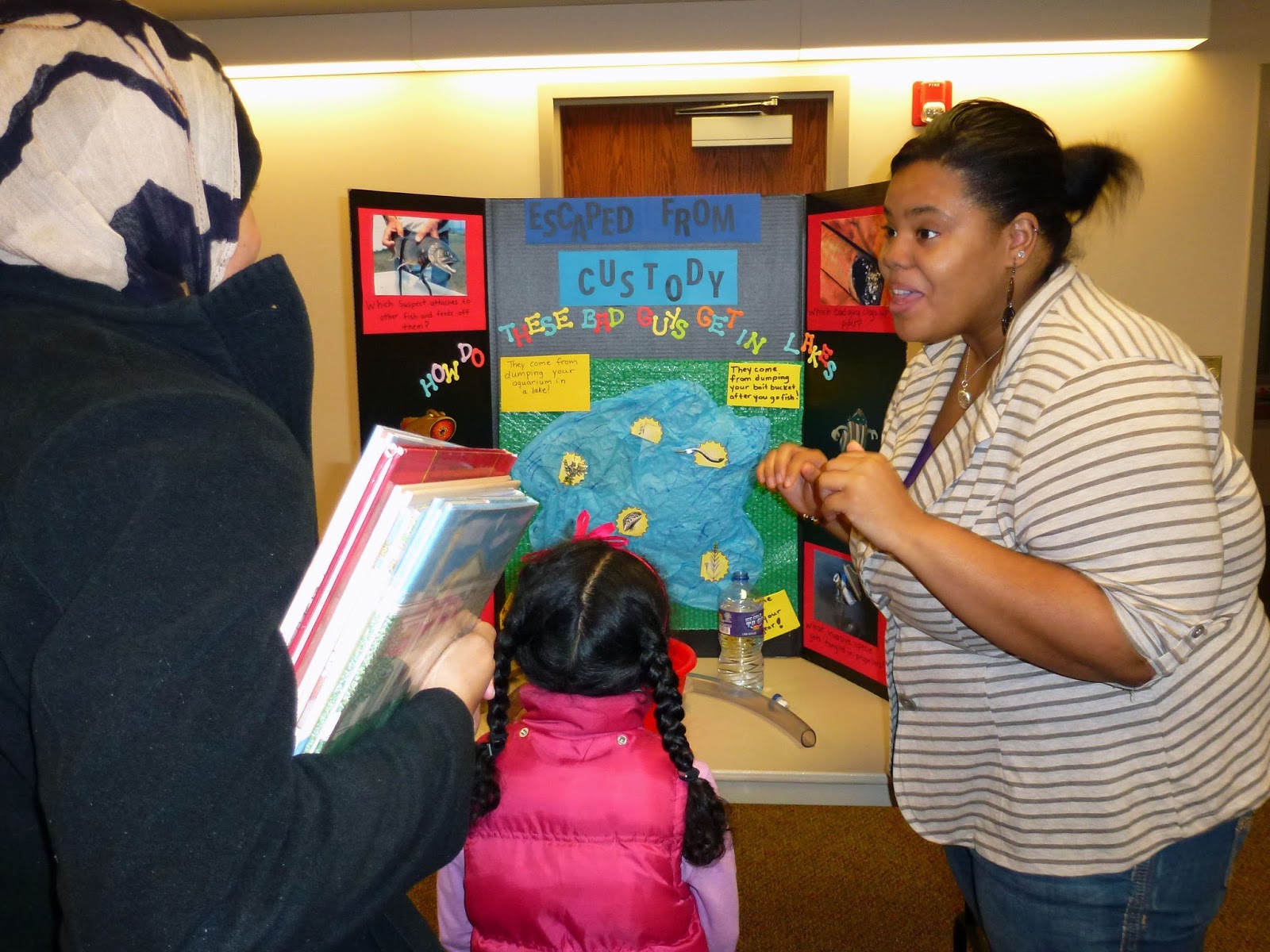
Anjanette and Corrie staffed two tables in the exhibit hall. One focused on AIS and featured “Nab the Aquatic Invader” information, invasive species watch cards, games, and suggested alternatives to releasing classroom pets into the wild (the HabitattitudeTM project). The second table focused on several different curricula and stewardship programs offered by IISG. CDs of Fresh and Salt and Greatest of the Great Lakes were available, as well as flash drives with The Medicine Chest and Sensible Disposal of Unwanted Meds. Teachers were very excited to receive these because they were so compact and comprehensive, with several asking if they could give a second one to their colleagues.
Two Great Lakes Restoration Initiative projects were highlighted in our displays – Great Lakes Organisms in Trade Initiative-Research, Outreach and Education and Undo the Great Lakes Chemical Brew.



.jpg)