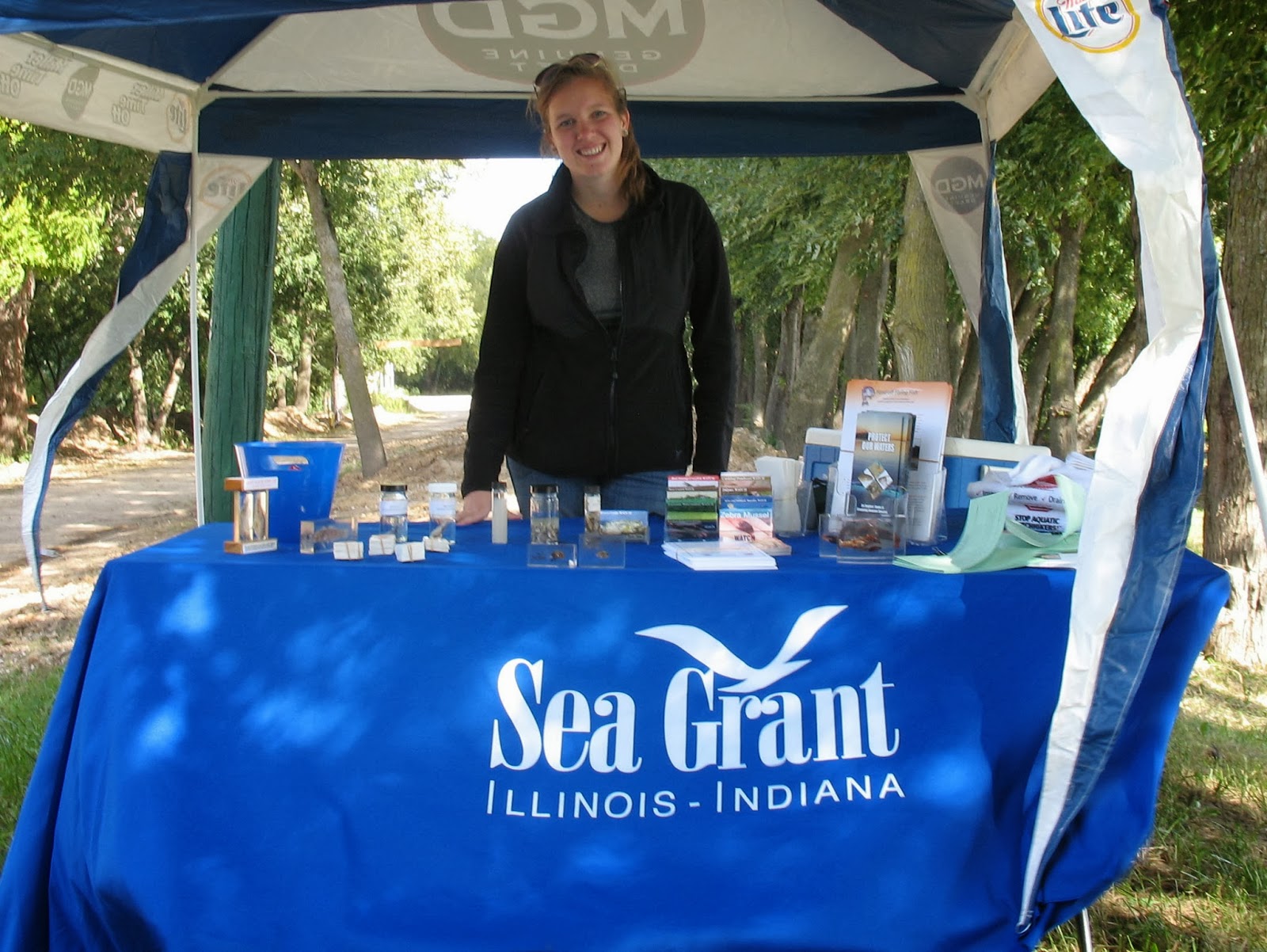
Alice Denny, a recent graduate from Hartwick College, spent the summer working with the Illinois-Indiana Sea Grant aquatic invasive species team in Glencoe, Illinois, and wrote in to share details about her experience.
“I’ve always had a love for being outdoors. Several family members of mine work in the environmental field, so that helped spark my interest in biology and environmental science. A relative of mine mentioned the IISG internship program to me last summer, but I was away at school and unavailable. I was very thankful that this internship was offered again this year as I finally got the chance to get involved with Sea Grant.
I worked with the Aquatic Invasive Species Outreach Team in Glencoe, IL. Specifically I worked with fishing tournament anglers and organizers, helping that group prevent the spread of aquatic invasive species. Anglers are a large and crucial audience when trying to reach recreational water users, as they are dependent on healthy water for fishing. However, little information was available on this audience and what they do in terms of AIS prevention. I conducted a survey with tournament organizers to better understand what their role was in AIS prevention, and I attended several fishing tournaments throughout the summer to conduct public outreach.
 I’ve gained so much more experience with public outreach and education through this internship. Going to events throughout the summer has provided me with experience explaining complex environmental issues to the public. I’ve always had an interest in ecology, but this internship has really fueled an interest in aquatic ecology, especially in the Great Lakes region. The Great Lakes are an important natural resource for us, and my internship gave me an opportunity to help protect the Lakes in a meaningful way.
At this point, I want to continue working in the environmental field before going back to school for any graduate work. At the moment, I’ve just been hired to continue with IISG as an outreach assistant. I’m obviously extremely excited to stay on board with the AIS team and continue working with recreational water users as well as other audiences critical to preventing the spread of these species.”
Alice is one of four interns who worked with IISG this past summer, and we’ll be featuring posts from the others coming up in future blog posts.
Katherine Touzinsky, a graduate student at Purdue University and 2014 Knauss Fellowship finalist, set out to prove to skeptics that Asian carp really does taste great. The taste test was held in conjunction with the Houston Bowfishing Classic tournament along the Wabash River outside Lafayette, Indiana.
Katherine and Angie Archer, fellowship specialist with IISG, served up tasty fried fish strips which Katherine calls “silvertips”, a wordplay combination of silver carp and wing tips. Many of the bowfishermen have caught Asian carp but had never tried this mild white fish. After watching friends enjoy the crispy fish, they were encouraged to grab a piece. The reactions ranged from “so-so” to “delicious,” with a few coming back for seconds (and even thirds).
The Houston Bowfishing Classic shoots are in their eighth year and are quickly gaining in popularity and notoriety among Midwestern bowfisherman. Katherine’s project, entitled “Winning Back the Wabash—Clean ‘em Out and Cook ‘em Up,” was funded by a Purdue Sustainability Office grant. The goal of the grant project is to help foster environmental stewardship and invasive species control through outreach and active engagement of community members. To help with control, the tournament offered an award to the most silver and bighead carp caught by a team, and another award for the biggest fish (by weight). The 14 teams hauled in 171 Asian carp, with the biggest silver carp weighing in at 11.3 pounds and a bighead carp that weighed 14.5 pounds.
The Dean John A. Knauss Fellowship, awarded annually through National Sea Grant, provides post-graduates the opportunity to work with legislative and executive branches of the U.S. government in Washington, D.C. for one year. Students who have an interest in oceanic and Great Lakes research or marine policies affecting our natural resources are encouraged to apply. For more information, visit the fellowship page on our website.
Illinois-Indiana Sea Grant’s summer interns are already hard at work assisting specialists in several areas, working directly on important issues and getting the public involved in problems facing the Great Lakes.
Alice Denny, one of the interns working with the aquatic invasive species team, has been working with AIS specialist Sarah Zack to bring important invasive species prevention information to fishing tournament organizers and participants. She just recently attended the first of several tournaments slated for this summer, and wrote in to tell us about the internship experience thus far.
“It has been a busy week for me at the AIS office. This summer I am primarily working with fishing tournament organizers and anglers to better understand their attitudes and practices in AIS prevention. Last weekend, I attended my first fishing tournament and had a great time. Although the weather was less than ideal at North Point Marina, Clean Boats Crew and I were able to reach out to the salmon and trout anglers in the Geoffrey Morris Memorial Tournament. Sarah and I attended the rules meeting Friday evening to talk about simple steps tournament anglers can take to prevent the spread of AIS. Then on Saturday I went to the weigh-in to speak with anglers one-on-one and hand out educational material. There were around 70 boats participating in the tournament, with multiple anglers per boat. The audience was receptive and I really enjoyed speaking with them about the importance of AIS prevention. I’ll be attending another tournament in Indiana next weekend, and I’m hoping for nice weather and lots of fish so I can reach as many anglers as possible! Overall I’m really enjoying working with this audience over the summer as I’m getting lots of experience with outreach.”
Several of our interns wrote about their experiences at the IAGLR 2013 conference, and there are many more events and projects they’ll be updating us on throughout the summer.
While parents, coaches, and friends gathered around to watch high school anglers show off their catch from a fishing tournament held early this week, IISG’s Sarah Zack was onsite to introduce competitors and on-lookers to simple practices that can prevent the spread of aquatic invasive species (AIS). Hosted by the Illini Bass Fishing Club, the event brought high school clubs from across Illinois to Clinton Lake on April 7 to see who could catch the most and the biggest bass. The tournament, one of few held at the high school level each year, gave IISG’s AIS outreach team an important opportunity to talk with young anglers about the threat of AIS to local waterways.
“Talking with the kids now plants that seed for future years,” said Brian Bevill, coach of the Illini Bluffs High School Bass Fishing Club.
During the few hours that IISG was onsite at Clinton Lake, Sarah talked with dozens of anglers and boaters from across Illinois. Frequent announcements from the tournament emcee also reminded the audience of the negative impacts AIS can have on the health of aquatic environments. Many of the people who visited the IISG booth had heard about Asian carp. But fewer people knew about the need to remove, drain, and dry all equipment after a day on the water. Most were also interested in learning about a new Illinois law that makes it illegal to drive with plants or mud still clinging to boats and trailers.
This High School Open is one of many fishing tournaments IISG’s AIS outreach team plans to attend this year in both Illinois and Indiana. This season especially, the team hopes to reach out to more amateur and semi-professional anglers with information about how they can prevent the spread of invasive species.
“These anglers want to make sure they’re doing their part to prevent the spread of AIS because they know that is an important part of preserving the sport of fishing for the future,” said Sarah. “It is encouraging that the message is being embraced. I was especially excited to work with the Illini Bass Fishing Club because of their commitment to AIS prevention.”
“We started this because we wanted to show kids in high school that if they care about fishing enough, and work hard enough, they can take it somewhere,” said Luke Stoner, executive administrator for the club. “What we really like to see are smiling faces and big old bass.”
This year, 134 students fought to catch the most and biggest fish. For many of the teams, the tournament marked their first day on the water this season. But after months of casting practice and learning how to “flip and pitch” the lure to trick the bass into biting, the student anglers were prepared.
Three teams brought in bags of fish weighing more than 17 lbs, and three fish came in at over 6 lbs. Their successes at this event will help students qualify to compete in sectional and state competitions slated for later this year.
“The competition in fishing is unlike any other sport,” said Kyle Sweet, a senior at Illini Bluffs High School in Glasford, IL. “In football, for example, you only play one other team at a time. Here we are competing with 67 teams and the fish at the same time.”