
Posted June 12th, 2014 in Climate Ready Communities, Recreation & Tourism
Summer and winter may look a little different this year. The National Weather Service Climate Prediction Center is reporting warmer temperatures in the Pacific Ocean along the equator, which could mean big things in the Midwest and around the world.
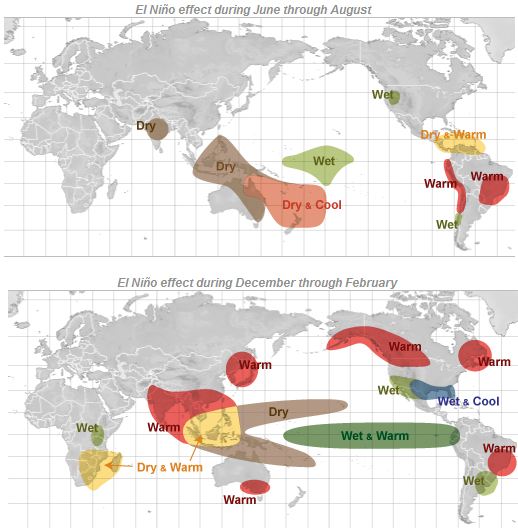
The global weather phenomenon is known as El Nino. It occurs every few years when a giant band of water in the tropical Pacific Ocean becomes unusually warm. This sets off a chain reaction of weather events that have historically resulted in severe droughts in portions of India, Southeast Asia, Australia, and South America. In contrast, El Nino often brings heavy rains to the West Coast.
The effects are a little milder in the Midwest, which is likely to see cooler summers and winters with less snowfall. Some parts of the region might even have better corn and soybean yields thanks to the milder temperatures.
El Nino events are difficult to predict, and there is no guarantee we will experience one this year. A recent advisory from the Climate Prediction Center, though, puts the chance of El Nino as high as 80 percent.
Keep an eye on the developing El Nino with weekly updates from the National Weather Service. And for more information on climate trends and changes in the Midwest, visit the Midwestern Regional Climate Center.
*Photo courtesy of the National Weather Service.