|
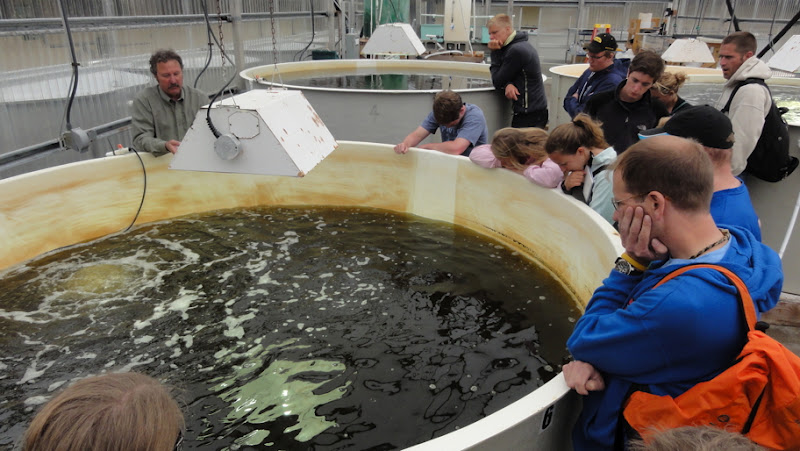
Bill Hanshumaker of the Hatfield Marine Science Center
and Oregon Sea Grant explains aquaculture research
being conducted at the facility. |
Each year, natural resource students from Purdue University, North Carolina State University, and the Swedish University of Agricultural Sciences come together to learn about sustainable use of natural resources in some part of the world. In July 2012, the course took place in the Pacific Northwest. Students visited old-growth forests, wildlife refuges, urban areas and more, learning about the political, social and economic concerns that factor into decision-making and development in the region.
Because of the partnership between Purdue University’s Department of Forestry and Natural Resources and Illinois-Indiana Sea Grant, students were able to connect with extension specialists from
Oregon Sea Grant to learn about coastal issues.
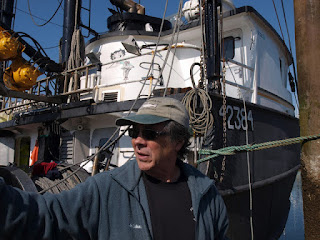 |
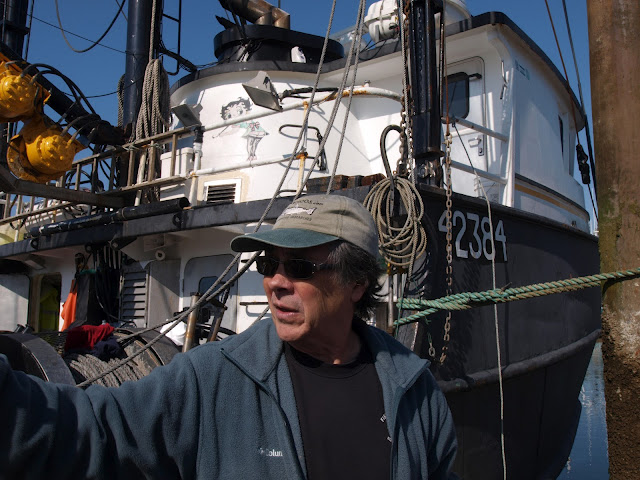
Oregon Sea Grant agent Jeff Feldner discusses
commercial fishing during a “dock walk.” |
IISG’s Carolyn Foley shares more about the course: “Amidst glorious sunshine, students learned about the strong fishing trade in Newport, OR, including oyster farming. They asked questions about how these trades are regulated in the Pacific Northwest, and what impacts their activities have on the surrounding community and natural resource use. They were also able to visit the Hatfield Marine Science Center and gain a healthy overview of the major issues affecting coastal resources in Oregon and surrounding states, including the development of technology to harness wave energy, impacts of naturally-occurring low-oxygen conditions, and effects of development on local wildlife populations. Some students even visited a large dock (~66’ x 19’ x 7’) that was ripped from its pilings in Misawa, Japan during the 2011 tsunami which crossed more than 11,000 km of Pacific Ocean and landed near Newport in early June, bringing with it more than 80 non-native, potentially invasive species of algae, snails, clams, and other life forms.”
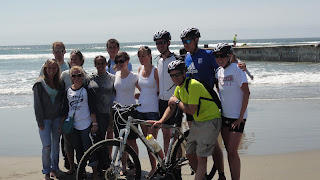 |
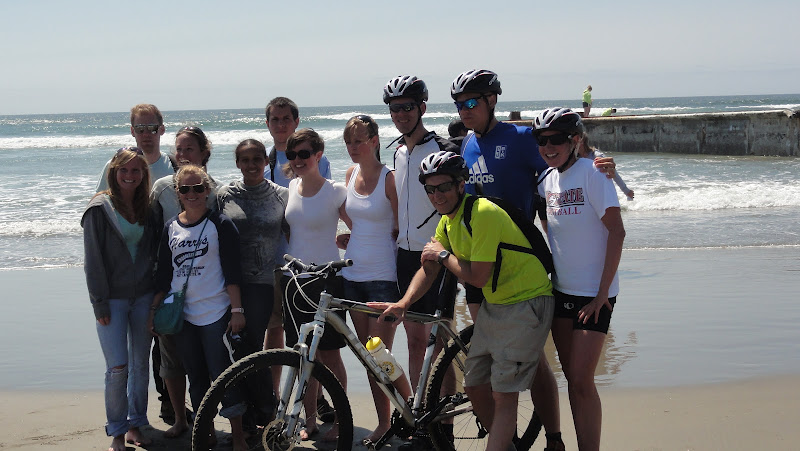
Students from the course gather in front of the
tsunami-generated floating dock that washed ashore
in early June 2012. Researchers have identified 92+
species that survived the trans-Pacific voyage. |
For more about some of IISG’s education initiatives, visit our education website. College and graduate students are also encouraged to contact their departments for information on similar courses and opportunities.
*Photos courtesy of George Hess with North Carolina State University
As an amendment to the Boater Registration and Safety Act signed into law by Illinois Governor Pat Quinn, aquatic plants and animals would need to be removed from seaplanes and watercraft before moving between bodies of water. The requirement is an important step in preventing the spread of aquatic invasive species throughout the state of Illinois, as well as between states and bodies of water where these vehicles might travel.
You can read a short synopsis of the legislation from our friends at Illinois Invasive Species Awareness Month
here, and read the full text of the legislation
here.
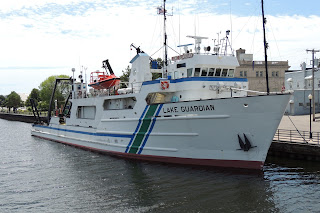
Fourteen teachers from throughout the Great Lakes basin embarked on the learning opportunity of a lifetime this month, taking part in a week-long workshop aboard the U.S. Environmental Protection Agency’s research vessel
Lake Guardian. They explored first-hand Lake Huron’s geology, limnology (freshwater science), and ecology, with a special focus on the food web as it relates to Huron’s fisheries.

The teachers worked side-by-side with scientists learning a great deal about what comprises research on the Great Lakes. They assisted with the collection of planktonic and benthic organisms, as well as gathering water quality data. They also explored Great Lakes curriculum and discussed how to integrate this information in their classrooms. You can see visit their blog and learn more at cossegreatlakes.net. This program is offered annually by
EPA’s Great Lakes National Program Office and the
Great Lakes Sea Grant Network. If you are an educator, consider applying next year for the cruise on Lake Ontario!
Illinois-Indiana Sea Grant researchers and specialists have been able to extend internship opportunities to four students this summer. Working directly with our staff and researchers, the students will get hands-on experience in their field while helping us pursue ongoing projects. Read more about this year’s group of interns and the issues they’ll be helping us address and investigate below.
Naoki Wada is a fourth-year Mechanical Engineering student studying at Purdue University, and is interested in how ocean waves can be harnessed as a sustainable energy resource.
As a native of Japan, Naoki was particularly struck by the results of the 2011 earthquake and tsunami: “My home country, Japan, where the supply of natural resources is very scarce, experienced one of the largest earthquake and tsunami last year, putting most of their nuclear power plants out of operation due to the safety concerns and…forcing the nation to rethink their future energy security. As an island nation surrounded by the ocean, utilizing oceanic energy by means of wave/tidal/current/power generation can be a remedy.” Naoki feels that the United States can also benefit from technology related to ocean-generated power; in addition to providing sustainable energy, it doesn’t require as much land as solar or wind farms and may be more palatable to planners and developers. After his graduation at the end of this year, Naoki intends to pursue graduate work in this field.
During his 2012 summer internship, Naoki is working with IISG-funded researcher Cary Troy of Purdue University and IISG staffers Carolyn Foley and Angela Archer to deploy a real-time monitoring buoy off of Michigan City, IN. The buoy will beam information about wave height, water temperature, wind direction, and other variables to the web every 10 minutes. Naoki is responsible for getting the buoy up and running so that IISG and Purdue University can continue to deploy it every year in the same location.
Sahana will be a senior at the University of Pennsylvania next year, and is majoring in Environmental Science with minors in Psychology and Economics. Sahana grew up in the Chicago area and considers Chicago her home, making this internship a terrific opportunity to work on issues close to her heart.
Sahana is working at the Chicago Metropolitan Agency for Planning (CMAP) this summer with IISG/CMAP Water Resource Economist Margaret Schneemann to create an outdoor water use manual for the 80 member-communities of the Northwest Water Planning Alliance (NWPA) in Illinois. The NWPA Outdoor Water Use manual is meant to educate homeowners about the consequences of outdoor water use and provide information on various approaches that homeowners or their communities can take to conserve water by reducing their outdoor use. The manual also contains information on a lawn-watering ordinance that the NWPA is recommending its member communities to adopt.
Meredith Brackett
Meredith is a recent graduate of the University of Illinois Urbana-Champaign, with a bachelor’s degree in Earth Systems Environment and Society. While planning to attend graduate school in the future, her internship with IISG will allow her to gain hands-on experience in the field as well as helping her find areas and issues for future study.
Meredith explains more: “I am working with Dr. Paris Collingsworth this summer and we are conducting a study to compare zooplankton community data collected by the Great Lakes National Program Office (GLNPO) with data collected by the Interagency Lower Trophic Level Monitoring Program of the Lake Erie Committee Forage Task Group (LEC-FTG). We are using statistical models to calculate zooplankton community similarity metrics at specific sample sites through time and space. This study will determine whether the LEC-FTG survey is capturing zooplankton community characteristics that are unique to those captured by the GLNPO data set.”
Lainey Pasternak
Lainey will be entering her junior year at the University of Illinois this fall, majoring in Natural Resources and Environmental Sciences, with a concentration in Resource Conservation and Restoration Ecology.
As an intern with IISG, Lainey will be working to help increase recreational water user knowledge of and education about steps to prevent aquatic invasive species from spreading in the Southern Lake Michigan area. She will also be designing and conducting a survey to evaluate Illinois-Indiana Sea Grant’s current outreach efforts, and use those results to formulate a formal research report and academic poster presentation by the end of the summer. Lainey will then be presenting the findings and the entire scope of her internship work at the 2012 Illinois Water Conference at the University of Illinois.
“Becoming an intern with IISG’s Aquatic Invasive Species Outreach team has allowed me to acquire a stronger knowledge base about the general AIS issues and management in the Great Lakes area, the role of recreational water users in their spread, and the importance of evaluating outreach campaigns,” Lainey says. “By surveying and speaking directly with the public, I will gain further insight into how to communicate current complex environmental issues with and to others. Overall, I am very excited to be a part of the Illinois-Indiana Aquatic Invasive Species Outreach Team this summer and expect to make a difference in this area for our future clean waters.”
We look forward to the results of the hard work from our interns, and sharing their efforts in another post later this year. Check back to see how these projects are progressing.
Greg Hitzroth is IISG’s new aquatic invasive species specialist, working out of the Chicago Botanic Gardens in Glencoe, Illinois. Greg will design and implement public outreach programs and resources designed to increase awareness of the spread of invasive species introduced to the waterways of Illinois and Indiana through commercial trade. He will also work closely with IISG’s Aquatic Invasive Species team to identify and partner with outside stakeholders, including suppliers of non-native species, to ensure greater public awareness of the impact of organisms in trade and strategies for reducing their movement into the Great Lakes region.
Greg holds a MS in Biology from Northern Arizona University. He joins IISG after a three-year tenure as a research assistant for the Plants of Concern Program at the Chicago Botanic Gardens.
The APEX awards are given each year to recognize outstanding publication work in a variety of fields by Communication Concepts, and Illinois-Indiana Sea Grant was chosen as one of this year’s winners!
From their website:
“…(Communication) Concepts sponsors the APEX Awards, the annual Awards for Publication Excellence, an awards competition providing recognition for outstanding publishing efforts from newsletters and magazines to annual reports, campaigns, social media and websites.”
IISG’s Terri Hallesy and Robin Goettel were chosen for the “Education & Training Publications” category. Their “Fresh and Salt” project, a collaboration with Center for Ocean Sciences Education Excellence Great Lakes, collected activities, lessons, and other materials that joined Great Lakes and ocean topics in a cohesive way.
 Designed for students in grades 5-10, the “Fresh and Salt” curriculum incorporated multiple facets of science education. Students learn about and even work on interactive mapping, investigation, experimentation, and additional concepts related to the science of both fresh and saltwater.
The curriculum’s 14 activities were structured for effective science learning, and to prepare students as future decision-makers and leaders. Activities were carefully selected based on a distinct set of criteria that would help students apply science process skills needed for effective learning.
Aligned with Great Lakes and Ocean literacy principles, timely issues include:
• Dominant physical features and their interconnections
• Geological phenomena
• Influence on weather and climate
• Human-environment connections and impacts
• Sustaining life on earth
• Biodiversity, food webs, and energy flows
• Exploration and technology innovation
“The COSEE Great Lakes Team accomplished our goal of providing educators with a science-based education resource that makes learning engaging,” said Hallesy. “It provides creative ideas to teach students about the Great Lakes and our oceans. Our intention is to educate students about ways to preserve and protect our aquatic ecosystems, while promoting environmental stewardship. ‘Fresh and Salt’ allows teachers to access relevant and timely science information leading to global awareness and environmental change.”
Teachers are encouraged to incorporate relevant activities and lessons into their planning. In addition, educators can contact Terri Hallesy or Robin Goettel to learn about other opportunities and materials for their classrooms.
Communication Concepts is a firm that works with firms to improve communications, PR, marketing, and more. They also provide reports on current trends and give annual awards to projects and organizations for their outstanding publications.
According to some of the latest research, a population of Asian carp as small as 20 in number could be enough to establish a damaging population of the invasive species in the Great Lakes.
From The Atlantic Cities:
“The report notes that this small population would have a greater than 50 percent chance of successfully spawning if they were to find a viable river access point to the lakes. Lake Michigan is the most likely target, and the Chicago Area Waterway System of rivers, sanitary canals and locks would be the most likely entry point. Already, the environmental DNA of carp has been detected as close as six miles from Lake Michigan. Some worry that the carp’s entrance into the Great Lakes is inevitable.”
Read more, including links to the full report and additional information, at the link above.
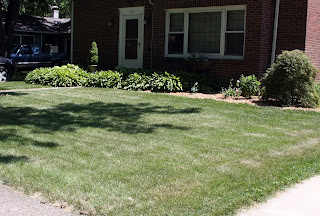
Large portions of both Illinois and Indiana continue to experience very low rainfall and drought conditions, and many homeowners are wondering what to do about their lawns. With water in high demand, several communities place watering schedules or restrictions in effect in order to conserve the available water. But what to do about your lawn?
According to Richard Hentschel, a horticulture educator who works with our
Lawn to Lake program, the simple answer is – nothing.
From the Chicago Tribune:
“’If your lawn is brown, it’s not dead,’ says Richard Hentschel, a University of Illinois Extension horticulture educator based in St. Charles (urbanext.illinois.edu/hort). ‘The grass has just hunkered down into survival mode. The plants have stopped growing and given up on their leaves to conserve water and are concentrating all their resources on keeping their roots and crowns alive.’”
Lawns are capable of surviving the conditions, but one area of concern is trees.
“Lawns are easily replaced, but trees are not. Even large trees need help to survive a drought – and if they die, it can take 20 or 30 years to replace that shade. Stress from the 2005 drought killed trees over the next several years. So put trees at the top of the list for watering.
Let the hose trickle for a good long time in several places under the tree’s canopy. Or spiral a soaker hose loosely around a tree trunk. Or buy a soaker bag at the garden center that will slowly ooze water to the roots. Most of a mature tree’s roots are within 6 to 8 inches of the soil surface.”
Richard Hentschel and Rachel Rosenberg (who is also quoted in the article) are both involved in our Lawn to Lakes program, which provides information to retailers, homeowners, and landscapers about natural lawn care alternatives and their benefits.
One of the unsung agencies that is heavily involved in restoring coastal ecosystems just happens to be one of the biggest and most crucial – The U.S. Army Corps of Engineers.
The U.S. Army Corps of Engineers and their Ecosystem Restoration Program are heavily involved in planning, developing, and executing projects that restore damaged ecosystems and areas and provide environmental benefits to communities, including several projects in and around the Great Lakes.
“The USACE works to restore degraded ecosystems to a more natural condition through large-scale ecosystem restoration projects, such as the Comprehensive Everglades Restoration, Louisiana Coastal Area Ecosystem Restoration, Chesapeake Bay Oyster Recovery, Aransas National Wildlife Refuge Beneficial Use of Dredged Material (restoration of marsh critical to the endangered Whooping Crane), and Houston Ship Channel Beneficial Use of Dredged Material (marsh restoration in Galveston Bay), and by employing system-wide watershed approaches to problem solving and management for smaller ecosystem restoration projects.”
Read more about this terrific program and about the substantial work that goes into these projects at the article linked above.