Sea Grant’s Center for Great Lakes Literacy (CGLL) held its first Mentorship Virtual Summit in 2022 to celebrate educator wins and share success stories from classrooms near and far. Attended by 35 mentors and mentees from across the Great Lakes region, the conference provided a space for top-tier science educators to describe some of their favorite lessons—those that provide students with fun and experiential learning opportunities that meet course objectives as well as help build a foundation for environmental stewardship.
CGLL mentors are star educators from schools and organizations from across the basin who have already attended Sea Grant workshops and have experience teaching about the Great Lakes in their classrooms. During the 2021-22 school year, mentors selected mentees from their school or organization with whom they collaborated to incorporate Great Lakes education into lessons with the hope of completing a stewardship piece as well.
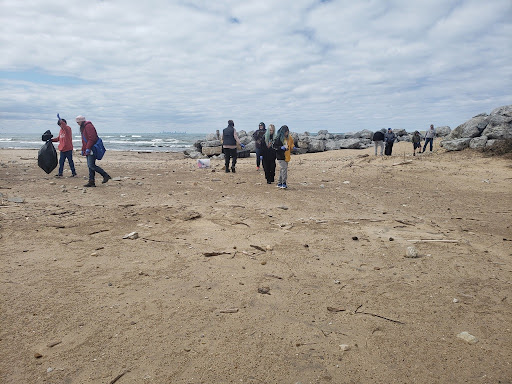
Students pick up marine debris at Portage Lakefront at the Indiana Dunes National Park. (Photo provided by Sarah Black)
For example, Sarah Black, a second grade teacher in Portage, Ind., paired up with a fellow educator as a mentor, and together they created a Young Scientists after-school club for fourth and fifth grade students in their elementary school. “We taught [them] about marine debris, invasive species, the biotic index, dune formation and weather versus climate,” said Black.
They also provided students with hands-on experiences at Indiana Dunes National Park by collecting marine debris at Portage Lakefront and Riverwalk, attending the Maple Sugar Time festival and going on a Mount Baldy hike. Students heard from a local meteorology student from Vincennes University and were also given an opportunity to participate in various research projects such as CoCoRaHS and plastic cup breakdown. These place-based lessons allowed Black to share information with students that applied to where they live.
Another mentor, Ashley Cosme, who works as a marine science and biomedicine teacher at Crown Point High School in Indiana, shared a bit about her experience: “I held a teacher workshop where we dove deep into the world’s largest freshwater system to examine the threats to the Great Lakes and how students can minimize the problem from spreading across the continent.”
She introduced teachers to hands-on lessons that focus on the causes and impacts of marine debris, and what can be done in their classrooms to decrease the negative impacts on the Great Lakes. Cosme was able to implement and master each lesson with her own students before teaching them to other educators. “Most importantly,” she said, “I made connections with other teachers in my district and developed meaningful professional relationships.”
To wrap up the experience, all participating mentors and mentees were invited to the virtual summit, which was supported with Great Lakes Restoration Initiative funding from the National Oceanic and Atmospheric Administration, to share what they learned throughout the process and their plans for the future.
“The point of the summit was to get people together to network—trying to build a community of practice. We want to have an opportunity for those teachers to strengthen bonds with other mentors and mentees in their states and surrounding regions,” described Illinois-Indiana Sea Grant’s Kristin TePas, who serves as lead for the mentorship program.
“The summit also presented the opportunity for a guided discussion on what worked and what didn’t work in terms of the mentorship programs, and that feedback is allowing us to create best practices to use moving forward,” she added.
Allowing educators the space to share their mentorship experience and how they’re using Great Lakes literacy in and out of the classroom demonstrates one of the main goals of CGLL.
“Taking knowledge and putting it into action is a primary goal of ours,” said TePas, “so the great part is not just that they’re more knowledgeable but also that they put that knowledge into practice.”
To learn more about the mentorship program and find lesson plans that cover Great Lakes literacy principles focusing on place-based education and community stewardship, visit the Center for Great Lakes Literacy website.
Illinois-Indiana Sea Grant is a partnership between NOAA, University of Illinois Extension, and Purdue University Forestry and Natural Resources, bringing science together with communities for solutions that work. Sea Grant is a network of 34 science, education and outreach programs located in every coastal and Great Lakes state, Lake Champlain, Puerto Rico and Guam.
Writer: Motinola Agunbiade
Contact: Kristin TePas