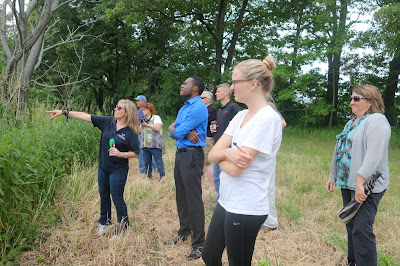
 The first step in useful communication is to listen to your audience. By addressing the perceptions and needs of a community, information can really have impact. With this mission in mind, IISG Environmental Social Scientist Caitie Nigrelli and her intern Carly Norris went to the Zephyr site in Muskegon County in Michigan.
The name, short for the former Zephyr Oil Refinery, refers to property on the Muskegon River that was polluted and contaminated from decades of oil spills beginning at the turn of the twentieth century.
But before permits are pulled and backhoes are delivered, Nigrelli and Norris, as environmental scientists, talk to the people who are being affected — to find out what their concerns are, what they’d like to see happen.
So they interviewed community stakeholders about how they feel about an area that was at one time ranked by the Michigan Department of Environmental Quality the fourth most hazardous in Muskegon County.
Regardless of its dirty and neglected past, many in the community are interested in seeing its eventual remediation and recovery, Nigrelli and Norris found.
“I was really pleased with the diversity of the people we talked with. It really helped me understand the interests and concerns of the stakeholders,” Nigrelli said. “Something that kept coming up was the importance of clear, consistent communication with the property owners adjacent to the site. Now we know where to focus our efforts.”
Norris added, “Incorporating community members in the cleanup process helps create an outcome more tailored to local views and ideas.”
Their contribution is one of several steps that traditionally take place before remediation under the
Great Lakes Legacy Act occurs.
The cleanup could get started as early as 2016. For more information and to follow the status of the project, visit
www.greatlakesmud.org.
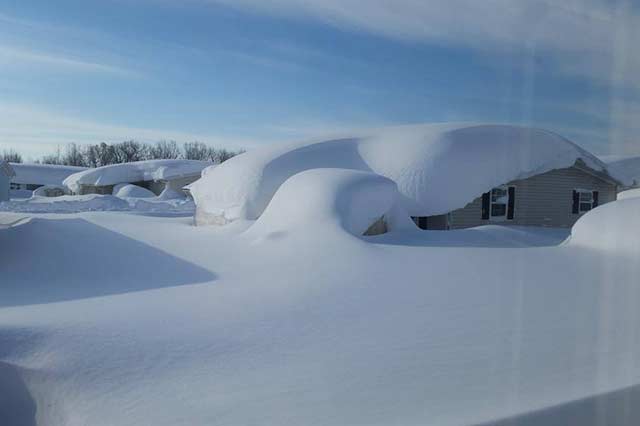 Scenes of massive snowfall in Great Lakes communities like Kalamazoo and Buffalo may become a thing of the past. A new study out of the University of Wisconsin suggests the region could see less lake effect snow as soon as the mid-21st century due to climate change. The total amount of precipitation will likely go up, but warmer temperatures and less lake ice means the air blowing east across the lakes will bring rain instead.
From the Post-Standard:
The biggest change from snow to rain would be in November, the study shows, making the massive lake effect storm near Buffalo last month less likely by 2100. That storm dumped 90 inches of snow in some areas in five days. Thirteen people died and more than 100 miles of the New York State Thruway was shut down for days.
 [Michael] Notaro’s article was published in the Journal of Climate just days before the Buffalo-area storm. He is a senior scientist at the Nelson Institute Center for Climatic Research in Madison, Wisc.
The paradox of lake effect snow, however, is that before it begins to drop off after 2050 it might actually increase for a few decades, according to research by Notaro and Colgate University professor Adam Burnett.
“My original idea was that in the short run, as the lakes become warmer and and lake ice disappears, we would still have enough cold air around to produce lake effect snow,” said Burnett, whose 2003 study showed a rise in lake effect snow from Lake Ontario. “You could end up with some pretty serious snows like we saw in Buffalo.” Read more
***Photo A: Lake effect snow near Buffalo, NY in November. Photo by Michael Garrood.
***Photo B: From WGGB in western Massachusetts.
After decades of remediation work, two Michigan sites are no longer considered Areas of Concern (AOCs). The U.S. Environmental Protection Agency officially removed Deer Lake in the Lake Superior basin and White Lake in the Lake Michigan Basin from the list of toxic hot spots last week.
These are the third and fourth U.S. sites to be delisted since a 1987 cleanup agreement with Canada identified areas hit hardest by legacy pollutants like PCBs and mercury. The Oswego River in New York became the first in 2006, and Pennsylvania’s Presque Isle Bay was delisted last year.

From the Detroit Free Press
The Deer Lake AOC, along the southern shore of Lake Superior on the Upper Peninsula, was listed because of mercury contamination that leached into water flowing through an abandoned iron mine, as well as other pollutants. Mercury contamination in fish—and reproductive problems—also were documented in animals and birds, including bald eagles.
The remediation efforts included a Great Lakes Restoration Initiative grant for $8 million that helped pay for a project diverting water from Partridge Creek. It previously fed the stream flowing through old mine workings under Ishpeming, which then ran into another creek and into Deer Lake.
The White Lake AOC was on Lake Michigan in Muskegon County and had been contaminated by pollution—especially organic solvents—from tannery operations, chemical manufacturing and other sources, degrading fish and wildlife habitats.
A $2.5-million grant was used to remove contaminated sediment and restore shoreline, with more than 100,000 cubic yards being removed. Read more
More than two dozen AOCs remain throughout the Great Lakes states. But as many as 10 are targeted for completion in the next five years thanks in part to funding from the Great Lakes Restoration Initiative, which will enter its second phase next year.
Two of the sites slated for delisting are the Buffalo and Grand Calumet rivers, where IISG’s Caitie McCoy has partnered with federal, state, and local groups under the Great Lakes Legacy Act to connect nearby communities with the remediation and restoration. A big part of this work has focused on integrating environmental cleanup projects into the classroom with place-based curriculum and stewardship projects.
***Deer Lake in Ishpeming. Credit: Stephanie Swart, Michigan Department of Environmental Quality.
Earlier this week, a new environmental monitoring buoy joined a chain of similar buoys that are increasing boating and swimming safety and helping anglers target specific species of fish from Ludington, MI to Michigan City, IN.
From Michigan Live:
 Deployed roughly two miles off the shores of South Haven on Wednesday, the buoy can distribute improved wind and wave observations in addition to measuring wind speed, wind direction, air temperature, relative humidity, solar radiation, water temperature and wave height among other variables.
“Given South Haven’s strong connection to Lake Michigan I am excited for the addition of this station to the regional buoy network,” South Haven Mayor Robert Burr said in a statement. “The city’s goal is to provide area boaters, swimmers, and water safety professionals with up-to-date lake conditions. Conditions on the big lake can change fast and we want everyone to be prepared when venturing out on the water.
Click on the link above to read the complete article. And visit our buoy website to learn more about how real-time data is helping weather forecasters and researchers better understand the nearshore waters of Lake Michigan.
**Photo: Boaters and swimmers enjoy the water at South Haven Beach
It’s beach season once again in southern Lake Michigan, and the rip current warnings have already begun.
The National Weather Service (NWS) has issued at least one advisory since Illinois and Indiana beaches opened last month asking beach-goers to think twice before taking a dip in the lake. And for good reason. Rip currents and other dangerous currents are the biggest threat to Great Lakes swimmers. Roughly 140 people have drowned in the lakes over the last 12 years due at least in part to dangerous currents. And most of those incidents happened in Lake Michigan.
Illinois-Indiana Sea Grant hopes to bring these numbers down with a new outreach effort that will raise awareness about dangerous currents in the Great Lakes. The “Implementing Dangerous Currents Best Practices” project was recently awarded funding from the NOAA Coastal Storms Program.
A collaborative effort Sea Grant programs in Michigan and Wisconsin, the project will include print and online resources—including educational videos—that introduce the science behind rip currents, provide tips for avoiding them, and explain what to do if you or others are caught in one. Many of these resources will be available in both English and Spanish.
Watch for further information on these outreach efforts and rip currents in the coming months. In the meantime, you can find tips for staying safe at the beach this summer at dangerouscurrents.org.
“Implementing Dangerous Currents Best Practices” continues years of efforts by Great Lakes Sea Grant programs, NOAA, and NWS to reduce dangerous currents drownings across the region. To learn more about these efforts, visit Rip Current Safety.
Several interests have aligned to propose a biking, hiking, and paddling route through the Great Lakes basin in both the U.S. and Canada.
“The Great Lakes Coastal Trail Conference — taking place Thursday and Friday in Saugatuck, Mich. — aims to bring together supporters in the U.S. and Canada to formalize development of a roughly 11,270-kilometre route.
The route would include Great Lakes shoreline and the St. Lawrence River, which connects the lakes to the Atlantic Ocean.
An aim is to draw tourists to the region, which includes eight U.S. states and Quebec and Ontario.
It would integrate independent biking and kayaking trail developments in states such as Illinois, Michigan and Wisconsin.”
Read more at the link above.
White Lake, located in Michigan just north of Muskegon, has long been listed as an Area of Concern in the Great Lakes region. Federal officials are currently moving forward on one of the last efforts to remove the lake from the AOC list.
“The lake is one of 14 major sites in Michigan on a list of toxic hot spots in the Great Lakes region. The cleanup work is difficult and expensive, but it’s expected to improve conditions for people and wildlife throughout the region.
Read the complete story at the link above.
Michigan Radio’s Here and Now recently discussed the issue of Asian carp and the State of Michigan’s preparations to prevent and fight the spread of the invasive fish.
From WBUR:
“Asian carp, an invasive and destructive fish, have spread through the Mississippi, Ohio, Illinois and Missouri rivers. In total, the fish are affecting more than 20 states from Louisiana to South Dakota.
Under the right conditions, it could take as few as a dozen Asian carp to establish a population in the Great Lakes. That’s according to a report published this month by scientists in Ontario.
If they’re correct, the risk of even just a handful of Asian carp escaping into the Great Lakes could be more significant than officials had planned.
From the Here & Now Contributors Network, Lindsey Smith of Michigan Radio reports on how the Department of Natural Resources in Michigan is getting ready to face off with this invader.”
Listen to the program or read the transcript at the link above.
Phragmites Australis, also know as the Common Reed, is a wetland plant that is not native to the Great Lakes. The invasive plant grows and spreads rapidly in the wetlands around the Lakes, and as a result can crowd out native plants that are beneficial to the local ecosystems.
Researchers at Michigan Tech are working on mapping the spread of the plant, though, in an effort to better understand its spread and plan for managing and reducing it.
From Upper Peninsula’s Second Wave:
“The common reed, or phragmites australis, isn’t native to the Great Lakes, but grows quickly in our climate conditions into large, tall stands that can threaten wetlands habitat.
The plant hasn’t been studied very much, or mapped, which was the goal of the Tech scientists, in cooperation with the U.S. Geological Survey, Boston College and the U.S. Fish and Wildlife Service. Together, teams first mapped the U.S. coastlines of all five Great Lakes using satellites.
Then, they did field studies along the coastlines to confirm the satellite findings, and plot the locations of large stands of the reed, in a first-of-its-kind map.”
Read more about the map at the link above and in the article at Science Daily.

 The first step in useful communication is to listen to your audience. By addressing the perceptions and needs of a community, information can really have impact. With this mission in mind, IISG Environmental Social Scientist Caitie Nigrelli and her intern Carly Norris went to the Zephyr site in Muskegon County in Michigan.